













 Quickly
 Socially
 Trending
 Crypto






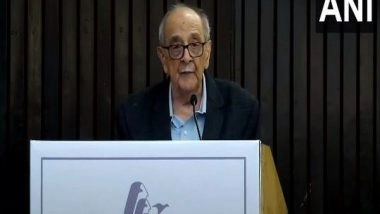
New Delhi [India], January 5 (ANI): Senior advocate Fali S Nariman said on Friday that while reading about the exhaustive and learned judgements on Kashmir recently, he has regretted that there was no dissenting view on the bench.
"On reading about the very exhaustive and learned judgements on Kashmir recently handed down by a constitution bench of five judges, my regret has been that there was no dissent," Fali Nariman said while speaking at the 28th Justice Sunanda Bhandare Memorial Lecture.
Also Read | US Presidential Election 2024: Joe Biden to Set Up Poll Fight With Donald Trump Saying ‘Democracy at Stake’.
Nariman argued that though a dissenting view might not have made any difference to the outcome of the judgement, it would have helped the public understand the contours of the unique, complicated case.
"A dissent would have made no difference to the outcome but better still it would have helped the not-so-well-informed general public to better understand and appreciate the contours of this unique, very long and somewhat complicated case about India's northernmost state," the senior advocate said.
Also Read | Delhi: Unable To Conceive, Woman Steals Newborn Girl From Government Hospital; Arrested.
Nariman said that a dissent is not only a safety valve but it also sends a message of assurance to the public that the Supreme Court is in robust health.
"...often a dissent in a bench of judges, whether of three, five, seven or nine is not just a safety valve, it also sends a message of assurance to the ever-curious and ever-anxious general public that the highest court is in robust health and is doing its allotted task well," the senior advocate said.
Quoting an American judge, Nariman said, "It is always necessary to recall what an American judge once wisely said: A dissent may salvage for tomorrow a legal principle that has been omitted or forgotten today."
The Supreme Court in December upheld the Union Government's decision to abrogate Article 370 of the constitution which gave special status to Jammu and Kashmir and said that every decision taken by the Centre on behalf of a State can't be subject to a legal challenge.
A five-judge Constitution bench comprising Chief Justice of India DY Chandrachud, Justices Sanjay Kishan Kaul, Sanjiv Khanna, BR Gavai, and Surya Kant delivered the verdict. The Constitution Bench was hearing a batch of petitions challenging the abrogation of Article 370 of the Constitution and bifurcating the state into two Union Territories.
On August 5, 2019, the Central government announced the revocation of the special status of Jammu and Kashmir granted under Article 370 and split the region into two union territories. (ANI)
(The above story is verified and authored by ANI staff, ANI is South Asia's leading multimedia news agency with over 100 bureaus in India, South Asia and across the globe. ANI brings the latest news on Politics and Current Affairs in India & around the World, Sports, Health, Fitness, Entertainment, & News. The views appearing in the above post do not reflect the opinions of LatestLY)
 Share Now
 Google Trends



 Live Bot