Golden Horizon Missile Offered to India by Israel: Everything You Need To Know
Israel has offered reportedly India the Golden Horizon, a hypersonic air-launched ballistic missile for the Su-30MKI. With a range up to 2,000 km and speeds over Mach 5, it targets bunkers and nuclear sites. The exclusive offer, emerging during PM Modi's Feb 2026 visit, would give India a unique deep-strike edge over regional rivals.

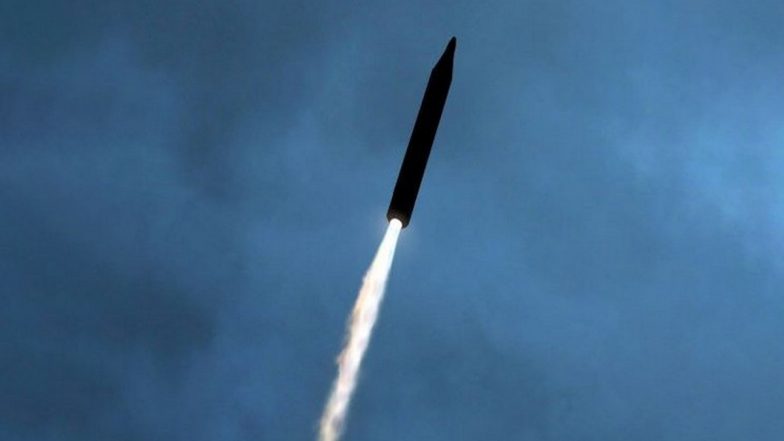
Mumbai, February 24: On the eve of Prime Minister Narendra Modi’s high-profile visit to Jerusalem on Wednesday, February 25, Israel has reportedly extended an exclusive offer to supply India with the Golden Horizon, an advanced air-launched ballistic missile (ALBM). If the deal is finalised, India would become the first and only nation to receive this strategic capability. Developed by Rafael Advanced Defense Systems, the missile is designed specifically for integration with the Indian Air Force’s (IAF) Sukhoi Su-30MKI fighter fleet, providing a specialised tool for deep-strike operations against heavily fortified targets.
The offer highlights a significant shift in the India-Israel defense partnership, moving from tactical weaponry toward high-end strategic deterrence. While current assets like the BrahMos cruise missile excel at high-speed precision, the Golden Horizon introduces a ballistic trajectory that makes it uniquely difficult for modern surface-to-air missile (SAM) systems to intercept. Defense analysts suggest the missile could serve as a vital "bridge" while India develops its own indigenous long-range air-launched ballistic systems under the Aatmanirbhar Bharat framework. What Are HAMMER Missiles? Smart Air-To-Ground Weapon Powering Indian Rafale Fighter Jets.
Golden Horizon Ballistic Missile: Strategic Reach and Hypersonic Speed
The Golden Horizon is built on the technological foundation of Israel’s Silver Sparrow, a target missile used to simulate complex ballistic threats. Once launched from a high-altitude fighter jet like the Su-30MKI, the missile arcs into near-space before plunging toward its target at hypersonic speeds exceeding Mach 5.
- Estimated Range: Approximately 800 km to 2,000 km, depending on launch altitude.
- Speed: Over 6,000 km/h (Mach 5+), significantly faster than the Mach 3 capability of the standard BrahMos.
- Trajectory: High-arcing ballistic path, which is harder to track and intercept than low-flying cruise missiles.
Annihilating Hardened Targets
Unlike standard air-to-surface munitions intended for battlefield depots, the Golden Horizon is engineered to neutralise "high-value" assets. Its immense kinetic energy, combined with a specialised warhead, allows it to punch through meters of reinforced concrete and deep earth. This makes it a primary tool for targeting:
- Subterranean command bunkers
- Hardened nuclear facilities
- Advanced radar arrays and airbase hangars
Impact on Regional Deterrence
The potential acquisition comes amid a sharpening "two-front" security challenge for India. Military observers note that an air-launched ballistic missile would allow IAF pilots to engage targets deep inside hostile territory while remaining safely outside the engagement envelopes of enemy long-range interceptors and SAM batteries, such as China’s HQ-9 or Pakistan’s LY-80 networks. President Droupadi Murmu Poses With Rafale Pilot Shivangi Singh Pakistan Claimed to Have Captured During ‘Operation Sindoor’.
While China operates a similar air-launched ballistic system known as the JL-1, it requires a large strategic bomber for deployment. In contrast, the Golden Horizon can be carried by India’s existing multi-role Sukhoi fleet, significantly lowering the logistical and operational barriers to maintaining a hypersonic deep-strike capability.
India and Israel have a long history of defense cooperation, ranging from the Heron TP drones to the Barak-8 air defense systems. Recently, during "Operation Sindoor," India successfully deployed Israeli-made Rampage and Spice munitions to disable regional air defense networks. The Golden Horizon represents the next evolution of this relationship, potentially paving the way for joint development and technology transfers that could accelerate India’s own indigenous missile programs.
(The above story first appeared on LatestLY on Feb 24, 2026 11:26 AM IST. For more news and updates on politics, world, sports, entertainment and lifestyle, log on to our website latestly.com).