
Business News | China's Solar Curbs May Accelerate India's Push for Domestic Wafer and Cell Manufacturing: Report
Get latest articles and stories on Business at LatestLY. China's proposed export restrictions on 12 solar photovoltaic (PV) manufacturing technologies may accelerate India’s push to develop domestic capabilities in solar wafers, cells and ingots, according to a report by JM Financial.

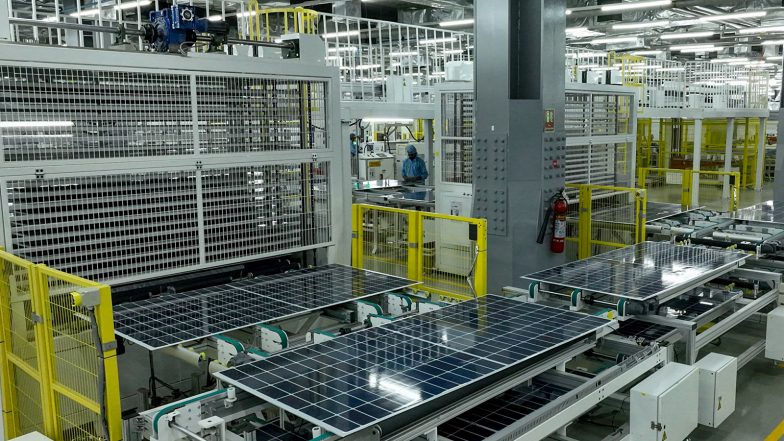
New Delhi [India], October 21 (ANI): China's proposed export restrictions on 12 solar photovoltaic (PV) manufacturing technologies may accelerate India’s push to develop domestic capabilities in solar wafers, cells and ingots, according to a report by JM Financial.
China's Ministry of Commerce and Ministry of Science and Technology proposed adding 12 solar PV manufacturing technologies to its Catalogue of Technologies Prohibited or Restricted from Export on October 16.
The proposal covers technologies used in manufacturing polysilicon, silicon wafers and solar cells, along with critical and core equipment incorporating these technologies.
The proposal divides the technologies into prohibited and restricted categories, with stakeholders invited to submit feedback until November 15, 2026.
Also Read | CJP's Saurav Das, Ashutosh Ranka Withdraw Delhi HC Plea After Judge Flags Alternative Remedy.
The JM Financial report said the development could strengthen the case for India to expand domestic solar manufacturing, particularly in areas further up the production chain. However, it cautioned against assuming that all TOPCon production lines, Chinese machinery or technology transfers would automatically be prohibited.
It said, “We view it as structurally positive for Indian solar manufacturing (may accelerate backward integration) with short-term disruption”
India remains dependent on China for several inputs required by solar manufacturers, including specialised production equipment, industrial gases and chemicals, spare parts, process software and skilled engineers.
This dependence could make the proposed restrictions a risk to near-term capacity expansion, even as they increase the importance of developing domestic manufacturing capabilities.
"The greatest opportunity lies in moving upstream, but that is where the technological and execution barriers are the highest," JM Financial added in its report.
The report also highlighted that potential beneficiaries may not necessarily be India's largest solar cell and module manufacturers. Companies that can move quickly from module assembly into the production of solar cells, wafers and ingots could be better positioned to benefit from the changing trade environment.
The development could also affect the cost of setting up new solar manufacturing facilities. Delays in equipment supplies or the need to procure more expensive equipment from European vendors could push up manufacturing costs. This, in turn, could lead to higher domestic solar cell and module prices.
If domestic prices rise significantly, India may further relax the ALMM-II mandate beyond December 2026, the report said. At the same time, Chinese exporters could become more aggressive in pricing finished solar products, including cells and modules, potentially making them more attractive to Indian developers. (ANI)
(The above story is verified and authored by ANI staff, ANI is South Asia's leading multimedia news agency with over 100 bureaus in India, South Asia and across the globe. ANI brings the latest news on Politics and Current Affairs in India & around the World, Sports, Health, Fitness, Entertainment, & News. The views appearing in the above post do not reflect the opinions of LatestLY)