
Business News | India’s Battery Storage Demand to Hit 236.22 GWh by FY32, Require Rs 3.49 Trillion Investment: Report
Get latest articles and stories on Business at LatestLY. The country witnessed a sharp acceleration in BESS deployment in 2026, with 8.2 GWh of capacity added between January and June, compared with less than 100 MWh in the same period of 2025, it noted.

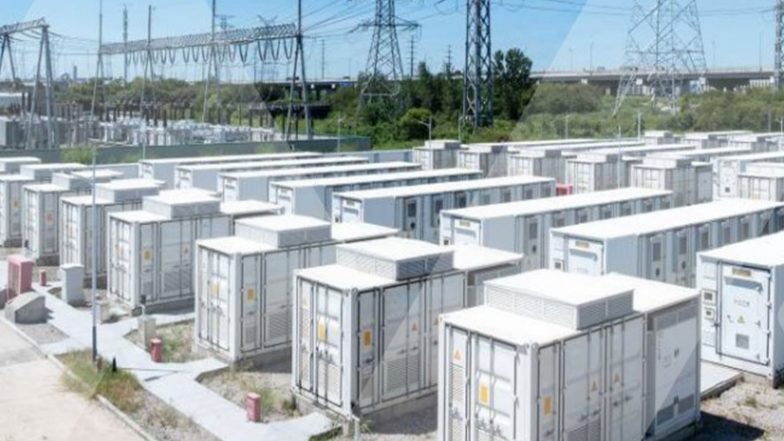
New Delhi [India], October 7 (ANI): India’s battery energy storage system (BESS) requirement is projected to surge nearly seven-fold to 236.22 GWh by FY2031-32, requiring investments of up to Rs 3.49 trillion, according to a Rubix Data Sciences report.
The country witnessed a sharp acceleration in BESS deployment in 2026, with 8.2 GWh of capacity added between January and June, compared with less than 100 MWh in the same period of 2025, it noted.
Also Read | Virat Kohli, Rohit Sharma Mimic KL Rahul, Shubman Gill and Ravindra Jadeja's Celebrations in New Ad.
Furthermore, as of August 2026, 9.08 GWh of BESS capacity was operational, while 79.92 GWh was under construction, with 79.92 GWh under construction, 24.13 GWh awarded, and 63.53 GWh under tendering, taking the total operational and identified project capacity to 176.66 GWh, with the current CEA project pipeline scheduled for commissioning till FY2029–30.
In capacity terms, the report noted, this represents approximately “75% of the NEP’s projected FY2031–32 requirements, although the identified capacity is at different stages of development and is not yet fully operational.”
“The share of BESS in India’s total energy storage requirement is expected to increase from ~42% in FY2026–27 to ~57% in FY2031–32,” it said.
The report estimated that India will require around Rs 3.49 trillion in investment in the sector by FY2031-32. Separately, the broader energy storage sector is expected to attract about Rs 4.79 trillion in investments by 2032.
The report expects India’s BESS market to expand strongly, supported by investments in domestic battery manufacturing, a sizeable project pipeline and government initiatives. Measures including Viability Gap Funding (VGF), the National Programme on Advanced Chemistry Cell (ACC) Battery Storage and interstate transmission system (ISTS) charge waivers are expected to improve project viability and encourage private-sector participation.
The government is also stepping up support for the sector. The Union Cabinet has approved the Rs 1.86 trillion PM-DHARA (PM-Developing Harmonized and Accelerated Renewable-energy Access) Scheme, which includes Rs 500 billion for the deployment of 50 GWh of BESS capacity by FY2032-33, it noted. (ANI)
(The above story is verified and authored by ANI staff, ANI is South Asia's leading multimedia news agency with over 100 bureaus in India, South Asia and across the globe. ANI brings the latest news on Politics and Current Affairs in India & around the World, Sports, Health, Fitness, Entertainment, & News. The views appearing in the above post do not reflect the opinions of LatestLY)