German Activists Launch Black Friday Campaign Against Amazon
The German Peng! Collective has started a new intervention against Amazon to mark Black Friday.

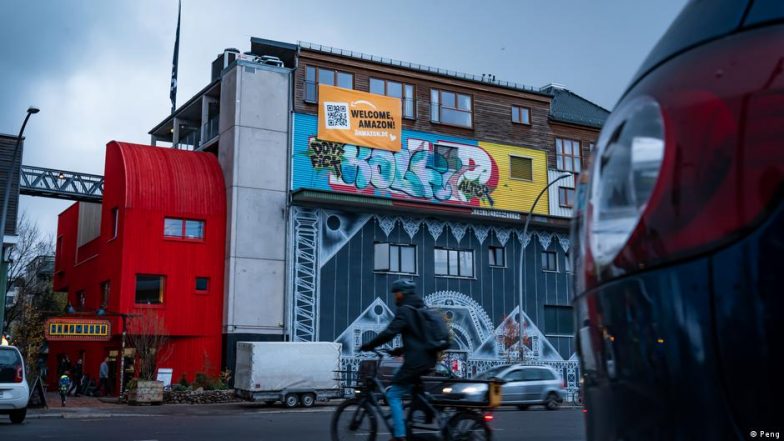
The German Peng! Collective has started a new intervention against Amazon to mark Black Friday. Unionists want a crackdown on subcontractors, but the industry is against an outright ban.The German artist-activist Peng! Collective greeted the traditional shopping frenzy of Black Friday Week with a campaign aimed at the online retailer Amazon and what one Peng activist called its "Soviet" business model.
Also Read | Sports News | Harmanpreet Hits Hat-trick to Guide Punjab to Quarterfinals of Hockey Nationals.
In keeping with Peng's ambition to create an "explosive concoction of activism, hacking, and art," the campaign is a four-pronged attack: A protest on Black Friday outside the "Amazon Tower" building in Berlin, an online petition, a satirical Amazon-themed "circus" created by the Rimini Protokoll theater group, and an "Amazon Leaks" page, where the company's employees can report alleged abuses at the company.
Also Read | India News | Delhi Govt Released Rs 415 Crore to NCRTC for RRTS Project: Transport Minister Kailash Gahlot.
But, according to Jean Peters, Peng spokesperson, investigative journalist and veteran of several Peng stunts, the reported working conditions are just a symptom of the basic problem: Amazon's colossally successful business model.
This, he claims, is unique, as it relies on monopolizing access to customers, forcing small retailers to give up huge percentages to sell on its marketplace and, above all, exploiting an army of small subcontractors whose employees have only limited-time contracts and few workers' rights.
Subcontractors and sub-subcontractors
Delivery companies in Germany like Amazon, Hermes, and FedEx use subcontractors who often contract even smaller companies. Some of these operations, according to Rory Linton, spokesman for Germany's second largest trade union Verdi, are so small that they only employ two or three people and only exist for a short time. "They know they can't fulfill the contracts if they have correct health and safety and pay a decent wage, so the big companies get rid of the responsibility," he said.
Linton describes cases where subcontractors did not allow their workers to turn on the Amazon app that records their working hours for the first and last hours of their shift. Not only that, Amazon stipulates that its "Freight Partners" in Germany can only operate a maximum of ten trucks, which, according to Verdi, both restricts any chance of competition and ensures that delivery drivers cannot organize effectively.
"With subcontractors there are almost no checks and balances in terms of workers' rights, health and safety," Linton told DW. "Often workers get less than minimum wage."
Would a ban be counterproductive?
Verdi wants an outright ban on subcontractors in the postal package industry, a demand that some of Germany's state governments have echoed.
But this would be a very bad idea, according to Sebastian Hassler, who has spent 20 years running several small and medium-sized logistics firms whose clients include Amazon and other major logistics companies.
"That won't solve the problem," he told DW. "Just because there are a few black sheep, who I believe are a minority — to ban the entire industry because of that! That's my livelihood, and we pay taxes and social contributions and treat people decently."
He also thinks banning the contracts like the ones he closes with Amazon would only concentrate more power in the larger companies' hands, as it would force delivery drivers to work directly for the company.
Frank Huster, head of the logistics industry association DSLV, which represents big hauling companies, says a ban would only have a disruptive effect on supply chains. "Any freight forwarder subcontracts transport companies on a regular basis. If precarious employment relationships are found at transport companies, this must be remedied in the internal relationship [between employer and employee] and not by a general ban on commissioning transport service providers," he told DW.
'Amazon is actually the fairest'
Hassler says there's plenty to criticize about Amazon: "I'm also critical of the fact that Amazon has this market dominance, and it's clear that it's getting tougher for mid-sized companies," he said. "And we know that Amazon pays very little tax, and I don't agree with that either."
And yet: "If I compare the big players, Amazon is actually the fairest," he added. "Amazon tells us how much we have to pay our drivers, and it's way over the minimum wage. And we have to prove the number of hours they worked."
He also says that in his experience, Amazon is among the quickest of the big companies to cancel contracts if compliance rules are broken.
The problem, according to industry representatives DW spoke to, had more to do with the state's failure to catch law-breaking companies.
"The big package delivery service providers are not law enforcement authorities," said Marten Bosselmann, head of the German Parcel and Express Association (BIEK), pointing out that all the legal instruments are in place to protect workers. "We would like to see more controls and the people who break the rules, who don't pay their workers properly, they have to be taken out of circulation."
'A planned economy for profit'
Activists, meanwhile, insist that Amazon's market dominance and all-consuming business model — funneling retailers and customers through its platform while keeping subcontractors small — suffocates competition.
"Amazon is a kind of microcosm of a radical planned economy to concentrate profits for a few people," said Jean Peters of Peng! "With Amazon we have a planned economy with total surveillance of all the workers and all the products, in a way the Soviets could only dream of. And all of that is done not for the redistribution of wealth, but for profit."
Amazon rejects all these claims, saying that it is in competition with several other major retailers, and that its marketplace model actually helps small businesses.
"The fact is that Amazon has created millions of good jobs while supporting hundreds of thousands of small businesses around the world," an Amazon spokesperson said in a statement to DW. "We offer our employees good wages and benefits, attractive career opportunities and a modern and safe working environment for all."
Olaf Scholz's government is planning a new postal services law that is to include a crackdown on subcontractor abuses.
"Non-transparent sub-subcontractor relationships and repeated violations of labor and social law requirements give reason to expand the legal instruments," the Economy Ministry said in a statement in January 2023.
Some 30,000 postal workers took to the streets of Berlin in October 2023 to demand action, and Amazon workers have gone on strike on Black Friday before.
And there has been a precedent for quick action: The government moved fast to crack down on meat industry subcontractors after a major scandal in 2020 revealed the exploitation of workers at the meat processing company Tönnies.
Jean Peters is not holding his breath, though. "We'll see," he said. Peters believes the Green Party would like to see stronger regulations on subcontractors, but fears that the governing coalition's Free Democrats (FDP), led by Finance Minister Christian Lindner, will try to protect Amazon's interests.
Edited by: Carla Bleiker
(The above story first appeared on LatestLY on Nov 24, 2023 06:50 PM IST. For more news and updates on politics, world, sports, entertainment and lifestyle, log on to our website latestly.com).