
India News | Development Gap Between Top and Bottom Must Be Minimised: RSS Chief Mohan Bhagwat
Get latest articles and stories on India at LatestLY. Rashtriya Swayamsevak Sangh (RSS) chief Mohan Bhagwat on Tuesday said that while development is taking place in India, the gap between those at the highest and lowest levels of development should be kept to a minimum.

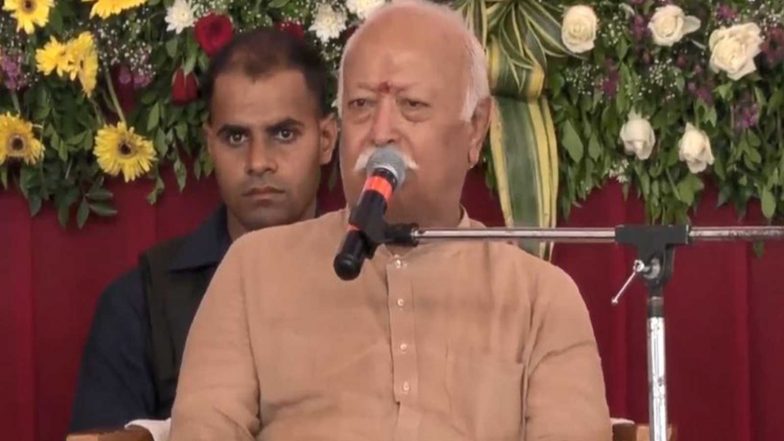
Yavatmal (Maharashtra) [India], September 29 (ANI): Rashtriya Swayamsevak Sangh (RSS) chief Mohan Bhagwat on Tuesday said that while development is taking place in India, the gap between those at the highest and lowest levels of development should be kept to a minimum.
Addressing a programme in Yavatmal organised to mark the birth anniversary of Pandit Deendayal Upadhyaya, Bhagwat said it may not be possible for every person in a large society to achieve the same level of development simultaneously, but development should be pursued keeping the last person in society in mind.
Also Read | Maharashtra: Couple Sells Baby To Buy Phones and Gold Chain in Chhatrapati Sambhajinagar; 7 Arrested.
“Development is taking place in our country. It may not always reach everyone at the same time. In such a large society, everyone may not be at the same level, but the difference between the lowest and highest levels of development should be as small as possible,” Bhagwat said.
Explaining the concept of Antyodaya, Bhagwat said the strength and well-being of a society should be judged by the condition of its most disadvantaged person, just as the strength of a chain is determined by its weakest link.
Also Read | Lohagad Murder Case: Ketan Agarwal Got Fiancee Siya Goyal's Name Tattooed as Birthday Gift.
He said Pandit Deendayal Upadhyaya’s philosophy emphasised compassion and the welfare of all. Referring to Mahatma Gandhi’s approach, Bhagwat said decisions should be evaluated by considering whether they improve the life of the person standing at the very end of society.
Bhagwat said every person should have access to six basic necessities — food, clothing, shelter, essential education, healthcare including doctors and medicines, and the capacity to offer hospitality to guests.
“Earlier too, there were poor people in our country, but they were not deprived of these necessities. They had houses, even if the walls were made of mud rather than stone, and they had clothes, even if they were cotton rather than silk,” he said.
Bhagwat said development should not be limited to the idea of the “maximum good of the maximum number of people”, but should aim at the welfare of everyone, linking the approach to Integral Humanism (Ekatma Manav Darshan).
Speaking about agriculture, Bhagwat also stressed the need to balance farmers’ welfare, soil fertility, forest conservation and sustainable farming practices. He advocated self-reliant farming in which farmers produce their own seeds and manure and reduce dependence on chemicals.
He said agricultural development should protect both farmers and nature, describing such a balanced approach as consistent with the principles of Integral Humanism. (ANI)
(The above story is verified and authored by ANI staff, ANI is South Asia's leading multimedia news agency with over 100 bureaus in India, South Asia and across the globe. ANI brings the latest news on Politics and Current Affairs in India & around the World, Sports, Health, Fitness, Entertainment, & News. The views appearing in the above post do not reflect the opinions of LatestLY)