
India News | Shiv Sena Vs Shiv Sena (UBT): Supreme Court Raises Concerns over Internal Democracy in Political Parties
Get latest articles and stories on India at LatestLY. A bench of Chief Justice of India Surya Kant and Justices Joymalya Bagchi and V Mohana observed that the Shiv Sena's constitution had undergone a significant transformation over the years, moving away from its originally democratic framework to what it described as "virtually a one-person structure."

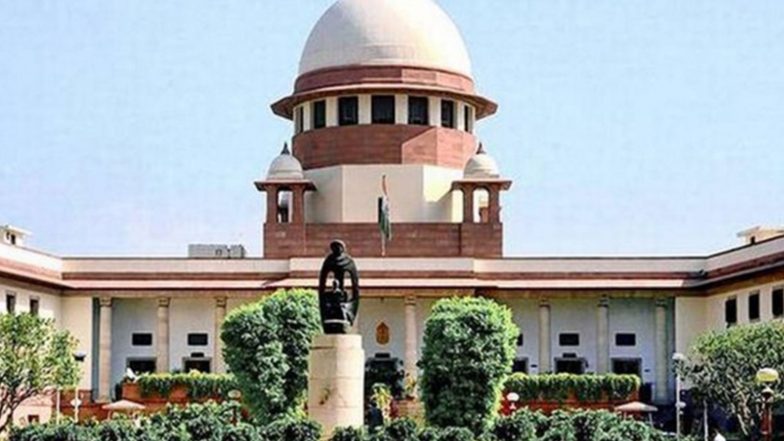
New Delhi [India], August 6 (ANI): The Supreme Court on Thursday raised broader questions about whether political parties themselves must adhere to democratic norms, while hearing the Uddhav Thackeray faction's challenge to the Election Commission's decision recognising the Eknath Shinde-led faction as the "real Shiv Sena."
A bench of Chief Justice of India Surya Kant and Justices Joymalya Bagchi and V Mohana observed that the Shiv Sena's constitution had undergone a significant transformation over the years, moving away from its originally democratic framework to what it described as "virtually a one-person structure."
Also Read | Google Pixel 11 Release: Full Specs, Leaked Features and Expected US Pricing.
The Bench remarked that when constitutional institutions are expected to uphold democratic values, it becomes necessary to examine whether political parties, too, are organised and governed on democratic principles.
"Originally, the party constitution was founded on democratic principles. Subsequently, it was amended and became virtually a one-person structure," the CJI observed.
Also Read | PM Kisan 24th Instalment: Complete Mandatory E-KYC To Receive INR 2,000 Kist.
Senior advocate Kapil Sibal, appearing for the Thackeray faction, countered that the Election Commission of India had no authority to scrutinise the validity or democratic character of a political party's constitution while adjudicating a symbol dispute.
CJI said that the debate extended beyond the Commission's jurisdiction and touched upon the larger constitutional expectation of democratic functioning within political parties.
"When we speak of democratic principles and institutions safeguarding democratic values, the question naturally arises whether a political party is itself expected to function democratically.
Sibal agreed that political parties should ideally function democratically but argued that they cannot be equated with constitutional authorities.
"But there is a distinction. Constitutional institutions perform constitutional functions, whereas political parties perform political functions. The standard of institutional integrity is necessarily much higher when a constitutional authority exercises its powers. A political decision can always be corrected. But a decision of the Election Commission, once taken in these circumstances, often cannot practically be undone," Sibal argued.
The arguments in the case will continue on August 11.
The Shiv Sena split into two factions in 2022, with one group led by Uddhav Thackeray and the other by Eknath Shinde.
Following the split, Shinde approached the Election Commission of India seeking recognition as the real Shiv Sena and claiming the party's name and its iconic bow and arrow symbol.
In deciding the dispute, the ECI primarily relied on the numerical strength of the party's legislators, instead of giving greater weight to the organisational wing. (ANI)
(The above story is verified and authored by ANI staff, ANI is South Asia's leading multimedia news agency with over 100 bureaus in India, South Asia and across the globe. ANI brings the latest news on Politics and Current Affairs in India & around the World, Sports, Health, Fitness, Entertainment, & News. The views appearing in the above post do not reflect the opinions of LatestLY)