India Steps Up Diplomatic Push as 9,000 Citizens Remain in Iran, MEA Assisting Students to Return Home
India on Thursday highlighted a high-level diplomatic push to protect Indian interests, emphasising the twin priorities of citizen safety and the stability of energy supply chains.

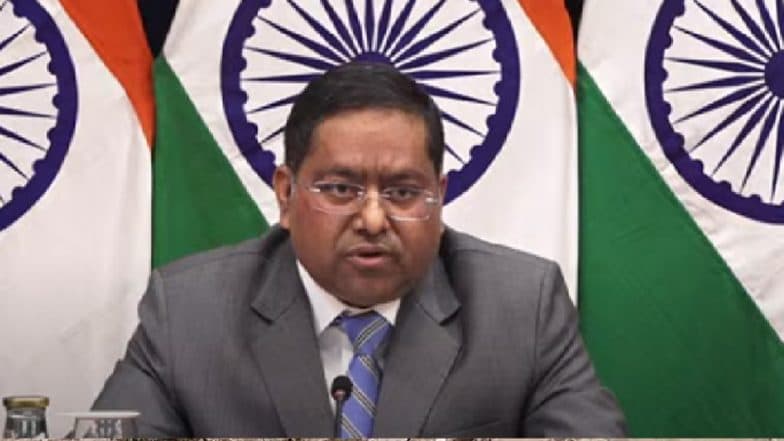
New Delhi, March 12: India on Thursday highlighted a high-level diplomatic push to protect Indian interests, emphasising the twin priorities of citizen safety and the stability of energy supply chains. During the weekly press briefing on Thursday, Ministry of External Affairs spokesperson Randhir Jaiswal said that India is working to ensure the safety of its 9,000 nationals in Iran, with several students and others returning home through embassy assistance.
Jaiswal confirmed that External Affairs Minister S Jaishankar held three telephone conversations with his Iranian counterpart, Abbas Araghchi, to ensure the safety of commercial shipping and protect India's energy security. "External Affairs Minister and the Foreign Minister of Iran have had three conversations in recent days. The last one discussed issues pertaining to the safety of shipping and India's energy security. Beyond that, it would be premature for me to say anything," he said. Iran’s Supreme Leader Mojtaba Khamenei Urges Muslim Neighbours to Clarify Stand on ‘Aggressors’ Against Iran.
Notably, following these talks, stabilisation in the transit of Indian oil tankers through the Strait of Hormuz was secured, a crucial chokepoint for the nation's energy imports. Moreover, the MEA is proactively assisting the approximately 9,000 Indian nationals currently in Iran, many of whom are students, seafarers, and pilgrims. "We've had some 9,000 Indian nationals who were there or who are there in Iran. These 9,000 Indian nationals comprise students. They also comprise seafarers, some business people, some professionals, and some pilgrims. Of these 9,000, you would have seen that we had issued an advisory some time back. Our mission issued an advisory following those advisories, which were issued on the 14th of January, if I'm not wrong, and 23rd of February, several Indian nationals, mostly students, a lot of students, left the country and reached home," said Jaiswal.
The Indian Embassy in Tehran is facilitating the safe movement of nationals who wish to leave the country. This includes helping them reach Armenia and Azerbaijan via land borders, where they can access commercial flights to return to India. "We have recently, as you know, we have shifted several Indian nationals, including students and pilgrims, who were based in Tehran to other safer locations and cities in the country. We are also assisting Indian nationals who wish to travel to Azerbaijan and Armenia, and from there to take commercial flights to return home. We are assisting them with visas. We are also assisting them with land border crossings. So this is happening," he said.
"We've had several Indian nationals who have approached us and we have helped them to cross over into Azerbaijan and Armenia and for them from there to take commercial options of flying back home. I would take this opportunity to advise all Indian nationals who desire to leave Iran via land borders. They should adhere to the advisory that our embassy has issued," he added. For those remaining in the country, the mission has moved Indian nationals--including students and pilgrims--from Tehran to safer cities. The Embassy has issued specific travel advisories (most recently on March 9) and remains in 24/7 contact with the community to provide consular support. Mojtaba Khamenei Issues First Statement After Becoming Iran’s Supreme Leader, Says Iran Should Use Strait of Hormuz Closure as Leverage.
"This was issued on 9th March and they will do the needful. Our mission in Tehran, needless to say, stays in constant touch with our community members and is offering all possible assistance to them. I would like to say that our mission is completely working and our Indian community for their benefit and security," he said. India's diplomatic efforts extend beyond Tehran, with Prime Minister Narendra Modi actively engaging with leaders across the Gulf to stress the importance of regional stability.
Prime Minister Modi has consistently urged regional leaders to return to dialogue and diplomacy, emphasising that "India First" remains the guiding ideology in navigating this global crisis. "Our Prime Minister, as you know, has spoken to several leaders in the Gulf after the conflict started. In these conversations, he stressed the need for dialogue and diplomacy so that early peace can return. He also underlined the need to avoid civilian casualties, and he focused on the priority for the protection of civilians," said Jaiswal.
Meanwhile, External Affairs Minister S Jaishankar and Russian Foreign Minister Sergei Lavrov shared their perspectives on the conflict. "The conversation between Foreign Minister Lavrov and External Affairs Minister. Post the conversation which happened yesterday, if I'm not wrong, we have given details of that conversation where the two leaders shared their perspectives and assessment on the ongoing conflict and several other issues were also discussed," he said.
"We have a large Indian community in the GCC countries, and obviously, their security and welfare are of utmost importance. This was highlighted. We also, in several cases, condemned the violation of the sovereignty and territorial integrity of states," he said. Meanwhile, multiple explosions have been reported across Iran's capital, Tehran and other cities as US-Israeli attacks continue. Iraq has shut down oil port operations after deadly attacks on two foreign oil tankers, as Bahrain, Kuwait, the UAE and Saudi Arabia intercept more Iranian missiles and drones, as reported by Al Jazeera.
(The above story is verified and authored by ANI staff, ANI is South Asia's leading multimedia news agency with over 100 bureaus in India, South Asia and across the globe. ANI brings the latest news on Politics and Current Affairs in India & around the World, Sports, Health, Fitness, Entertainment, & News. The views appearing in the above post do not reflect the opinions of LatestLY)