Inside the Slippery World of Eel Smuggling
Traffickers are making big bucks smuggling millions of critically endangered eels across continents, in suitcases on planes or by exploiting legal loopholes to end up on dinnerplates.

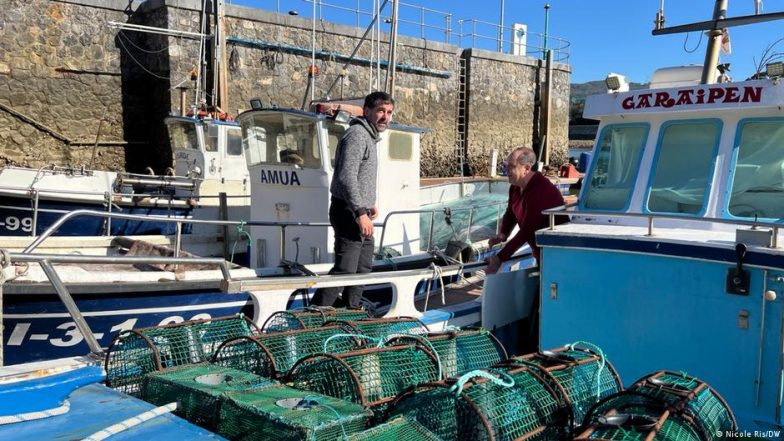
Traffickers are making big bucks smuggling millions of critically endangered eels across continents, in suitcases on planes or by exploiting legal loopholes to end up on dinnerplates. Where are the smuggling hotspots?In Plentzia, a small waterfront town close to bustling Bilbao, eel fishing has long been part of daily life. Now fisherfolk across Spain's Basque Country can no longer catch the animals, a prized delicacy at the center of what authorities describe as one of the world's most lucrative wildlife trafficking trades.
The regional ban is meant to protect the European eel, a critically endangered species, which has seen population declines of around 95% since the 1980s. Yet local fishermen argue the regulations punish those who adhere to them, while criminal networks profit from a billion-euro trade in illegally caught eels.
"So it's the Basque fishermen who will make the eel extinct when the rest are allowed to fish?" said Unai Eizaguirre who's been fishing eels for 30 years and is now facing the prospect of income shorfalls. "It's ridiculous."
Conservationists support the ban as an emergency response in the face of multiple threats from pollution and climate change. But marine biologist Estibaliz Diaz says longer-term measures, like removing hydroelectric dams that block migration routes and kill eels with their turbines are also needed.
"I don't know if the eel has time to wait for these projects to show their effects," said Diaz, who works with local marine research institute AZTI.
Eel smuggling as lucrative as drugs
Part of what makes European eels so vulnerable is their remarkable life cycle, which was, until relatively recently, a source of mystery. Scientists now know adult eels migrate thousands of kilometers from European rivers to the Sargasso Sea in the North Atlantic, their only known spawning grounds. They breed and then die, leaving their larvae to drift to Europe. By the time they reach rivers, they've transformed into tiny, transparent "glass eels."
Today, only about 12% survive the journey from the Sargasso to the Gulf of Biscay and connected waterways, Diaz told DW. The young glass eels conservationists are trying to protect are the most valuable in the illegal trade, fetching up to €9000 ($10,400) per kilogram.
"You can compare it with drug trafficking. Every year they seize tons of illegally caught eel in Europe," said Eizaguirre. "The big business lies in trafficking them to Asia," adding that the huge profits and comparatively small fines for smaller infractions by local fishers make the risk worth it. However, when criminal organizations are involved, penalties can be substantial with fines up to 6 times the value of illegally smuggled eel.
Demand in countries such as China, South Korea and Japan is driving prices. As is a biological peculiarity: so far, it's been exceedingly difficult to get eels to reproduce in captivity. This means fish farms — where the eels are raised before being sold to premium restaurants — need a steady stream of young from the wild. Sometimes, the same smuggled eels come back to Europe as fillets for the sushi market.
Conservationists had hoped pressure on the species would ease when the EU banned export of the species outside the bloc in 2010. Instead, organized crime groups have increasingly muscled in on the market, with the illegal trade now generating an estimated €3 billion in profits in peak years.
"Our estimated maximum was always 100 tons of glass eels smuggled annually. That's already around 300 million fish," said Florian Stein, head of policy and science at the German Angling Association. But information from his contacts in the illegal trade have led him to the conclusion that it was a "very conservative estimate."
International law enforcement agencies are also cracking down, with Europol's Operation Lake seizing 22 tons of glass eels and arresting 26 suspects between 2024 and 2025.
"There has been a lot of pressure from law enforcement throughout Europe," said Interpol's Sanchez Romero. "That's why the criminal groups always look for new routes."
Eels smuggled in plain sight in regular suitcases along complex routes
Still, Stein, who did his doctoral dissertation on international eel smuggling and advises the German government, said trafficking has increased since 2020, and illegal trade routes have become more complex.
"Ten years ago, Madrid airport was still one of the biggest smuggling hotspots," he said. This was due to its proximity to fishing grounds in northern Spain and Portugal.
Increased checks by Spanish authorities on flights to East Asia forced traffickers to adapt. Experts now say a new route running through North Africa via Morocco, Mauritania and Senegal has become increasingly important.
Geography is one reason the route is attractive. The Strait of Gibraltar is 14 kilometers at its narrowest point and a busy maritime junction. "We know that many drugs are also transported through this strait," Moroccan investigative journalist Yassir Al-Makhtoum told DW.
European eels also inhabit rivers and estuaries in Morocco. Though the country has banned the export of glass eels smaller than 12 centimeters (4.7 inches), it is building a legal domestic eel trading industry. Experts fear that's acting as a cover for trafficked animals coming in from Europe.
From Morocco, smugglers then move eels along numerous routes to Asia. The means are not always sophisticated. Glass eels can be transported in ordinary suitcases on domestic flights. They're placed in bags filled with a little water and insulated to keep their temperature stable. They can survive for up to 48 hours in those conditions. Once in Asia, they go to the fish farms.
A species running out of time
Eels are an important indicator species for the health of ocean and riverine ecosystems because their long migrations across multiple habitats make them vulnerable to problems that could also harm other species. They also serve as important prey for herons, otters and larger fish.
"But the impact of its disappearance is difficult to predict," said marine biologist Diaz.
Under EU regulations, member states must undertake measures to allow 40% of adult eels to return to the Sargasso Sea to spawn. Diaz also wants to ensure at least 40% of glass eels make it back from the Sargasso Sea.
But European eels are not the only eel species under threat. A proposal to protect all freshwater eel species from illegal and unsustainable trade was rejected at the 2025 CITES wildlife conference. For Stein such protection is key.
"The proposal should be on the table again at the next conference. I just don't know how else we can get a handle on this problem," said Stein, adding more lobbying and coalition building is needed to advocate for a ban.
“The eel for us is more than just a fish,” said Unai Eizaguirre. “It's been part of our identity for centuries.” For fishermen like him, better protection for the eel represents a chance at a sustainable future.
Edited by: Jennifer Collins
The research for this story was sponsored by: The Med Mosaic.
(The above story first appeared on LatestLY on Sep 09, 2026 02:50 PM IST. For more news and updates on politics, world, sports, entertainment and lifestyle, log on to our website latestly.com).