Why TV Weather Forecasters Are Receiving Online Hate
An email death threat marked the beginning of the end of one meteorologist's job.

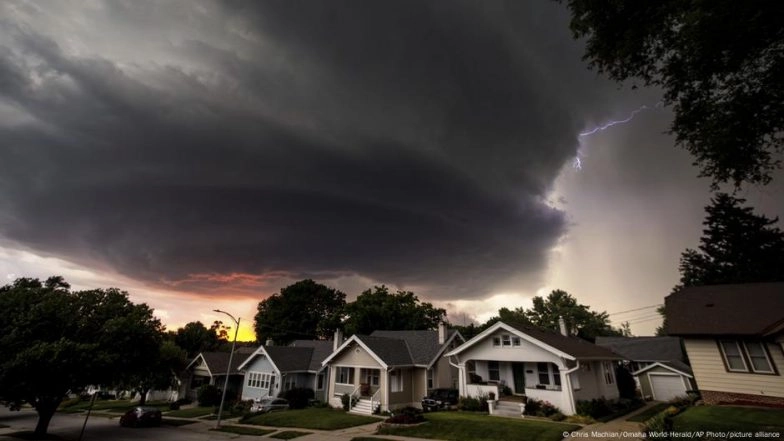
An email death threat marked the beginning of the end of one meteorologist's job. Experts say climate misinformation and conspiracy theories are fueling online hate.One morning Chris Gloninger opened his emails to find a message from a viewer asking for his home address, saying they wanted to give him a welcome he would remember.
"My heart raced and I felt paralyzed," remembers Gloninger, who at the time was presenting the weather on a TV station in Des Moines, in the midwestern US state of Iowa.
Also Read | India News | Heavy Rains Raise Landslide Risk in Assam, ASDMA Issues Advisory.
The email referenced the case of a man who had been arrested for attempted murder of supreme court associate Brett Kavanaugh, after showing up at his house with a gun and zip ties.
It was the final straw after a string of harassment since taking the job as chief meteorologist. He called the police and rushed to a hotel with his wife.
Rise in online hate towards weather forecasters
As some of the most visible faces of climate change communication, TV forecasters have come to bear heat from the rise in misinformation and conspiracies fueling online hate.
Viewing climate change as the most important issue of our time, Gloninger had actively championed its prominent inclusion in his TV work.
After taking the Des Moines job, he tailored coverage to the more climate-skeptical leanings of Iowa, a state which been a conservative stronghold since President Donald Trump's first election. He tried to link it to everyday experiences such as how drought might impact farmers in the largely agricultural area.
It was then that the emails started arriving in his inbox, at first the usual pushback and then ramping up to more aggressive threats. He noticed viewers were politicizing the science.
"They were saying, we're tired of this liberal agenda," said Gloninger. "It should never be about politics, because this is a science that has the support of 99% of its academic community."
A long history of misinformation
Today climate misinformation and conspiracies are rampant online. This is despite overwhelming scientific consensus that climate change is causing more extreme weather that will only further escalate as global temperatures continue to rise.
The roots of this can be traced back to the middle of last century. Despite major fossil fuel companies uncovering the link between burning coal, oil and gas and global heating as early as the 1960s, many pursued an active strategy of denial and playing down the science.
But as glaciers have melted, sea levels risen and dangerous weather intensified, denial has become a harder sell. So instead, experts say misinformation has shape-shifted into a form of "delayism" — either by casting doubt on climate solutions or greenwashing companies to give the false impression that they are environmentally friendly.
Research in 2024 showed how fossil fuel and petrochemical companies spent millions on advertising that included misleading claims about their commitment to renewable energy. The sector actually spends just 1% of global investment on clean power and is actively exploring new oil and gas fields.
Complex web of misinformation actors
Today the networks behind climate misinformation have become very intricate, said Ece Elbeyi, a researcher at the University of Copenhagen in Denmark.
It not only involves those with a vested interest in slowing climate action working with lobbyists and think tanks, but can include media outlets, trolls, Russian bot-farms, and influencers amplifying misinformation on social media platforms, where algorithms favor emotionally charged messaging.
Political actors, particularly those with nationalist or conservative platforms, have exploited misinformation to mobilize their base, said Elbeyi. "They might not explicitly deny climate change, but they frame climate solutions, like for instance international agreements or carbon regulations, as threats to national sovereignty or economic freedom."
Rallying against climate action has become an identity issue and therefore more difficult to challenge, said Elbeyi. Political identity, they added, is one reason a person might share misinformation or send angry messages to someone like Gloninger.
Fertile ground for conspiracy theories
Sometimes misinformation can veer into wild conspiracy theories, which can be particularly attractive to people with high levels of paranoia, insecurity or egocentricity, explained Daniel Jolley, an associate professor in psychology at the University of Nottingham.
Jolley says conspiracies can often make people feel more valued or comforted by painting another powerful group as "evil" and that they often spike after disasters.
In the wake of deadly flash flooding in Texas this summer, conspiracies surged online accusing scientists and government agencies of causing the disaster by manipulating the weather using cloud seeding.
"People are trying to explain issues that are massive, issues that make us feel uncertain, anxious, and perilous," said Jolley.
Jolley expects that because our climate is changing, misinformation and weather conspiracies will become increasingly prominent.
Meteorologists are among the most visible when it comes to communicators of climate science and therefore often come to bear the brunt of attacks, Jolley continued.
What can be done to stop misinformation?
Both Jolley and Elbeyi see education as key in how to identify misinformation.
Elbeyi says this must involve vulnerable groups in debates because the misinformation tends to thrive when groups feel decisions are made without, or even against, them. "And this exclusion can directly erode public trust in scientists and science more generally."
When it comes to conspiracy theories, building trust and being empathetic to why people may have those beliefs is a better tactic than debunking, said Jolley. He says support is also needed for those, like Gloninger, on the receiving end of abuse.
In the aftermath of the death threat, Gloninger sought therapy and was diagnosed with post-traumatic stress disorder — or PTSD. He couldn't sleep and his health deteriorated, leading to a skin condition.
The police caught the perpetrator and fined him $150 (€129). Meanwhile back at the TV station, Gloninger continued working. But after management received a flood of emails from what he calls a loud minority, Gloninger was told to stop mentioning climate change.
He made the choice to leave his job rather than stay and ignore climate change. He says he still finds the decision hard to talk about.
Yet he did feel he made some impact in bringing climate change awareness to a new, conservative audience. He has kept a large folder filled with positive messages from viewers.
He thinks it would be a mistake if climate communicators and weather reporters backed off now because of online hate.
"I do think that there's less coverage of climate change because of the fear of retaliation," said Gloninger "And I encourage meteorologists to double down."
Edited by: Tamsin Walker
Holly Young adapted this story from an episode of DW's Living Planet podcast. Find the audio version here.
(The above story first appeared on LatestLY on Sep 16, 2025 01:20 PM IST. For more news and updates on politics, world, sports, entertainment and lifestyle, log on to our website latestly.com).