
World News | Iran IRGC Claims Interception of US MQ-9 Drone over Khuzestan Region's Ahvaz
Get latest articles and stories on World at LatestLY. Iran's Islamic Revolutionary Guard Corps says it intercepted and destroyed an American MQ-9 drone in Ahvaz near the Iraq border, according to Press TV. The US Air Force describes the MQ-9 as a large, remotely piloted aircraft used primarily for intelligence, surveillance, reconnaissance, and air strikes.

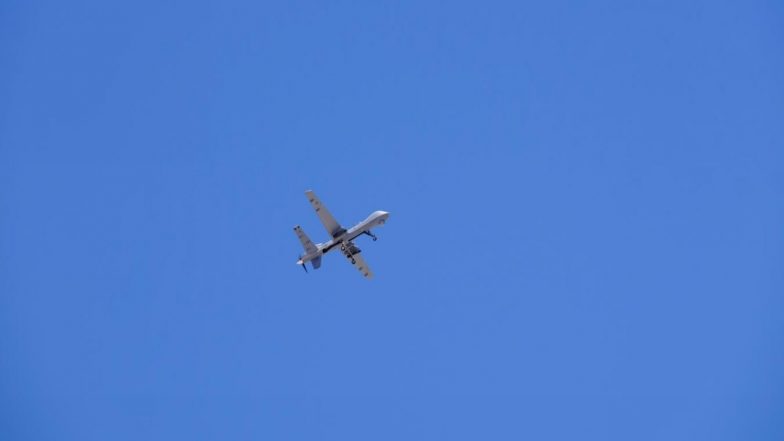
Tehran [Iran], July 19 (ANI): Iran's Islamic Revolutionary Guard Corps says it has intercepted and destroyed a US MQ-9 drone in Ahvaz, a city in the Khuzestan region that borders Iraq, state-run Press TV reported.
An MQ-9 is a "large, remotely piloted unmanned aerial vehicle designed primarily for intelligence, surveillance, reconnaissance, and air strikes," according to a description by the US Air Force.
Also Read | Facebook Down: Desktop Users Hit by ‘Account Temporarily Unavailable’ Error.
The development comes amid a sharp escalation in regional hostilities, with US Central Command (CENTCOM) carrying out a series of military operations targeting Iranian assets. The strikes mark an "eighth consecutive night" of kinetic actions against Tehran-backed facilities in the region.
According to an official statement released on X, the operation was executed late Saturday under direct authorisation from the White House. "US Central Command (CENTCOM) completed another round of strikes against Iran on July 18 at 11:30 p.m. ET, at the Commander in Chief's direction," the statement read.
Also Read | Oman: India-Origin Woman Shabnam Begum Alleges Abuse, Unpaid Wages After Housemaid Job in Muscat (Video).
Authorised by US President Donald Trump, the military engagement was also "designed to further degrade Iran's ability to threaten commercial shipping in the Strait of Hormuz," CENTCOM stated.
During the operational sweep, American forces engaged multiple strategic locations, focusing heavily on degradation operations. The strikes successfully hit Iranian military coastal surveillance and air defence facilities, maritime capabilities, and missile and drone storage sites. CENTCOM noted that the primary objective of the mission was to continue degrading "Iranian military capabilities".
The military action also served as a direct retaliatory response to hostilities directed at American personnel the previous day, specifically designed to "punish" Iran following the fatalities of two American service members during an assault attributed to Tehran-backed forces in Jordan. Elaborating on this punitive objective, CENTCOM confirmed that the strikes were intended to "swiftly punish Islamic Revolutionary Guard Corps forces who launched attacks against American service members in Jordan last night".
The two US soldiers lost their lives on Friday while they "defended against Iranian ballistic missile and drone attacks". CENTCOM further noted that another service member was still missing in action, bringing the official tally to 16 US military personnel killed since hostilities escalated on February 28 following joint US-Israeli strikes.
Providing an update on the wounded, the military command stated, "Four American service members were medically evacuated to Jordanian hospitals. They have since been discharged. Other personnel who were evaluated for minor injuries have returned to duty."
Highlighting the scale of the American military posture amid this escalating regional friction, the command added, "More than 50,000 U.S. men and women in uniform are operating across the Middle East. They remain highly vigilant, focused, lethal, and ready."
In response to these incursions, counter-claims emerged from the region. Iranian state media reported that the latest operations targeted fuel infrastructure at the Al-Azraq US base in Jordan. This follows assertions by the IRGC the previous day that it had struck American aircraft deployed in the country using a combination of missiles and unmanned aerial vehicles.
Washington had initiated this latest round of military actions earlier this month, accusing Tehran of threatening maritime traffic in the Strait of Hormuz, the world's most vital energy conduit. In retaliation, Tehran has repeatedly targeted American bases across Gulf nations.
This ongoing escalation marks a sharp deterioration in relations, occurring just weeks after the collapse of an interim diplomatic framework intended to de-escalate the conflict. President Donald Trump and Iranian President Masoud Pezeshkian had previously signed a 14-point bilateral agreement on June 17 aimed at halting the hostilities. The framework mandated an immediate cessation of military actions, including theatres in Lebanon, and bound both capitals to negotiate a permanent settlement within a 60-day window.
However, the diplomatic track disintegrated on July 8 when President Trump declared that the agreement was "over". Tehran subsequently voided the memorandum of understanding, alleging that Washington was "violating all its commitments".
Reacting to the developments, Iranian Supreme Leader Mojtaba Khamenei, who assumed leadership following the death of his father, Ali Khamenei, during the February 28 opening of hostilities, severely criticised the American administration.
In a statement published on X, the supreme leader, who has remained out of public view since the outbreak of the war, asserted, "The repeated breaches of the agreement by the Great Satan [the US] regarding the MOU signed by the Presidents of Iran and the US have once again laid bare a fundamental truth. The signature of the US President is utterly worthless and devoid of credibility." He further warned that the ongoing campaign "once again demonstrated to everyone the worthlessness of the American president's signature".
Khamenei cautioned Washington against broader escalation, stating, "Now that the American enemy is seeking to escalate the conflict, thereby incurring even heavier costs and further humiliation, it should know that the noble nation of Iran and the Resistance Front have unforgettable lessons in store for it."
Reiterating this aggressive posture, Major General Mohsen Rezaei, senior military adviser to the supreme leader, warned via state media channels that Tehran is prepared to launch "full-scale offensive operations" should American strikes persist. Rezaei concluded by stating that "Iran will no longer limit itself to retaliatory, like-for-like responses", indicating a potential shift towards unrestricted regional warfare. (ANI)
(The above story is verified and authored by ANI staff, ANI is South Asia's leading multimedia news agency with over 100 bureaus in India, South Asia and across the globe. ANI brings the latest news on Politics and Current Affairs in India & around the World, Sports, Health, Fitness, Entertainment, & News. The views appearing in the above post do not reflect the opinions of LatestLY)