
World News | Is the 2020s China's Decade?
Get latest articles and stories on World at LatestLY. China is steadily expanding its global influence and aiming to reshape the international order as American dominance wanes. While Beijing avoids direct conflict, experts warn of potential risks regarding Taiwan by 2028, highlighting that China must commit resources, not just rhetoric, to fully achieve its ambitions.

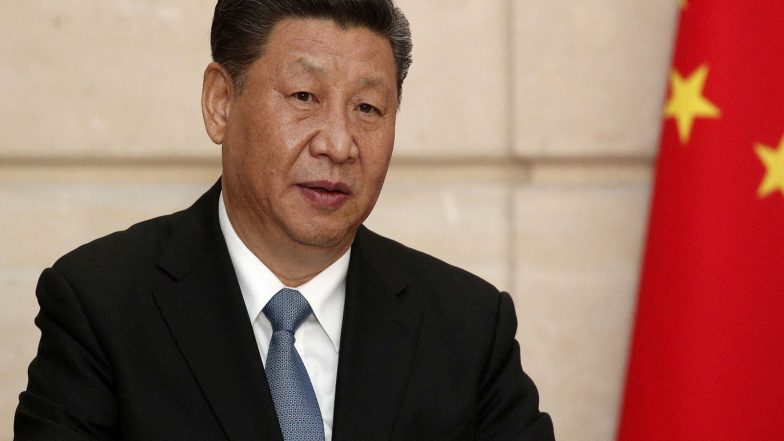
Hong Kong, September 15 (ANI): Chairman Xi Jinping has set China on an undeviating course, and that trajectory involves the Asian country displacing the USA’s dominance both in the region and globally. There are questions over whether China will be able to achieve that, and whether it will result in overt armed combat.
China has a clear vision for the future political and international order, one it is patiently implementing. Beijing says it wants power reapportioned away from liberal democracies and hegemonies to a more equal distribution. That is the narrative, anyway.
Also Read | Whyalla Steelworks Layoffs: 600 Jobs Cut As Administrators Permanently Shut Down Blast Furnace.
However, just as the Chinese Communist Party (CCP) cannot tolerate devolving power to its own people, China views itself as the rightful heir to global influence and power. It wants an international order made in its own likeness, one that suits its preferences and priorities, and that comes at the expense of principles such as human rights and international law.
Writing in the US-based China Leadership Monitor, which is published quarterly, Ryan Hass, an American foreign policy analyst at the Brookings Institution, noted: “Beijing views America as declining but dangerous. Rather than confront the United States in a contest for leadership, China is content to patiently accumulate power and influence until such time as the country becomes broadly recognised as leader of a new political order. Such an outcome is possible but not preordained. A core tension is whether China will match its expansive vision with a willingness to pay the costs of leadership. Rhetoric without the backing of economic resources is an expression of ambition, not a plan for realising it.”
Also Read | Donald Trump Dismisses Stricter AI Regulation Calls, Says ‘Whoever Wins AI Wins’; Know Why.
Hass pointed out, “China’s focus is on revising the political and normative foundations of the US-led liberal political order while preserving features of the broader international system from which it benefits”.
For a long time, China has been peddling the story that the West is in terminal decline, and that it is inexorably rising. For example, China’s Ministry of Foreign Affairs released a 2021 report that described America’s political system as “gravely ill with money politics, elite rule, political polarisation and a dysfunctional system”.
The China Institutes of Contemporary International Relations (CICIR), a think-tank affiliated with the Ministry of State Security, concluded, “The international order is in a transition period wherein the old order is disintegrating while the new one has yet to be established. The so-called liberal international order that underpinned the post-Cold War international system has already collapsed.”
In many ways, this conclusion is correct. The USA is a shadow of its former self, where self-interest and hubris now reign instead of commitments to universal principles such as right and wrong. The USA has retreated from many spheres, such as its USAID commitments, diminishing its soft power. Instead of gathering countries together, Trump has proved divisive.
There is no doubt China has grown in swagger. There have been wobbles, such as its response to COVID-19, but, overall, China is growing in influence, if not always in popularity. Its newfound confidence was observable last year when the USA backed down after China’s threat of sanctions relating to rare-earth elements. It has also safely navigated the energy shock caused by the USA and Israel war against Iran.
Another place evincing this confidence is the South China Sea. The tenth anniversary of the Permanent Court of Arbitration’s unanimous ruling against Beijing’s territorial claims there occurred on 12 July 2026. China disparages the ruling, describing it as “a political farce masquerading as a legal process”. It refuses to acknowledge the ruling, even though it is a signatory to the very treaty it vehemently criticises.
Attacked mercilessly by Chinese officials and media, Jay Tarriela, a Philippine Coast Guard spokesperson, said this: “Countering Beijing’s disinformation is exhausting. It’s frustrating. Some days it’s disappointing. But I’ll answer every lie – because this fight was never about me. If China wins the battle of narratives and teaches us to accept defeat, the loss will not be ours alone. It’ll belong to the Filipino children not yet born, who will grow up believing what’s ours was never worth defending. The truth shall set us all free.”
In Beijing’s attempt to upend the current international order, the situation has reached the point where Chinese commentators claim China and the USA are on an equal footing. They describe it as a period of “strategic stalemate”, where the power gap has reduced. Yet Hass pointed out, “Even as Beijing judges that the power gap between the United States and China is narrowing, it is not spiking the proverbial football in celebration – as part of a deliberate effort to avoid conflict with the United States as its power declines.” In fact, it appears the CCP has deliberately cooled down its rhetoric on American decline to avoid triggering Trump.
The planned meeting between Trump and Xi later in September is therefore of intense interest. Who has leverage? What demands will China make? Will Trump make concessions?
This rebalancing of the international order is, of course, a dangerous period. One power appears to be waning and another rising, and this often leads to conflict and war under what is referred to as the Thucydides Trap.
Beijing is naturally aware of this danger. Hass explained: “From Beijing’s perspective, this heightened risk increases the need for Washington and Beijing to deepen engagement and leader-level involvement to militate against a slide toward US-China confrontation or conflict. China still views the United States as ‘its top strategic threat’. In the face of this threat, China’s objectives in its America policy are ‘…avoiding conflict, engaging in limited cooperation and preparing for long-term competition,’ according to Renmin University’s Wang Wen.”
But could war break out between China and the USA?
In a 13 September 2026 interview, former Australian Prime Minister Kevin Rudd assessed a one-in-three chance that China might invade Taiwan by 2028. He remarked, “Well, I’ve been looking at the US-China relationship over Taiwan for the better part of 50 years, since I was a junior woodchuck at the Australian National University, and through a period of working in our embassy in Beijing, as prime minister, foreign minister and as a China analyst since then. So I don’t reach these conclusions lightly, and I’ve never been in the Taiwan alarmist category, nor am I now. It’s just that I think I’ve got a responsibility to point to elevated risk.”
Rudd is considered an expert on China, and he warned of the intensity of Chinese military preparedness and dress rehearsals for a Taiwan invasion. “It has been moving at angular levels, that is, sharply up.” He also referred to upcoming tripwires, one being Taiwanese presidential elections slated for January 2028, where the Democratic Progressive Party, hated by Beijing, could win a fourth consecutive term.
The Australian added, “What concerns me is President Xi looking at that and seeing it as a tripwire for pulling the military lever, if he makes a profound miscalculation about the level of American ultimate resolve in providing the defence for the Taiwanese, given that’s been the assumed reality since 1949.”
That year, 2028, also marks the final year of Trump’s second term. “Is that a factor here as well? …The capacity for Chinese miscalculation goes to the heart of their analysis of President Trump himself.” Trump has indicated Taiwan is thousands of miles from the USA, that Taiwan stole the USA’s semiconductor industry, and that he is holding further arms sales hostage depending on Taiwanese behaviour. Rudd warned, “My concern is the Chinese Communist Party is analysing that and reaching, I think, a dangerous conclusion that therefore American resolve has evaporated.”
Rudd fears Xi may misread Trump’s political position and think he can get away with a military operation against Taiwan. However, “I think any sober and real calculation of all the risk elements would still cause him, on balance, to conclude this is too risky an enterprise. Which is why I say, in 2028, this is still not a probability. I am pointing, however, to it being an elevated possibility, one in three.”
One thing is clear. Despite noble appeals to the “rules-based order” from Western countries, the international order has been irrevocably altered. Nobody is able to kick China’s military out of its bases in the South China Sea, for example.
Sir John Chipman, CEO of the International Institute of Strategic Studies, pointed out, “During the Cold War there was no ‘rules-based order’; there was balance of power, regulated by arms control. Now we have neither; and rules cannot be enforced.”
Chipman describes international law as “no longer fit for purpose. It’s outdated, not least because it doesn’t account for non-state actors or so-called grey-area threats. A period of harsh realpolitik will inevitably reshape international law. In the meantime, as international law is honoured more in the breach than in the observance, it cannot be the decisive factor in determining national security policy. That pains the liberal conscience, but is consistent with the liberal lament that the ‘rules-based order’ is dead.”
Beijing has long reached the point where “its leaders conclude they no longer need to submit to a US-led international political order that fails to take account of its top priorities and concerns,” Hass acknowledged.
The American academic concluded, “Alert to risks, Beijing does not seek to confront America in a clash for supremacy or assume the burdens of unipolar leadership. Nor are China’s leaders clamouring to tear down the old order to create a new one out of whole cloth … Rather, Beijing is working methodically to build international support for filtering out aspects of the existing order that Beijing opposes and replacing them with concepts that better align with China’s preferences. China’s ideational appeal is to construct an updated international order that better reflects the interests and concerns of the ‘global majority’.”
China speaks often of “win-win” cooperation. But what it really means is that China must win at all costs. It also decries “zero sum games” and “Cold War mentalities”. Yet in accusing others of hegemony, China is equally guilty of bullying and bludgeoning weaker states, whether it is Manila sticking up for its territorial rights in the South China Sea, or using trade and tourism as economic tools of coercion.
All Beijing’s talk is shown as a sham, since China is not ashamed to pressure others into complying with its own priorities. It continues to condone Russian actions in Ukraine and has not once condemned Vladimir Putin’s war, even as it pretends to be a neutral party. What China wants is greater respect and deference. It is angered when it does not receive this.
Hass noted, “As more countries come to depend on China for their own development, China builds greater leverage to compel political accommodation to its priorities. When countries refuse to yield to Chinese requests, particularly on issues implicating China’s ‘core interests’, they face strong coercive pressure. China has built a robust regulatory, legal and security toolkit to threaten and punish countries that defy their demands.”
China’s investment in the Belt and Road Initiative has shrunk considerably, forcing Beijing to be far more selective as to where it spends money. Interestingly, it is stingy when it comes to supporting international organisations, and its foreign aid budget has remained static even as the USA dramatically slashed USAID.
Hass concluded, “Beijing’s ambition to architect an updated international political order is transparent. What remains to be seen, however, is whether China will commit resources to underwrite its ambitions and become adept at attracting international support for its vision. Absent new investments in international institutions, public goods and partnerships with other key countries, China’s efforts to reform the international political order may wither. America’s retreat from its traditional leadership role has opened a lane for China. To fill it, though, Beijing will need to put forward resources, not only rhetoric.”
So is the 2020s China’s decade? It has already achieved much, but it still has work to do to convince others of its benign intentions. That will be difficult, for its intentions and modus operandi are malignant. (ANI)
(The above story is verified and authored by ANI staff, ANI is South Asia's leading multimedia news agency with over 100 bureaus in India, South Asia and across the globe. ANI brings the latest news on Politics and Current Affairs in India & around the World, Sports, Health, Fitness, Entertainment, & News. The views appearing in the above post do not reflect the opinions of LatestLY)