
World News | Want to Change Pak’s Existing Corrupt Political System: Muttahida Qaumi Movement Founder Altaf Hussain
Get latest articles and stories on World at LatestLY. Muttahida Qaumi Movement (MQM) founder and leader Altaf Hussain has called for a change in what he described as Pakistan’s “corrupt, unjust and oppressive” political system, alleging that the country is being governed under the influence of powerful elements of the military establishment.

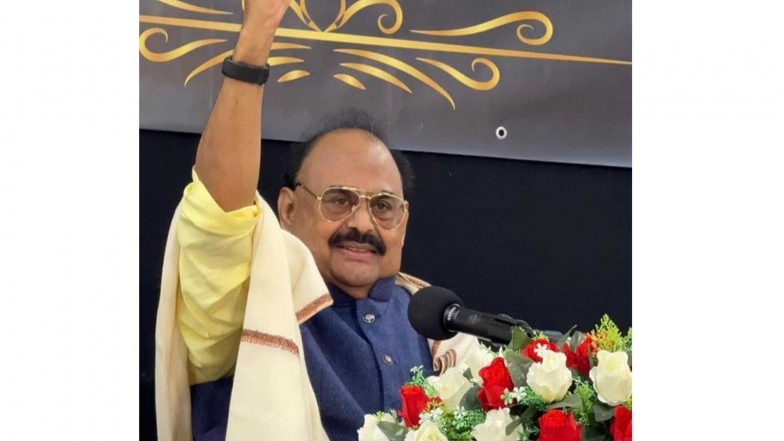
London [UK], September 22 (ANI): Muttahida Qaumi Movement (MQM) founder and leader Altaf Hussain has called for a change in what he described as Pakistan’s “corrupt, unjust and oppressive” political system, alleging that the country is being governed under the influence of powerful elements of the military establishment.
Addressing a gathering organised by MQM UK in London to mark his 73rd birthday on Monday, Hussain said his opposition was not directed at any individual but at what he described as a system in which political power is placed above the law.
Also Read | BLACKPINK's Lisa Spotted Arm-in-Arm With Rumoured Boyfriend Blue Pongtiwat in London?.
“I was never against any individual. I was against a corrupt, unjust and oppressive system. I wanted to change Pakistan’s corrupt political system, and even today I want a change in the existing corrupt system of government,” he said.
Hussain said Pakistan did not have genuine democracy but “stratocracy”, which he defined as a system in which the country is run by powerful elements of the military establishment.
Also Read | Fact Check: Is Kim Kardashian Pregnant With Boyfriend Lewis Hamilton's Child? Truth Behind Viral Post.
“Pakistan does not have democracy but stratocracy, meaning that the country is being run by powerful elements of the military establishment,” he said.
Clarifying his position on the military, Hussain said he was not opposed to the army as an institution but objected to what he described as its involvement in political affairs.
“I am not against the army. I believe that every country needs an army for its defence, and Pakistan also needs an army. However, the army is operating beyond its constitutional sphere,” he said.
He alleged that military officers had been appointed to civilian institutions and that the military establishment exercised influence over the country's political and administrative system.
“I am not against the soldiers of the army; rather, I oppose the policies of a few generals whose decisions result in losses and harm to the country and its people,” Hussain said.
Referring to his long-standing opposition to military involvement in politics, Hussain alleged that his criticism had resulted in him being labelled an opponent of the army and an enemy of Pakistan.
He also recalled the 1992 military operation against the MQM in Sindh. Hussain claimed that the operation, launched on June 19, 1992, resulted in the deaths and disappearances of thousands of MQM workers.
According to Hussain, the operation was initially presented as an action against major criminals, kidnappers and local strongmen, but was ultimately directed against the MQM.
“I had already clearly expressed my apprehension that this operation would actually be against MQM. My words proved to be correct, and the military launched an operation against MQM on 19 June 1992,” he said.
Hussain further alleged that MQM workers were subjected to extrajudicial killings and enforced disappearances during the operation. He also referred to allegations attributed to former Federal Interior Minister Chaudhry Shujaat Hussain concerning the burial of MQM workers in the Margalla Hills.
Comparing the treatment of MQM workers during the 1990s with the treatment of Pakistan Tehreek-e-Insaf (PTI) workers after the May 9, 2023 events, Hussain said the scale of repression against MQM had been considerably greater.
“I say that not even five per cent of what happened to MQM and the Mohajirs has happened to PTI workers in Punjab,” he said, while questioning how many PTI leaders and workers had been killed or disappeared.
Hussain said his objective remained to replace what he described as a system dominated by feudal and military power with one based on equal rights.
“I wanted to change Pakistan’s corrupt political system, and even today I want a change in the existing corrupt system of government. I want to free Pakistan from feudal lords and waderas. I want a system in which every citizen has equal rights, regardless of their religion or belief,” he said.
“My opposition is not directed against any individual, province or political party; rather, it is against a system in which power becomes superior to the law,” he added.
Hussain also criticised what he described as the influence of feudal structures in Sindh and Punjab, along with corruption and the subordination of democratic institutions to military authority.
On religious extremism, Hussain alleged that religion and the name of Islam had previously been used for political and strategic objectives. He said the consequences of such policies were still being felt, particularly in Khyber Pakhtunkhwa.
“The consequences of those policies are still before the country today, with suicide attacks taking place across the country and innocent citizens losing their lives,” he said.
Hussain also said he did not fear those who opposed him, stating that he feared no one except Allah.
The gathering in London was attended by MQM supporters and community members from different parts of the United Kingdom, as well as party office-bearers and supporters who travelled from the United States, France, Belgium and the Middle East. (ANI)
(The above story is verified and authored by ANI staff, ANI is South Asia's leading multimedia news agency with over 100 bureaus in India, South Asia and across the globe. ANI brings the latest news on Politics and Current Affairs in India & around the World, Sports, Health, Fitness, Entertainment, & News. The views appearing in the above post do not reflect the opinions of LatestLY)