Indian Banks Collected Over INR 7,000 Crore in FY26 for Failing Minimum Balance; HDFC Leads With INR 1,798.14 Crore
In FY26, Indian banks collected over INR 7,086 crore for minimum balance non-maintenance, with private lenders accounting for INR 4,948.71 crore and PSBs INR 2,137.92 crore. HDFC and Axis led private collections, while basic savings accounts remained exempt from these penalties. HDFC and Axis represent 58 per cent of the total amount collected by private banks.

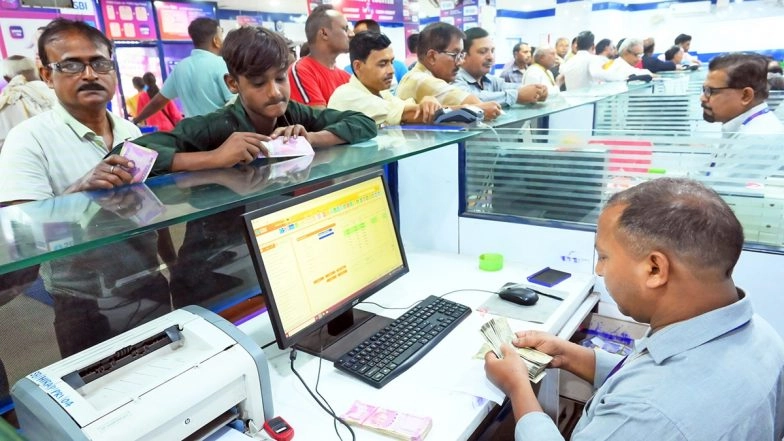
Private and public sector banks across India collected more than INR 7,086 crore from customers during the 2025-26 financial year as penal charges for failing to maintain the required minimum average balance in savings and current accounts. Providing the data in a written reply to the Rajya Sabha on Tuesday, July 28, Minister of State for Finance Pankaj Chaudhary revealed that private lenders accounted for more than double the amount collected by their public sector counterparts.
Breakdown of Penal Charges by Bank Categories
According to Reserve Bank of India (RBI) figures shared in Parliament, 19 private-sector banks collectively gathered INR 4,948.71 crore from account holders for failing to meet average balance criteria over the course of the fiscal year. Bank of Baroda Breach: Experts Explain How Email-Driven Cyberattacks Can Be Prevented.
In comparison, public sector banks (PSBs) collected INR 2,137.92 crore for the same reason during the same period. Among private lenders, HDFC Bank recorded the highest penal collections at INR 1,798.14 crore, followed closely by Axis Bank at INR 1,081.33 crore. Together, these two institutions accounted for INR 2,879.47 crore, representing 58 per cent of the total amount collected by private banks in this category.
Exemptions for Basic Accounts
Addressing concerns regarding financial inclusion, the minister clarified that standard penalty rules do not apply across all banking products. "No penal charges are levied on Basic Savings Bank Deposit Accounts, including those opened under the Pradhan Mantri Jan Dhan Yojana," Chaudhary said.
Strengthening Financial Health and ECLGS 5.0
Shifting focus to the broader performance of state-owned lenders, the minister reported that the financial health of public sector banks has shown notable improvement, backed by sound balance sheets, historically high profits, and multi-decadal low levels of gross non-performing assets (GNPA). He noted that PSBs have maintained steady credit expansion across multiple economic sectors. Bank of Baroda Data Breach: What Account Holders Need To Do.
Additionally, Chaudhary updated Parliament on administrative measures implemented to protect domestic commerce, noting that the government rolled out the Emergency Credit Line Guarantee Scheme 5.0 (ECLGS 5.0) in May 2026 to assist businesses facing short-term liquidity mismatches resulting from ongoing developments in West Asia.
(The above story first appeared on LatestLY on Jul 29, 2026 08:30 PM IST. For more news and updates on politics, world, sports, entertainment and lifestyle, log on to our website latestly.com).