List of Education Ministers of India: Tenure and Qualifications
Following Union Education Minister Dharmendra Pradhan's resignation, a look back at India's education leaders from 1947 to 2026 highlights the portfolio's diverse academic and political stewardship. The office of the Education Minister has historically been viewed as one of the most intellectually demanding assignments in the Union Cabinet.

The resignation of Union Education Minister Dharmendra Pradhan on July 25 has once again brought India's high-stakes education portfolio into sharp national focus. Stepping down following weeks of intense student agitations and accountability debates surrounding competitive examination irregularities, Pradhan’s departure marks the end of a notable five-year tenure.
As the Union Cabinet prepares to navigate leadership for the ministry, a retrospective look at independent India’s educational stewardship highlights the diverse academic and political backgrounds of the leaders who have shaped the nation's schooling and higher education landscape since 1947. Will There Be Nationwide Protest by CJP on 26th July or It Is Cancelled After Dharmendra Pradhan's Resignation?
From Independence to Present: Complete Ministerial Roll
Since the inception of independent India, the Ministry of Education - briefly designated as the Ministry of Human Resource Development (MHRD) between 1985 and 2020 - has been steered by a wide spectrum of scholars, legal luminaries, scientists, and political leaders.
Education Ministers of India (1947-2026)
| Name | Tenure | Qualification |
| Maulana Abul Kalam Azad | 1947–1958 | Self-taught Islamic scholar, journalist, and author |
| Dr. K.L. Shrimali | 1958–1963 | MA (Philosophy), PhD from Columbia University |
| Humayun Kabir | 1963 | MA (English), MA (Philosophy, Politics, Economics) from Oxford |
| M.C. Chagla | 1963–1966 | BA (History) from Oxford, Bar-at-Law (Inner Temple) |
| Fakhruddin Ali Ahmed | 1966–1967 | St. Stephen's College, Bar-at-Law (Inner Temple) |
| Dr. Triguna Sen | 1967–1969 | Dr.-Ing (PhD in Engineering) from Munich University |
| Dr. V.K.R.V. Rao | 1969–1971 | PhD in Economics from Cambridge University |
| Siddhartha Shankar Ray | 1971–1972 | LLB, Bar-at-Law (Inner Temple) |
| Prof. S. Nurul Hasan | 1972–1977 | MA, DPhil (History) from Oxford University |
| Pratap Chandra Chunder | 1977–1979 | BA (History), LLB, DPhil (Arts) from Calcutta University |
| Dr. Karan Singh | 1979–1980 | MA, PhD (Political Science) from Delhi University |
| B. Shankaranand | 1980 | BA, LLB from Belgaum/Mumbai |
| S.B. Chavan | 1980–1984 | BA, LLB |
| K.C. Pant | 1984–1985 | MSc (Science) |
| P.V. Narasimha Rao | 1985–1988 | BA, LLB (Osmania & Nagpur Universities) |
| P. Shiv Shankar | 1988–1989 | BA, LLB from Osmania University |
| V.P. Singh | 1989–1990 | BA, BSc, LLB (Allahabad & Pune Universities) |
| Raj Mangal Pande | 1990–1991 | BA, LLB from Allahabad University |
| Arjun Singh | 1991–1994 | BA, LLB from Rewa Darbar College |
| Madhavrao Scindia | 1995–1996 | MA from Oxford University |
| P.V. Narasimha Rao | 1996 | BA, LLB (Osmania & Nagpur Universities) |
| S.R. Bommai | 1996–1998 | BA, LLB |
| Dr. Murli Manohar Joshi | 1998–2004 | MSc, PhD (Physics) from Allahabad University |
| Arjun Singh | 2004–2009 | BA, LLB from Rewa Darbar College |
| Kapil Sibal | 2009–2012 | BA, LLB, LLM (Harvard Law School) |
| M.M. Pallam Raju | 2012–2014 | BE (Electronics), MBA from Temple University (USA) |
| Smriti Irani | 2014–2016 | School Education (Class 12) |
| Prakash Javadekar | 2016–2019 | B.Com (Hons) |
| Dr. Ramesh Pokhriyal 'Nishank' | 2019–2021 | MA, PhD (Hemwati Nandan Bahuguna Garhwal University) |
| Dharmendra Pradhan | 2021–2026 | MA (Anthropology) from Utkal University |
The Institutional Weight of the Portfolio
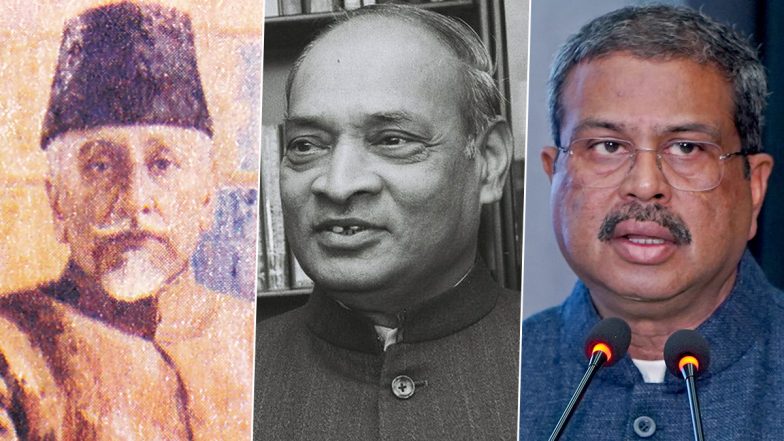
The office of the Education Minister has historically been viewed as one of the most intellectually demanding assignments in the Union Cabinet. From independent India's first minister, Maulana Abul Kalam Azad - who laid the foundational stone for institutional bodies like the UGC, AICTE, and Sahitya Akademi over an eleven-year tenure - to modern architects of policy, the chair requires balancing macro-level structural vision with grassroots administrative delivery. Dharmendra Pradhan Resigns As Education Minister, Says ‘Pained by Last 10 Days’ Events’.
Throughout the decades, leadership styles have shifted in response to changing national imperatives. While early decades emphasised institution-building and expanding basic literacy, later periods focused on higher education expansion, legal frameworks like the Right to Education Act under Kapil Sibal, and large-scale structural transitions such as the National Education Policy (NEP) 2020 overseen by Ramesh Pokhriyal 'Nishank' and subsequently implemented by Dharmendra Pradhan.
Context Behind Dharmendra Pradhan’s Exit
Dharmendra Pradhan's departure closes a chapter defined heavily by the roll-out of NEP 2020, digital learning initiatives, and skill development integration. However, persistent administrative challenges - particularly concerning systemic leaks and controversies surrounding national recruitment and entrance examinations - created intense pressure from student collectives and political opposition. With the portfolio currently vacant following his resignation, political observers anticipate that the incoming minister will face immediate priorities regarding examination security reforms, institutional transparency, and the steady execution of long-term academic modernisation goals.
(The above story first appeared on LatestLY on Jul 25, 2026 07:12 PM IST. For more news and updates on politics, world, sports, entertainment and lifestyle, log on to our website latestly.com).