E20 Petrol Reduces Mileage by up to 6%, No Evidence of Engine Failures, Says Nitin Gadkari
Union Minister Nitin Gadkari informed Parliament that 20 per cent ethanol-blended petrol (E20) reduces vehicle mileage by 2 to 6 per cent but cuts carbon emissions by 30 per cent. Joint industry tests revealed no engine failures, and the government defended the phased rollout. 'The fuel efficiency of vehicles may be reduced by 2 to 6 per cent depending on the vehicle category and vintage,' Gadkari said.

- Read in
- हिंदी
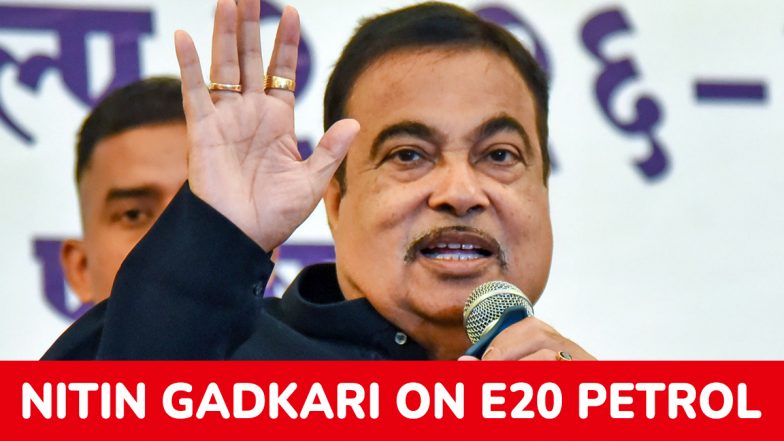
Union Minister for Road Transport and Highways Nitin Gadkari informed Parliament on Thursday, July 30, that petrol blended with 20 per cent ethanol (E20) can reduce vehicle fuel efficiency by 2 per cent to 6 per cent, depending on the vehicle category and age. However, he asserted that extensive testing has revealed no evidence of engine failures linked to the fuel.
In a written reply in the Lok Sabha, Gadkari noted that while E20 causes a marginal drop in mileage, it delivers improved vehicle acceleration, better ride quality, and roughly 30 per cent lower carbon emissions compared to traditional E10 fuel. E20 Petrol May Harm BS-III Vehicle Rubber Parts and Gaskets, Nitin Gadkari Clarifies No Major Engine Issues.
Findings from Joint Industry Studies
According to the minister, comprehensive evaluations were conducted jointly by the Automotive Research Association of India (ARAI), the Society of Indian Automobile Manufacturers (SIAM), and Indian Oil Corporation Ltd (IOCL). The testing examined the impact of E20 fuel across BS-III, BS-IV, and BS-VI petrol-powered two-wheelers and four-wheelers. Protocols utilised standard certification procedures alongside custom testing setups designed in consultation with original equipment manufacturers (OEMs).
"The fuel efficiency of vehicles may be reduced by 2 to 6 per cent depending on the vehicle category and vintage. The tests for engine durability on a dynamometer and vehicle tests on road have not shown any failures due to E20," Gadkari stated.
Addressing Consumer Concerns and Implementation
The rollout of E20 petrol - consisting of an 80:20 ratio of petrol to ethanol - has previously faced scrutiny from opposition parties and consumer groups. Critics have raised concerns regarding compatibility with older vehicles, potential drops in fuel economy, increased maintenance costs, and potential warranty liabilities. Despite these criticisms, the government maintains that the nationwide transition has been implemented gradually and supported by scientific validation. Major automakers have also confirmed that they continue to honour standard vehicle warranty claims for vehicles utilising E20 fuel. Nitin Gadkari Gets Bombay HC Nod to Sue Meta, X, Google Over Deepfakes Linking Him to E20 Fuel Policy.
Background of India's Ethanol Blending Programme
Gadkari highlighted that the Ethanol Blended Petrol (EBP) Programme has progressed through a phased, consultative framework involving NITI Aayog, oil marketing companies, SIAM, ARAI, the Indian Institute of Petroleum (IIP), and other technical bodies. India's blending initiative began as a pilot project in 2001, followed by the commercial introduction of E5 fuel in 2006. While blending stood at just 1.53 per cent during the 2013–14 period, rates have climbed significantly following the scaling of domestic production capacity and supportive regulatory frameworks.
Official data indicates that fuel blends of E15 and above have been in circulation for over three and a half years, while higher E19 to E20 blends have been utilised across India for more than two and a half years.
(The above story first appeared on LatestLY on Jul 31, 2026 01:31 PM IST. For more news and updates on politics, world, sports, entertainment and lifestyle, log on to our website latestly.com).