From Xi Jinping to Vladimir Putin: PM Narendra Modi Holds 15 Bilateral Meetings in 3 Days at the BRICS Summit
Prime Minister Narendra Modi concluded an action-packed diplomatic schedule on Sunday, holding 15 high-profile bilateral meetings over three days on the sidelines of the 18th BRICS Summit at Bharat Mandapam.

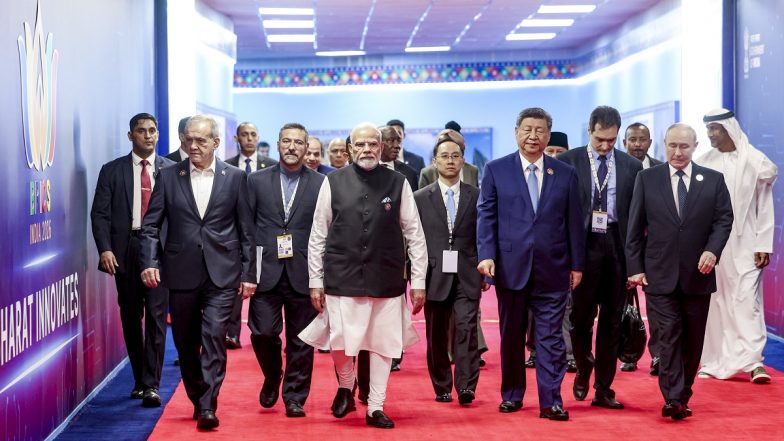
Prime Minister Narendra Modi concluded an action-packed diplomatic schedule on Sunday, holding 15 high-profile bilateral meetings over three days on the sidelines of the 18th BRICS Summit at Bharat Mandapam. Running parallel to the main summit sessions, this marathon of face-to-face engagements gave New Delhi an opportunity to push its core economic, defense, and national security interests while consolidating India's role as a bridge between major global powers and the Global South.
Alongside formal sit-down talks, the Prime Minister conducted multiple pull-aside conversations with foreign dignitaries and heads of international agencies. The engagements coincided with India wrapping up its year-long BRICS chairship. ‘China and India Are Partners, Not Rivals’: Xi Jinping at BRICS.
Why This BRICS Summit Was a Big Win for India
Hosting the expanded BRICS bloc gave India a distinct strategic edge at a time of heightened global fragmentation. The summit underscored India's commitment to "multi-alignment"—maintaining stable ties with Western powers while taking a leading role in non-Western multilateral groupings.
Through these 15 side meetings, India successfully steered key discussions toward its own foreign policy priorities, including cross-border counter-terrorism, maritime security, digital public infrastructure, and securing resilient critical mineral and energy supply chains.
Border Peace with Beijing, $100B Trade Target with Moscow
The most anticipated engagement was PM Modi's meeting with Chinese President Xi Jinping—marking Xi’s first visit to India in seven years. The discussions focused on stabilizing bilateral relations and managing the disputed Line of Actual Control (LAC). Modi emphasized that mutual respect, sensitivity, and interest must guide ties, reiterating that differences should not be allowed to turn into disputes.
In another major sit-down, PM Modi met Russian President Vladimir Putin to review strategic cooperation. The two leaders agreed to expand trade in national currencies, target $100 billion in bilateral trade by 2030, and deepen ties across defense, critical minerals, and civil nuclear energy. Modi reiterated India's call for dialogue and diplomacy to resolve the Ukraine conflict. BRICS Summit 2026 ‘Selfie’ With Vladimir Putin, PM Modi, Xi Jinping Posing for Photo? Fact Check Reveals Truth.
Secure Routes, Semiconductors, and the Global South Push
Beyond global superpowers, New Delhi used the summit to secure its immediate economic and strategic neighborhood:
-
Energy Security & Critical Routes: Talks with Iranian President Masoud Pezeshkian and UAE Crown Prince Sheikh Khaled bin Mohamed bin Zayed Al Nahyan focused on West Asian stability, energy flows, and Chabahar Port operations.
-
High-Tech & Supply Chains: A meeting with Malaysian PM Anwar Ibrahim centered on securing semiconductor supply chains, digital infrastructure, and fintech expansion.
-
Global South Leadership: Engaging with leaders from Egypt, South Africa, Ethiopia, Nigeria, and Indonesia reinforced India's role as the advocate for developing nations on global platforms.
The New Delhi Declaration
The high-stakes bilateral diplomacy unfolded alongside the broader summit agenda, which culminated in the unanimous adoption of the BRICS New Delhi Declaration 2026. The document echoed India's stance on terrorism, called for urgent reforms of global political and financial institutions, and advocated for fairer global governance.
By driving 15 bilateral agreements in just 72 hours, India demonstrated that its pragmatic, interest-driven diplomacy can turn multilateral platforms into tangible national security and economic gains.
(The above story first appeared on LatestLY on Sep 13, 2026 07:34 PM IST. For more news and updates on politics, world, sports, entertainment and lifestyle, log on to our website latestly.com).