What CJI Surya Kant Said About Youth and How It Sparked the Cockroach Janata Party
Chief Justice Surya Kant's May 2026 courtroom remarks comparing certain agitators to 'cockroaches' sparked intense backlash and led to the creation of the satirical Cockroach Janta Party. The CJP successfully transitioned its digital momentum into physical ground protests, staging sit-ins at prominent locations like New Delhi's Jantar Mantar.

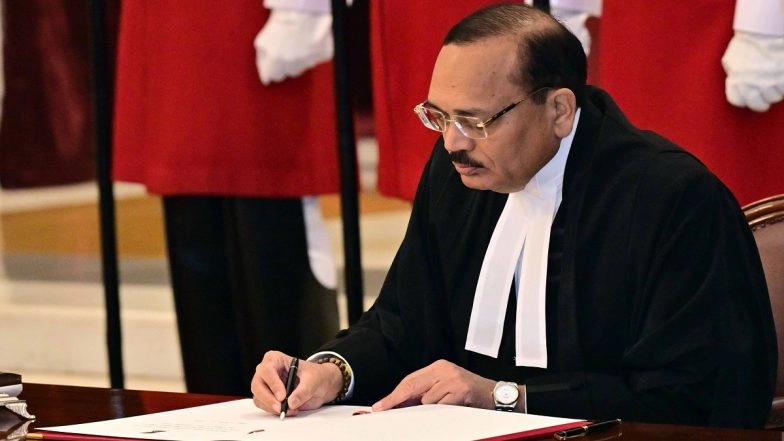
What began as an offhand judicial observation inside the Supreme Court of India in mid-May 2026 rapidly transformed into one of the country's most unexpected youth-led political movements. The creation of the satirical Cockroach Janta Party CJP) directly traces back to remarks made by Chief Justice of India (CJI) Surya Kant, which triggered widespread public debate, intense social media backlash, and weeks of physical demonstrations.
The episode underscores the volatile intersection of judicial commentary, digital activism, and deep-seated economic anxieties regarding youth unemployment and competitive examination irregularities in India. Cockroach Janta Party Withdraws Jantar Mantar Protest After Government Accepts Demands (Watch Video).
The May 15 Hearing and CJI Surya Kant's Controversial Remarks
The controversy erupted on May 15, while a Supreme Court bench presided over by CJI Surya Kant was hearing a legal matter. During the proceedings, the bench expressed frustration regarding repetitive or frivolous litigation challenging professional designations. In oral observations that quickly escaped the courtroom confines, the CJI remarked that certain frustrated young individuals who fail to secure stable employment often turn into media, social media, or Right to Information (RTI) activists to attack public systems, comparing them metaphorically to "cockroaches" and "parasites of society".
The choice of terminology immediately drew sharp criticism. Transcripts and reporting of the comments circulated widely across digital platforms, outraging student bodies, job aspirants, and young professionals who felt targeted by the highest judicial authority.
The Birth of the 'Cockroach Janta Party'
Within 78 hours of the courtroom exchange, the online backlash coalesced into an organised digital entity. Initiated as a satirical response by young online commentators - notably led by political communications graduate Abhijeet Dipke - the "Cockroach Janta Party" was launched on social media. Adopting the tongue-in-cheek tagline "Voice of the Lazy & Unemployed", the digital platform capitalised on the judicial slur to reclaim the narrative. The movement drafted an open manifesto, utilised AI-generated imagery featuring a cockroach on a mobile screen, and amassed millions of followers within days. What started as a viral meme page rapidly morphed into an online rallying point for broader systemic grievances, particularly chronic unemployment and repeated paper leaks plaguing national recruitment and entrance tests like NEET-UG. Will There Be Nationwide Protest by CJP on 26th July or It Is Cancelled After Dharmendra Pradhan's Resignation?
Subsequent Clarifications and Institutional Fallout
As public outcry intensified, the Supreme Court administration and legal circles sought to address the fallout. CJI Surya Kant issued a clarification emphasising that his oral observations had been misinterpreted by sections of the media. The clarification stated that the critique was strictly directed at individuals who infiltrate professional spaces- such as the legal bar, media, and activist networks - using fake or fraudulent degrees, rather than the nation's youth at large. The CJI expressed pride in India's human resource potential, noting that his remarks did not target bona fide job seekers or students.
Despite the official clarification, the cultural and political impact of the episode proved irreversible. The CJP successfully transitioned its digital momentum into physical ground protests, staging sit-ins at prominent locations like New Delhi's Jantar Mantar. The movement cemented itself as a defining symbol of youth frustration, proving how a single courtroom metaphor can inadvertently catalyse a nationwide socio-political mobilisation.
(The above story first appeared on LatestLY on Jul 25, 2026 06:37 PM IST. For more news and updates on politics, world, sports, entertainment and lifestyle, log on to our website latestly.com).