Why Pune Residents Are Taking to Streets To Demand Ban on DJs During Ganeshotsav 2026
Ahead of Ganeshotsav, Pune citizens are demanding a complete ban on high-decibel DJs and loudspeakers during festival processions, citing noise pollution, health concerns, obscene songs and traffic disruption. Protesters said their campaign is not against any religion or festival, but against excessive noise and commercialisation, and called for a 'DJ-free'Ganeshotsav.

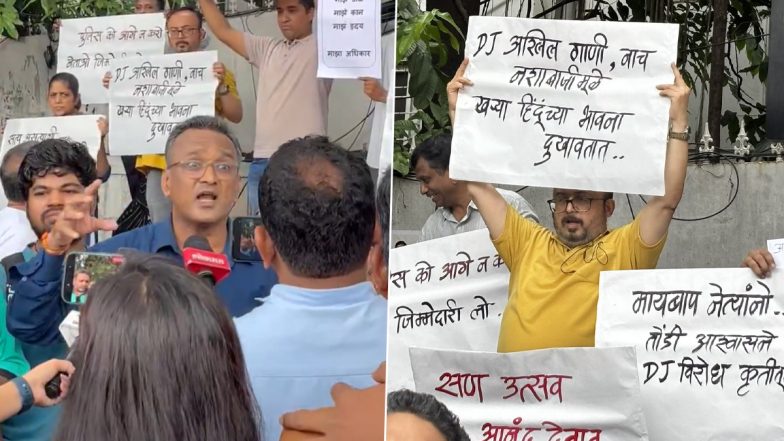
With the Ganeshotsav season approaching, Pune residents have taken to the streets demanding a complete ban on high-decibel DJs and loudspeakers during festival processions, saying excessive noise has become a serious public health and civic issue. Citizens marched from Abhinav Chowk to the historic Shaniwar Wada and staged demonstrations at Goodluck Chowk, raising slogans such as "Abki Baar, Loudspeaker Hadhpaar" (this time, loudspeakers must go).
The protesters stressed that their campaign was not against any particular religion or festival, but against excessive noise, obscene songs and the commercialisation of public celebrations, Mid Day reported. They demanded strict enforcement of the Supreme Court and High Court norms governing noise pollution and said this year's Ganeshotsav should be made "DJ-free." Why Tata Power Asks Mumbai Ganesh Mandals To Apply Early for Ganeshotsav 2026 Electricity Connections.
Punekars Demand Ban on DJs During Ganeshotsav
Resdients of Pune 4 cane together at Good luck Chowk to voice their protest against DJs, loudspeakers, movie songs, laser lights which the Mandals are planning to use during Ganesh Utsav. pic.twitter.com/XACgcShFrZ
— Konknastha Bharatiya (Modi Ka Parivar) (@BharatFirst3112) August 30, 2026
Why Pune Citizens Want DJs Banned
Residents said high-decibel sound systems used during immersion processions and other festivals cause considerable distress to senior citizens, children, women, patients and people living near procession routes.
They claimed that prolonged exposure to loud sound can aggravate health problems, including blood pressure and hearing-related issues. BMC Denies Mandatory Fitness Certificate for Large Ganesh Idols Ahead of Ganeshotsav 2026.
Several protesters also shared personal experiences of the impact of loudspeakers. One participant recalled that his grandfather had died in 1990 after, he claimed, being subjected to excessive loudspeaker noise. He said that despite decades having passed, the situation had not changed substantially.
Residents Cite Long Hours Of Noise
Residents said the noise often begins around 7.30-8 pm on the eve of immersion processions and continues for two to three days.
People living along procession routes complain of severe headaches and being unable to stay inside their homes. Some families, protesters said, are forced to leave the city during the festival period to escape the noise.
The protesters also highlighted the impact of excessive noise on animals and birds and called for a more environmentally responsible celebration of Ganeshotsav.
Obscene Songs And Commercialisation
Pune has witnessed growing criticism over what citizens described as the "distortion" of traditional celebrations.
Protesters particularly objected to obscene songs and vulgar dance performances during processions, saying that many families and younger people now avoid participating in immersion processions because of the atmosphere.
RSS worker Rajesh Mandire, who participated in the campaign, said opposing DJs should not be equated with being "anti-Hindu" or "anti-religion". He said Hindu traditions place greater emphasis on devotional practices such as reciting the Ramraksha, Hanuman Chalisa, and Ganpati Atharvashirsha rather than creating excessive noise.
Citizens said traditional instruments such as dhol-tasha and lezim could be permitted subject to reasonable noise limits, but demanded a complete ban on DJs playing obscene or excessively loud music.
Protesters Raise Enforcement Concerns
The protesters also raised allegations of political interference in the enforcement of noise regulations.
They referred to an incident involving Vidyanand Bapat, who had spoken against DJs and excessive noise in the municipal corporation. According to protesters, political workers subsequently confronted and allegedly attacked him, following which police removed him from the premises.
They also alleged that attempts were made on social media to portray him as anti-Hindu.
The incident, protesters said, has strengthened the perception among citizens that political interests are influencing enforcement against noise pollution.
They criticised political representatives and the mayor for allegedly siding with festival organisers and their workers instead of taking a broader view of public health and the interests of all Pune residents.
Questions Over Political And Business Interests
Young protesters further alleged that political interests are linked to the DJ and loudspeaker business, resulting in noise-control restrictions remaining largely ineffective.
They also questioned the administration's enforcement capacity, claiming that only around five decibel meters are available for the entire Pune area and that even officials are not always clear about their deployment.
The protesters demanded that existing noise regulations be enforced consistently during the festival rather than only during isolated inspections.
Citizens Seek Fewer Ganesh Mandals
Citizens also linked the noise issue to traffic congestion and emergency movement during Ganeshotsav.
They demanded a reduction in the number of Ganesh mandals, arguing that the proliferation of small installations creates additional congestion and makes it difficult for ambulances and emergency vehicles to move through the city.
Some senior residents suggested adopting the "one peth, one Ganpati" or "one village, one Ganpati" model, with community celebrations held at larger open grounds rather than having separate installations at extremely short distances.
Demand To Restrict Private Sound Systems
Protesters also demanded that authorities stop allowing private mandals to install high-powered sound systems under different names such as DJ, plasma, pressure mid.
They said police should use public announcement systems only where necessary for crowd management and should not permit private sound systems that contribute to excessive noise.
Their demands therefore extend beyond a ban on DJs to stricter regulation of the wider use of amplified sound during public celebrations.
Campaign To Continue Ahead Of Ganeshotsav
The protesters warned that the campaign would continue until authorities register stringent cases against those violating noise regulations and ensure sustained enforcement.
"The fight will not stop until the destructive business of noise pollution operating under political and administrative protection is brought to an end," protesters said, calling for intensified public mobilisation ahead of Ganeshotsav.
The campaign comes as Pune prepares for the annual Ganeshotsav celebrations, putting the focus on how authorities balance religious and cultural festivities with noise regulations, public health, traffic management and the interests of residents living along procession routes.
(The above story first appeared on LatestLY on Aug 31, 2026 11:52 AM IST. For more news and updates on politics, world, sports, entertainment and lifestyle, log on to our website latestly.com).