Hanuman Locket Guide: The Types, Meaning and Metal Choices to Know Before Sawan 2026
A guide to the Hanuman locket ahead of Sawan 2026 — Chalisa, gada, panchmukhi and yantra designs, silver vs gold vs steel, and when to start wearing one.

Sawan begins on 30 July this year in North India and runs to 28 August, with the four Somvars falling on 3, 10, 17 and 24 August. In the South and West, the month follows the Amanta calendar and opens on 13 August. It is Shiva's month — and for a growing number of devotees, that is precisely why it has become the season to begin wearing a Hanuman locket.
The logic is not a stretch. In the Shiva Purana tradition, Hanuman is revered as Rudravatar — the eleventh Rudra, an incarnation of Shiva himself, born to serve Rama. Sawan intensifies Shiva worship, and by extension the worship of his avatar. Add the fact that Tuesdays and Saturdays already belong to Hanuman in the weekly cycle, and the month offers an unusually dense run of auspicious starting points.
But the revival has less to do with the panchang than with who is wearing these pendants now. Walk through a gym in Gurugram or a co-working floor in Bengaluru and you will spot them: matte steel discs and small gada pendants sitting under collars, worn by men in their twenties and thirties who would not describe themselves as especially religious. Devotional jewellery in India has quietly shed its association with age. What follows is a practical guide to the category — what the designs mean, which metal actually survives Indian weather, and how to choose without overspending.
What a Hanuman Locket Signifies
Hanuman occupies a specific emotional register in Hindu devotion. He is not primarily a deity of wealth or learning. He is the deity of courage, loyalty, physical strength and the dissolution of fear — which is why the Hanuman Chalisa is the verse Indians reach for on turbulent flights and in hospital corridors.
Tulsidas built that promise directly into the text. The line bhoot pisach nikat nahi aave, mahavir jab naam sunave — ghosts and malign spirits keep their distance where Hanuman's name is spoken — is the single most quoted assurance in the Chalisa, and it is the idea a Hanuman locket makes portable. Devotees wear one for protection while travelling, steadiness during a difficult stretch, focus in studies or training, and relief from anxiety.
It is worth being clear-eyed here: these are matters of faith and tradition, not claims with evidence behind them. What a locket reliably does is act as a physical cue — a small, repeated reminder of an intention. For most wearers, that is the whole point.
The Main Types of Hanuman Locket
Most designs on the market fall into five families. Any reasonably stocked Hanuman locket collection will carry some version of each.
The Hanuman Chalisa Locket
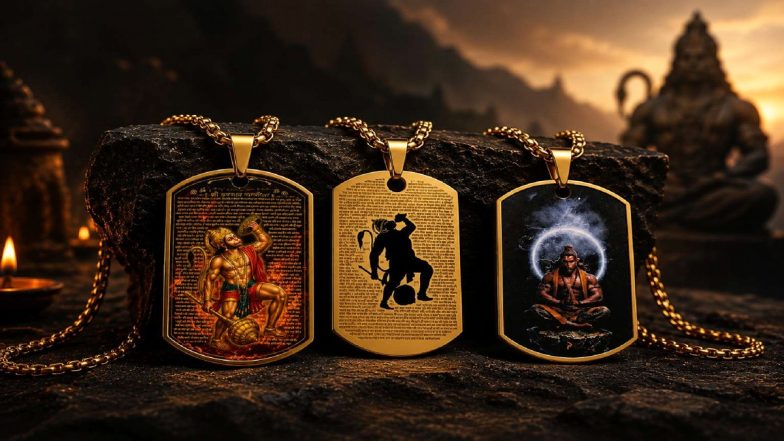
The most popular design in India today, and the one that has driven the category's growth. All forty verses of the Chalisa are compressed into micro-text and engraved onto a single small surface — usually a disc or hexagon, sometimes a bar. The appeal is obvious: you carry the complete text rather than a symbol of it.
Engraving quality is where these pieces separate. Cheap versions use shallow printing that wears off the raised surfaces within months of daily contact with skin and fabric. Laser-engraved steel cuts into the metal itself, so the text survives. If you are buying online, ask for a macro photograph of the text and check whether individual characters are legible or have collapsed into grey noise. A well-made Hanuman Chalisa locket should let you read the verses under a phone camera's zoom.
The Hanuman Gada Locket
The gada is Hanuman's mace and the most direct symbol of strength in the iconography. It has become the favourite among gym-goers — a small, heavy, unmistakably masculine pendant that carries meaning without announcing devotion the way a figurative murti does. Look for three-dimensional relief rather than a flat silhouette; the depth is what makes it read as a gada rather than a club-shaped tag.
The Panchmukhi Hanuman Locket
The five-faced form — Hanuman, Narasimha, Garuda, Varaha and Hayagriva — is traditionally associated with protection from all five directions, each face said to counter a different category of fear. It is the form recommended most often by priests to those seeking comprehensive protection, and it is the most visually detailed of the five, which makes execution matter. Detail this fine is difficult to render at pendant scale, and poorly cast panchmukhi pieces lose the distinction between faces entirely.
The Hanuman Yantra Locket
Yantra designs use geometric and syllabic inscription rather than figurative imagery. They appeal to wearers who want something abstract — a piece that does not read as overtly religious at a glance. Smaller category, but a steady one.
The Simple Murti or Face Pendant
The classic: Hanuman's profile or seated figure in relief. This is what most Indian families have bought for generations, usually in gold, usually for a child.
Silver, gold or steel: the choice that actually matters
More people search for silver and gold Hanuman lockets than for any single design type — which tells you the metal decision comes first for most buyers. Each has a real case.
Silver carries the strongest traditional weight. It is the metal most associated with devotional jewellery in Indian households, it is affordable, and 92.5 sterling holds detail well. The trade-off is tarnish. Silver oxidises in humidity, and Indian monsoon humidity is unforgiving — expect to polish a silver Hanuman locket regularly, and expect the engraved recesses to darken first. Some wearers like that patina. Many do not.
Gold is the heirloom choice, and for a piece meant to be handed down there is no substitute. But gold at pendant weight is expensive, and — a point rarely made in shops — 22k gold is soft. Fine engraving on soft gold rounds over with years of daily wear. Gold-plated alternatives solve the cost problem and introduce a worse one: the plating wears through at exactly the high-contact points, and a Hanuman locket showing base metal through Hanuman's face is not a good outcome.
316L stainless steel is the newer entrant and the reason the category has opened up to younger buyers. It is the surgical-grade alloy used in medical implants: it does not rust, does not tarnish, does not react with sweat, and is hypoallergenic. For a piece intended to stay on through bathing, gym sessions and monsoon, it is the only one of the three that genuinely does not require maintenance. It also holds laser engraving harder and sharper than silver or gold, which is why nearly every Chalisa micro-engraving design is executed in steel.
The honest summary: buy gold if it is meant to be inherited, silver if tradition matters more than upkeep, and steel if you intend to never take it off.
When to Start Wearing One
Tuesday and Saturday are the traditional days to begin — Tuesday most commonly. During Sawan, the Somvars (3, 10, 17 and 24 August in North India) carry additional weight for anything connected to Shiva, and Sawan Shivratri falls on 11 August. Many devotees wash the locket in clean water or milk, offer it briefly at a Hanuman temple or home shrine, and wear it from that morning.
There is no scriptural restriction on who may wear a Hanuman locket. Age, gender and background are not barriers, and the common belief that only celibate men may wear one has no textual basis.
Care, Chain and Everyday Rules
⦁ Match the chain metal to the pendant. A steel pendant on a plated chain will outlive the chain, and the mismatch shows within a season.
⦁ Length matters more than people expect. 20–22 inches sits at the sternum and stays under a collar; 24 inches sits lower and reads as jewellery rather than devotion. Choose deliberately.
⦁ Skip the ultrasonic cleaner on any engraved piece. A soft cloth after a heavy sweat session is sufficient for steel; silver needs an anti-tarnish cloth and an airtight pouch when not worn.
⦁ Perfume goes on before the locket, not after. Alcohol accelerates tarnish on silver and eats plating.
What to Expect on Price
The market splits cleanly. Steel and plated pieces from direct-to-consumer brands sit roughly between ₹1,500 and ₹3,000, which is where most of the Chalisa and gada designs live — brands such as Etchcraft Emporium operate in this band, with cash on delivery and returns that make first-time online buying low-risk. Sterling silver from established jewellers runs ₹2,000 to ₹6,000 depending on weight. Gold is priced by the gram against the day's rate plus making charges, and a meaningful Hanuman pendant rarely comes in under ₹25,000.
Whatever the budget, the two questions worth asking any seller are the same: what exactly is the metal, and can you show me the engraving at macro zoom. Vague answers to either are the reliable signal to walk.
Frequently Asked Questions
Which Hanuman locket is best to wear? It depends on intent. For daily protection, the Hanuman Chalisa locket carrying all forty verses is the most popular choice. For strength and confidence, devotees prefer the gada. For protection from all directions, the panchmukhi form is considered most powerful.
Can I wear a Hanuman locket while bathing or sleeping? In 316L stainless steel, yes — it is waterproof, sweat-proof and hypoallergenic. Silver and gold-plated pieces are better removed before bathing.
Which day should I start wearing a Hanuman ji locket? Tuesday is the most common choice, with Saturday a close second. During Sawan, Mondays carry extra significance.
Is there a rule about who can wear one? No. There is no restriction of age, gender or background in the tradition.
What is written on a Hanuman Chalisa locket? The complete Hanuman Chalisa — all forty verses composed by Tulsidas — engraved in micro-text.
(All articles published here are Syndicated/Partnered/Sponsored feed, LatestLY Staff may not have modified or edited the content body. The views and facts appearing in the articles do not reflect the opinions of LatestLY, also LatestLY does not assume any responsibility or liability for the same.)