Why Are India Starting At 5/0 Against Afghanistan In Their Chase of 219 in IND vs AFG 3rd ODI 2026?
In a rare and highly unusual start to a cricket innings, India began their run chase against Afghanistan at 5/0 before openers Rohit Sharma and Yashasvi Jaiswal had even faced a single delivery.

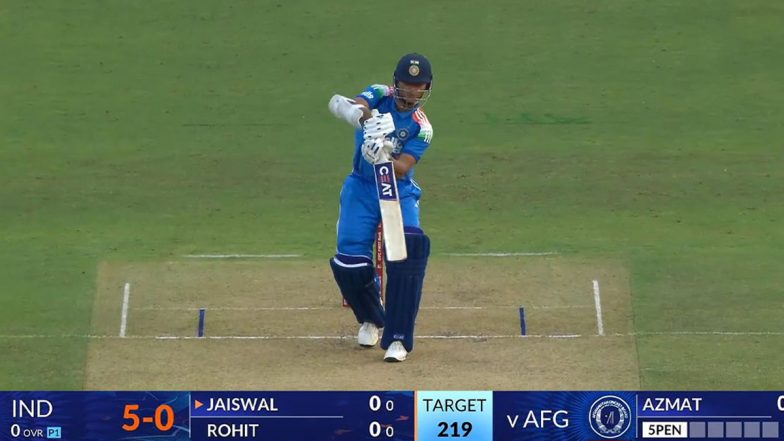
In a rare and highly unusual start to a cricket innings, India began their run chase against Afghanistan at 5/0 before openers Rohit Sharma and Yashasvi Jaiswal had even faced a single delivery. The five-run head start was awarded to the hosts during the third and final One Day International (ODI) at the M.A. Chidambaram Stadium on Saturday, following a disciplinary penalty levied against Afghanistan captain Hashmatullah Shahidi. You can find India National Cricket Team vs Afghanistan National Cricket Team Match Scorecard here.
Why Are India Starting At 5/0?
The incident occurred during the latter stage of the first innings, specifically on the final delivery of the 40th over. Shahidi, who was anchoring his team's recovery from a severe batting collapse, ran straight through the restricted central zone, commonly known as the 'danger area' , after completing a single.
Under the laws of cricket established by the International Cricket Council (ICC), players are strictly prohibited from treading on the middle of the pitch to prevent spikes from damaging the surface, which could unevenly assist bowlers. On-field umpires Chris Gaffaney and Rohan Pandit had already issued two formal warnings to the Afghanistan skipper earlier in the innings. Because Shahidi breached the zone for a third time, the umpires immediately disallowed the run taken and penalised the tourists five runs. Hashmatullah Shahidi Scores Maiden One-Day International Century, Achieves Feat During IND vs AFG 3rd ODI 2026.
What is Five Penalty Runs Rule?
In cricket, the Five Penalty Runs Rule serves as a standardized disciplinary sanction used by umpires to punish illegal fielding, player misconduct, or unfair play. Governed by the Marylebone Cricket Club (MCC) Laws of Cricket, when an infraction occurs, the non-offending team is automatically credited with 5 extra runs added directly to their total score.
Depending on the nature of the rule breach, some offences carry an instant penalty, while others trigger a punishment only after a formal warning has been issued.
1. Instant Penalty Offences (No Warning Given)
For these major structural or illegal fielding violations, umpires award 5 penalty runs to the non-offending side immediately:
Ball Hitting a Discarded Helmet (Law 28.3): If a fielding team places a protective helmet on the ground behind the wicketkeeper and a live ball strikes it during play, the ball becomes dead instantly, and the batting side is awarded 5 penalty runs.
Illegal Fielding (Law 28.2): A fielder cannot deliberately use clothing, a cap, or any equipment outside of their physical body to stop or field the ball.
Unauthorised Entry: If a player enters or returns to the field without the umpire's explicit permission and comes into contact with the live ball, play is halted, and 5 penalty runs are given to the batting team.
Deliberate Distraction or Deception (Law 41.5): This covers "fake fielding" or verbal antics where a fielder intentionally tries to deceive or distract a batter after they have received the delivery.
2. Delayed Penalty Offences (After One Official Warning)
For minor or behavioral issues, the umpire will issue a first and final warning to the team captain (or individual player). If any player on that team repeats the offence during the match, 5 penalty runs are awarded to the opposition:
Damaging the Pitch / Protected Area (Law 41.14 & 41.15): Bowlers and batters are strictly prohibited from stepping or running on the central 5-foot by 2-foot "danger area" of the pitch to prevent damage from shoe spikes. Following an initial team warning, a repeat offence results in 5 penalty runs to the opposition (and any runs scored on that specific delivery by the batting side are disallowed).
Wasting Time (Law 41.9 & 41.10): Deliberate time-wasting by either the batters or the fielding side to exploit match conditions or manipulate the clock results in a warning, followed by a 5-run penalty on a secondary occurrence.
Unfair Ball Modification (Law 41.3): Any attempt to alter the condition of the match ball illegally (such as ball-tampering, using fingernails, or rubbing it on rough surfaces) will attract a replacement ball and 5 penalty runs. Prasidh Krishna Picks Maiden One-Day International Fifer, Achieves Feat During IND vs AFG 3rd ODI 2026.
3. Player Conduct Penalties (Law 42)
Introduced in 2017 to manage player behavior on the field, the rule applies a strict system for code-of-conduct violations:
Level 1 Offences: Minor dissent, aggressive gestures, or excessive appealing receive a first and final warning. A second Level 1 infraction by the same team grants the opposition 5 penalty runs.
Level 2 Offences: Serious dissent towards an umpire, throwing a ball at a player dangerously, or deliberate physical contact results in an immediate 5 penalty runs awarded to the non-offending team without warning.
(The above story first appeared on LatestLY on Jun 20, 2026 05:58 PM IST. For more news and updates on politics, world, sports, entertainment and lifestyle, log on to our website latestly.com).