What Is a Black Hole Star? Astronomers Discover New Cosmic Object Using NASA's James Webb Space Telescope
Researchers at MIT using the James Webb Space Telescope have discovered 'MoM-BH*-1', a rare 'black hole star' in the early universe. The object combines a central black hole with a gas envelope the size of our solar system, emitting 100 billion times the energy of a normal star. 'Our picture of this object is evolving very rapidly,' said lead author Rohan Naidu.

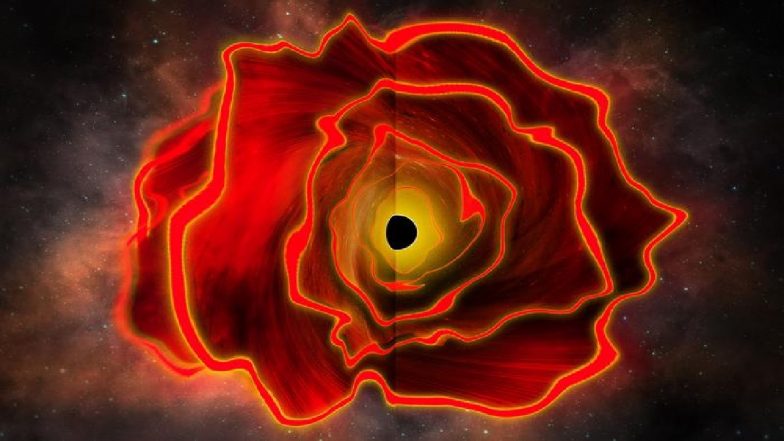
Astronomers at the Massachusetts Institute of Technology and collaborating institutions have identified an entirely new type of astrophysical object in the early universe. Detected using NASA’s James Webb Space Telescope (JWST), the object resembles an enormous star spanning the size of our solar system, yet it emits 100 billion times more energy than any known star can physically produce, pointing instead to power levels typically generated by a black hole. Published in the journal Nature, the findings present a hybrid cosmic body that researchers have designated as a "black hole star".
What Is a Black Hole Star?
A "black hole star" is a newly theorised astrophysical mashup that combines a central black hole with an extensive, star-like envelope of gas, reports EurekAlert. Rather than operating on standard nuclear fusion - the energy source powering typical stars - this object is fueled by a central black hole surrounded by a dense cocoon of hydrogen. Total Solar Eclipse 2026: Stunning Photos and Videos of Surya Grahan From Iceland and Spain.
Astronomers Discover 'Black Hole Star' in Early Universe Using JWST
Astronomers discover a brand-new type of astrophysical object: A black hole star
Astronomers at MIT and elsewhere have spotted an extremely bright red spot in the early universe. The object resembles an enormous star, spanning the size of our solar system. But it also is putting… pic.twitter.com/SRYeNBfaCA
— Ryan sikorski (@Ryansikorski10) August 12, 2026
“Our picture of this object is evolving very rapidly,” says lead author Rohan Naidu, a NASA Hubble Fellow and Pappalardo Fellow at MIT’s Kavli Institute for Astrophysics and Space Research (MKI). “We think there is a central black hole that is 100,000 times as massive as the sun. And around this black hole, there would be this very extended envelope of gas that looks like a star the size of the solar system. It’s huge," he added.
Detecting the Anomaly Through 'Mirage or Miracle'
The discovery emerged from a survey named “Mirage or Miracle” (MoM), through which researchers aimed to locate the earliest and most distant galaxies just a few hundred million years after the Big Bang. Instead of standard early galaxies, the team flagged a feature that stood out for its distinct red colour and exceptional brightness. When analysing the light signatures, the team noted an unusually deep “Balmer break,” where light completely disappears below certain wavelengths. Furthermore, the spectrum contained almost no metals, showing only hydrogen and helium. These anomalies ruled out ordinary stars. Through advanced simulations, the researchers determined that an extremely dense screen of hydrogen could produce the required light-blocking patterns without dust, while an active black hole accounted for the extreme energy output. Will Earth’s Gravity Disappear for 7 Seconds on August 12? NASA Says Viral Claim Is False.
Solving the Mystery of 'Little Red Dots'
The research team has named the object MoM-BH*-1. The researchers suspect that black hole stars could demystify the mysterious "little red dots" appearing in nearly every deep space image captured by JWST. "These little red dots seem to be everywhere in the early universe but essentially disappear by the present day," Naidu says. "What exactly these objects are has been one of the most debated topics of the JWST era," he added. While other red dots found in JWST surveys share similar properties, MoM-BH*-1 stands out because its energy output completely outshines its surrounding host galaxy. The study was supported by the MIT Department of Physics, NASA, and the Space Telescope Science Institute.
(The above story first appeared on LatestLY on Aug 13, 2026 02:14 PM IST. For more news and updates on politics, world, sports, entertainment and lifestyle, log on to our website latestly.com).