Nepal Seeks Climate Compensation From India, China and US After Deadly Floods
Nepal has formally demanded climate compensation from the world’s top greenhouse gas emitters—specifically naming China, the United States, and India—following devastating flash floods that have killed more than 1,000 people and left thousands missing across the country

- Read in
- हिंदी
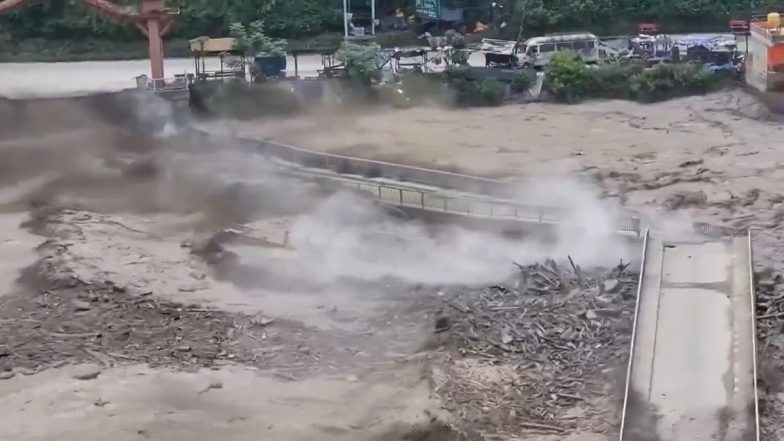
Nepal has launched a diplomatic push for climate-related compensation from major greenhouse-gas emitters including India, China and the United States following devastating flash floods that have killed more than 1,100 people and left thousands missing. Nepal's Foreign Minister Shishir Khanal has described the demand as a question of legal and moral responsibility rather than charity, arguing that the Himalayan nation contributes very little to global emissions but is facing severe climate-related risks, according to a report.
The demand comes after the August 26 flash floods in the Bhotekoshi river basin caused widespread destruction in Nepal's Rasuwa, Nuwakot and Dhading districts. Homes, roads, bridges and hydropower infrastructure were damaged, while thousands of people were displaced. Nepal Floods: 500 Workers Feared Trapped in Tunnels as Death Toll Surpasses 950.
Nepal Shifts From Aid To ‘Climate Justice’
Khanal said Kathmandu was changing its diplomatic approach from seeking conventional aid to pursuing what it calls climate justice and compensation.
“This is not a matter of charity; it is a matter of legal and moral liability,” Khanal said in an interview with Kantipur TV, excerpts of which were cited by The Kathmandu Post and reported by the two publications. Tragedy in Nepal: How Do Flash Floods Happen?.
Nepal argues that its greenhouse-gas emissions are “virtually negligible” compared with those of major economies, yet it is highly exposed to glacier melt, unstable mountain slopes and extreme weather events.
Khanal has identified China, the US and India as the world's three largest current greenhouse-gas emitters and said they have a responsibility towards vulnerable countries facing the consequences of climate change.
Death Toll Crosses 1,100
According to figures cited by India Today, at least 1,127 people have died and around 3,900 remain missing following the floods. The disaster has affected several districts in Nepal's Bagmati province and also caused major disruption to infrastructure and livelihoods.
The disaster followed what authorities and experts believe was a massive rock-and-ice avalanche near the Nepal-China border. However, scientists have cautioned that more detailed research is required to determine the precise trigger and establish the extent to which human-induced climate change contributed to this particular event.
Nepal Seeks Help From Loss And Damage Fund
Alongside its diplomatic demand, Nepal has formally approached the Fund for Responding to Loss and Damage, seeking urgent financial assistance. The request was jointly signed by Finance Minister Swarnim Wagle and Forests and Agriculture Minister Geeta Chaudhary. Nepal said the disaster had caused extensive economic and non-economic losses beyond the country's immediate response capacity.
The fund was agreed upon at the COP27 climate summit in 2022 and operationalised at COP28. It is intended to support developing countries that are particularly vulnerable to climate-related loss and damage.
Nepal is seeking assistance not only for immediate relief but also for reconstruction, resettlement and specialised requirements, including rescue teams, forensic expertise and temporary bridges.
Reconstruction Could Cost Billions
The scale of the destruction is expected to put significant pressure on Nepal's economy.
Finance Minister Swarnim Wagle has estimated that rebuilding damaged infrastructure could cost between $4 billion and $5 billion, equivalent to nearly 10% of the country's economy.
The floods have also damaged hydropower infrastructure, an important part of Nepal's economy and its plans to expand electricity exports. The destruction has forced the country to reassess infrastructure risks in the Himalayan region.
India Continues To Provide Relief
Nepal's compensation demand comes even as India is providing immediate humanitarian assistance to flood-affected communities. The Times of India reported that displaced residents in Nuwakot have been receiving shelter and medical assistance at the Nepal-Bharat Maitri Bhawan, a facility rebuilt with financial support from the Indian Embassy following the 2015 earthquake. More than 100 displaced people were reportedly staying there each night.
One flood survivor also expressed gratitude for India's assistance, describing India as a neighbour and friend. The distinction is significant: Nepal's current demand for climate compensation is framed as a broader question of international responsibility, while relief operations involve immediate humanitarian support from neighbouring and other countries.
India’s Climate Position
Nepal's argument also enters a long-running international debate over how responsibility for climate change should be measured. India is among the world's largest greenhouse-gas emitters in absolute terms, largely because of its population and economic scale. However, its per-capita emissions remain substantially below those of the US and are also lower than China's, according to figures cited by India Today.
India has traditionally argued that climate obligations should take into account historical emissions, per-capita emissions, development requirements and the greater contribution of countries that industrialised earlier.
That makes Nepal's call for compensation a complex diplomatic issue rather than a straightforward claim against individual countries.
Balen Shah May Raise Issue At UN
Nepal is also considering taking the issue to the United Nations General Assembly.
Prime Minister Balendra “Balen” Shah may travel to New York to attend the 81st UNGA and personally highlight the flood disaster and Nepal's demand for climate justice and compensation. Foreign Minister Khanal had initially been expected to represent Nepal at the gathering.
The UNGA general debate is scheduled to begin on September 8, with the main general debate taking place later in September.
A Wider Himalayan Climate Concern
Nepal's compensation campaign comes amid growing concern over climate-related risks across the Hindu Kush Himalayas. Rising temperatures, glacier loss and changes in mountain ecosystems are increasing concerns about floods, landslides and other hazards.
Khanal has stressed that the issue extends beyond Nepal because Himalayan glaciers feed river systems on which billions of people across South Asia depend.
Experts, however, caution against attributing any single extreme event solely to climate change without detailed scientific analysis. The latest disaster is believed to have involved a combination of geological and high-altitude factors, with the precise relationship to climate change still requiring further study.
For Nepal, the immediate focus remains rescue, relief and rebuilding. At the diplomatic level, however, Kathmandu is seeking to turn the disaster into a wider discussion about who should pay for climate-related losses faced by countries that contribute relatively little to global emissions.
(The above story first appeared on LatestLY on Sep 02, 2026 06:20 PM IST. For more news and updates on politics, world, sports, entertainment and lifestyle, log on to our website latestly.com).