
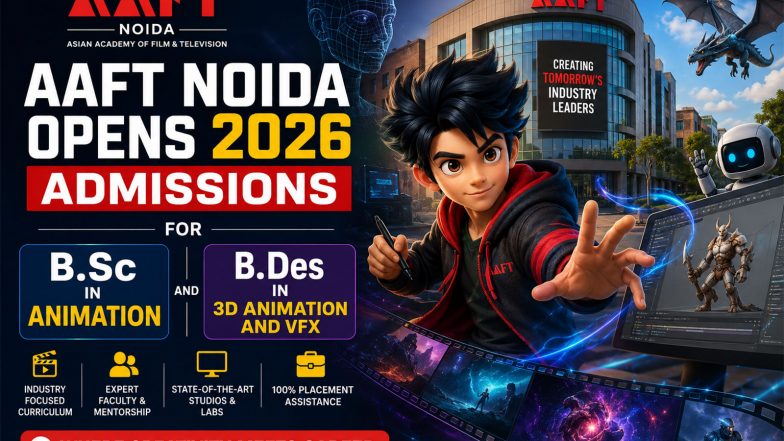
Business News | AAFT Noida Opens 2026 Admissions for B.Sc in Animation and B.Des in 3D Animation and VFX
Get latest articles and stories on Business at LatestLY. Noida (Uttar Pradesh) [India], July 25: If you are looking for the best animation course in Delhi NCR, 2026 is a good time to make that decision. India's animation and VFX industry is growing faster than at any point in its history. Films, OTT series, advertising campaigns, gaming studios, and digital content platforms are all producing more visual content than ever before, and the demand for trained animators and VFX artists is rising sharply across all of them.

VMPL
Noida (Uttar Pradesh) [India], July 25: If you are looking for the best animation course in Delhi NCR, 2026 is a good time to make that decision. India's animation and VFX industry is growing faster than at any point in its history. Films, OTT series, advertising campaigns, gaming studios, and digital content platforms are all producing more visual content than ever before, and the demand for trained animators and VFX artists is rising sharply across all of them.
AAFT Noida has announced that 2026 admissions are now open for two of its most sought-after programmes: the B.Sc in Animation, a three-year degree, and the B.Des in 3D Animation and VFX, a four-year degree in Noida Film City. Both are offered at its campus inside Marwah Studios, Noida Film City.
For students looking for a 3D animation course after 12th, or an animation and VFX course that goes beyond basic software training, both programmes are built around hands-on production work inside four dedicated in-house studios, using industry-standard tools alongside AI-assisted creative workflows. Seats for the 2026 batch are limited and admissions are now open.
Also Read | Rahul Gandhi Reacts to Dharmendra Pradhan's Resignation, Says 'Let's Get Rid of This Regime' (Video).
B.Sc in Animation or B.Des in 3D Animation and VFX: Which One Fits You
AAFT Noida offers two undergraduate degrees in animation. Choosing between them comes down to time against depth, and the difference is more specific than it first appears.
The B.Sc in Animation is a three-year degree, built for students who want a broad foundation across the full range of animation and VFX disciplines. It covers:
- 2D and 3D animation
- Character design
- Visual storytelling
- Motion graphics
- Simulation and compositing
- Virtual production
Students train on industry-standard software throughout, including Autodesk Maya, Blender, Unreal Engine, ZBrush, Nuke, Adobe Creative Cloud, and 3ds Max. The degree closes with a specialisation semester and a full industry internship, so graduates leave with a showreel they can take directly to studios, production houses, and content companies.
The B.Des in 3D Animation and VFX is a four-year degree, built for students who want to combine design thinking with technical production skills. For anyone researching a VFX course in India that is both creative and technically rigorous, this programme goes in depth into 3D modelling, rigging, lighting, compositing, rendering, and visual effects, with a sustained emphasis on crafting visual stories and building immersive worlds.
The first two years of both degrees are identical. The fourth year is not padding spread across the programme. The B.Des adds two complete semesters the B.Sc does not have, and they are dedicated to real-time production: Unreal Engine 5 workflows, building virtual worlds, procedural content creation, look development, virtual cinematography, Niagara real-time effects, camera tracking and matchmove, live-action and CG integration, and a dedicated subject on the role of AI in animation and VFX.
Students on the B.Des train on Unreal Engine, Unity, Blender, Autodesk Maya, and 3ds Max, and graduate with skills directly applicable to film, OTT, advertising, virtual production, and game development roles.
The practical question is one of time against depth. Three years gets a capable animator into the industry a year earlier. Four years produces a designer with real-time and virtual production skills on top of the same foundation. For students comparing animation colleges in Delhi NCR, neither is the better degree in the abstract. The right answer depends on whether the priority is entering the industry sooner or arriving with a wider technical range.
Both programmes are housed within AAFT Noida's School of Animation, with dedicated in-house production studios and faculty who have worked across the film, OTT, and gaming industries professionally.
Is Animation and VFX a Good Career Choice in 2026?
India's animation industry is no longer just about children's cartoons. Indian VFX studios are already working on Hollywood productions. OTT platforms are commissioning animated series with production values that match international content. Gaming studios are hiring 3D artists and VFX professionals in large numbers. Advertising agencies are using animation and motion graphics across every category of brand campaign, from television commercials to Instagram reels. The scope is broad, and it is still expanding.
Students who complete a 3D animation and VFX course today are not entering a niche creative field. They are entering one of the highest-demand technical and creative professions in India's media and entertainment economy. The highest package reported from AAFT Noida's animation programmes is 14 LPA.
What Does the B.Sc in Animation Course Cover?
The curriculum is structured to build students from the ground up, with each year preparing them for a more specific role in the industry by the time they graduate.
First Year: Building the Foundation
Semester 1 covers Visual Communication, Creative Foundation, Graphic Design, Script and Storyboard, and 2D Animation. Students begin with visual storytelling, colour and layout, then move into typography and composition, narrative structure, and the fundamentals of frame-by-frame character animation.
Semester 2 moves into production: Digital Filmmaking, Audio and Video Editing, Motion Graphics Design, VFX and Compositing, and Web Media Design. By the end of the first year students have handled a camera, cut footage, built kinetic typography, worked with green screen and digital compositing, and designed animated content for digital platforms.
Students begin working in the studio labs from the first semester itself, so they are comfortable with the tools and the production environment well before the advanced work begins.
Second Year: Advancing Technical Skills
Semester 3 is where the 3D pipeline starts: Pre-visualization, Modeling and Texturing, Rigging and Animation, Lighting and Rendering, and Simulation and Effects. Students plan scenes through storyboards and animatics, build 3D models and realistic textures, create skeletal rigs, work with lighting to set mood, and produce dynamic effects like fire, water and particles.
Semester 4 advances all of it: Environment Modeling and Texturing, Surface and Look Development, Character Design, Character Rigging and Animation, and FX and Dynamics, covering explosions, fluid dynamics and complex simulations. Alongside the technical subjects, students take the CARE Online Program for career readiness and EDGE / Professional Practice, which introduces real industry workflows, teamwork and deadlines.
A Summer Internship of six to eight weeks follows the Semester 4 examinations, giving students their first period of professional work before the final year begins.
Third Year: Specialisation and Industry Work
Semester 5 is the specialisation semester. Students work through Pre-Production, Prototype (CG Development), Production, and Post-Production, and then choose one of four Final Project Portfolio tracks:
- Visual Communication Design -- brand identity, UI/UX, explainer videos and visual storytelling
- 3D Animation Filmmaking -- complete 3D film production from concept to post
- 2D Animation Filmmaking -- the full 2D workflow through to a finished film
- Visual Effects Filmmaking -- VFX-led filmmaking across live-action, CG development and compositing
Semester 6 is a full industry internship or project, with a submitted report reflecting the work and its professional application. By graduation, students leave with a body of work they can show to employers, not just a certificate.
What Does the B.Des in 3D Animation and VFX Course Cover?
The B.Des in 3D Animation and VFX is a design-led programme that takes students deep into the visual and technical craft of 3D content production across four years.
Its first four semesters run the same foundation as the B.Sc, from visual communication and 2D animation through to character rigging, look development and FX and dynamics, with the same CARE and EDGE modules and the same six-to-eight-week Summer Internship after Semester 4.
Semesters 5 and 6 are where the degrees separate, and where the fourth year earns its place. Semester 5 covers Real Time 3D Production, teaching Unreal Engine 5 workflows and core real-time concepts for animation, games, virtual production and immersive experiences; Building Virtual Worlds, covering world-building, level design and asset integration; Procedural Content Creation, covering procedural modelling, terrain generation, particle systems and parameter-driven design through node-based systems and scripting; Look Development; and Virtual Cinematography, which blends traditional filmmaking technique with digital workflows.
Semester 6 moves into advanced visual effects: Visual Effects Workflow, teaching Unreal's Niagara system so artists can build real-time particle effects without programming support; Camera Tracking and Matchmove, covering 2D and 3D tracking, lens calibration and CGI integration with live-action footage; Real-Time FX for games, virtual production and immersive media; Live and CG Integration; and Role of AI in Animation and VFX.
That final subject is worth pausing on. It covers AI-driven character animation, motion capture enhancement, facial expression realism, generative design, style transfer and real-time rendering, alongside the ethics and creative balance of using these tools. It is a credited subject in the syllabus, not an add-on.
Semester 7 is the specialisation semester, running the same four Final Project Portfolio tracks as the B.Sc. Semester 8 is a full industry internship.
Career roles for B.Des graduates include 3D Animator, VFX Artist, Character Designer, Motion Graphics Designer, Compositing Artist, Look Development Artist, FX and Simulation Artist, Lighting and Rendering Artist, Pre-Visualization Artist, Environment and Asset Artist, Virtual Production Artist, and Augmented Reality Visual Artist, across film studios, OTT production houses, advertising agencies, gaming companies, and digital content studios.
Learning Animation for the AI Era
At AAFT School of Animation, students learn the core craft of animation, VFX, game design and real-time production, now built around AI-powered creative workflows. From concept art and storyboarding to 3D asset creation, cinematic video, character motion, sound, voice and Unreal Engine workflows, the curriculum is structured for how studios are actually beginning to work.
The school maps this onto a five-stage studio pipeline that students move through: Ideate, covering scripts, prompts, moodboards and concept directions; Visualize, covering storyboards, cinematic frames and pre-visualization; Create, covering characters, environments, 3D assets and textures; Animate, covering motion, voice, sound, VFX and real-time output; and Build Portfolio, covering studio-style projects and final reels.
The AI toolkit students explore is specific:
- Midjourney -- visual references, style exploration, character ideas and world-building
- Runway -- AI video generation, cinematic experimentation and VFX ideation
- Meshy AI -- AI-assisted 3D asset and environment development
- Kling AI -- image-to-video, scene motion and cinematic sequences
- Higgsfield -- AI-led video creation and character movement
- ElevenLabs -- narration, character voices, dubbing and audio storytelling
- Suno -- background scores, sound moods and music ideas
- Claude -- script ideation, story structure, character briefs and production planning
This sits alongside the traditional toolchain rather than replacing it. Students still learn Maya, Blender, Unreal Engine, ZBrush, Nuke and 3ds Max to a professional standard. The difference is that they leave knowing where the AI-assisted workflow fits into a real pipeline, which is increasingly what studios are asking new hires about.
The 100-Hour Studio Experience
The 100-Hour Studio Experience is an intensive, eight-hour-a-day, production-driven programme run in a studio-like environment on campus. Over a focused stretch of 100 hours, students work in studio-simulated spaces with live cameras, chroma setups and professional lighting to create a complete digital short film, from conceptualisation to final cut, across 2D, 3D, AI and VFX.
Students from every academic year step into a real studio workflow: developing the idea, planning the shoot, working on set, and editing the final output, all against an actual production schedule. Faculty are engaged full-time across the six production days. Participants receive a certificate on completion, and the finished film becomes a portfolio-ready project.
These are purpose-built production environments with professional-grade hardware and industry-standard software, not general-purpose computer labs. Students take on real production tasks inside them from the first semester, and AAFT Noida brings working animators, VFX supervisors and studio heads to campus for masterclasses and portfolio reviews, with 30+ industry speaker interactions built into the programmes.
For students in Delhi NCR looking for a 3D animation course in Noida with proper studio infrastructure, AAFT Noida's campus is one of the few places in the country where students can say they trained in a real production facility rather than a college lab.
Mentored by Charuvi Agrawal
The Industry Dean of AAFT School of Animation is Charuvi P. Agrawal, a filmmaker, digital artist and sculptor. She is known for the critically acclaimed Shri Hanuman Chalisa and for co-creating Legend of Hanuman on Disney+ Hotstar, work that has had a significant impact on the Indian OTT landscape. Her artistic practice spans miniatures, her signature 'claytronics', and large installations, with exhibitions at venues including the National Gallery of Modern Art in Delhi and Mumbai. Her most recent creation, Lumena, will travel across four continents.
For students on both programmes, her mentorship translates into 50+ hours of in-person learning, 10 masterclasses, portfolio review from Charuvi and her team, and access to internship and placement pathways through her industry network.
Students also learn from faculty who have worked at the level they are aiming for. Neeraj Kumar, Assistant Professor, has contributed to Avengers: Endgame, Star Wars and Captain Marvel across a nine-year VFX career. Srishty Aggarwal has spent nine years in the gaming industry across AAA titles including Elden Ring, Alan Wake II and Kingdom Hearts 3. Shubham Mittal has worked with Rockstar Games and Sumo Digital on Red Dead Redemption 2 and Grand Theft Auto 6.
In Their Own Words
Akshay Marwah, CEO, AAFT Noida, said: "India's animation and VFX industry needs trained professionals, and it needs them now. Studios are growing faster than colleges are producing qualified graduates. Both the B.Sc in Animation and the B.Des in 3D Animation and VFX are built around that reality. What has also changed is how studios actually work today. AI tools are now part of the production pipeline at every stage, from concept art to final rendering, and students who do not understand how to work alongside these tools will be at a disadvantage the moment they enter a studio. Our curriculum is built with this in mind. Students train across four dedicated in-house studios, including one focused specifically on AI-integrated film production, and the B.Des carries a credited subject on the role of AI in animation and VFX. Our students leave with real skills, real portfolios, and real connections to the industry. That is what gets them hired."
Placements and Industry Connect
With 2,800+ hiring partners, AAFT Noida has a track record of placing animation graduates in roles that match the skills they built during their degree. Recent placements include Harsh Sharma at YRF Studios, Akshay Karwasara at Industrial Light and Magic, Rita Kumari at Meta Bharath, and Vishal Singh at ABP Network. Alumni work at studios and networks, including Walt Disney, Sony, Adloid, Digitoons, Rajshri and iTV Network.
The institution's 37,000+ alumni network spans studios, production houses, gaming companies, and content agencies across India and internationally. The highest package reported from the animation programmes is 14 LPA.
For students looking for an animation college in India with strong placement support, AAFT Noida's combination of production infrastructure, industry-experienced faculty, and a wide hiring partner network makes it one of the most career-focused options available.
Admissions Open for 2026
Students who have completed 10+2 from a recognised board or institution can apply for both the B.Sc in Animation and the B.Des in 3D Animation and VFX. Applicants need a minimum of 50% marks in 10+2 (45% for reserved categories) and must clear the AAFT Global Entrance Test (GET). No prior animation experience or portfolio is required.
Seats are limited for the 2026 batch. Students can apply at admissions.aaft.com or visit the AAFT campus in Noida Film City for a campus tour and a free career counselling session.
About AAFT Noida
Established in 1993, AAFT Noida carries a 33-year legacy in creative education and is ranked among the Top 10 creative institutions globally. Its network of 37,000+ alumni spans films, OTT platforms, television, journalism, advertising, fashion, animation, and digital media across India and the world.
The institution operates from Marwah Studios, Noida Film City, one of India's most active production facilities, with full infrastructure including chroma studios, broadcast studios, post-production labs, radio production setups, and professional camera equipment. With 90+ career-driven courses, 2,800+ hiring partners, and 20+ global academic affiliations, AAFT Noida follows a curriculum that balances creative training with real-world application and remains committed to preparing globally competitive talent for India's growing media and entertainment economy.
For Admission and Media Inquiries, Contact:
AAFT Noida
FC-14/15, Sector-16A
Noida Film City, Uttar Pradesh, India
Phone: 08062911638 / 08062911639 / 09811014536
Email: help@aaft.com
Website: www.aaft.com
(ADVERTORIAL DISCLAIMER: The above press release has been provided by VMPL. ANI will not be responsible in any way for the content of the same.)
(The above story is verified and authored by ANI staff, ANI is South Asia's leading multimedia news agency with over 100 bureaus in India, South Asia and across the globe. ANI brings the latest news on Politics and Current Affairs in India & around the World, Sports, Health, Fitness, Entertainment, & News. The views appearing in the above post do not reflect the opinions of LatestLY)