
Business News | Global Industry Leaders Back India’s Chip Ecosystem Push Under ISM 2.0 at Semicon India 2026
Get latest articles and stories on Business at LatestLY. Global industry leaders stated highlighting the rapid expansion of the domestic chip manufacturing landscape under the newly unveiled India Semiconductor Mission (ISM) 2.0.

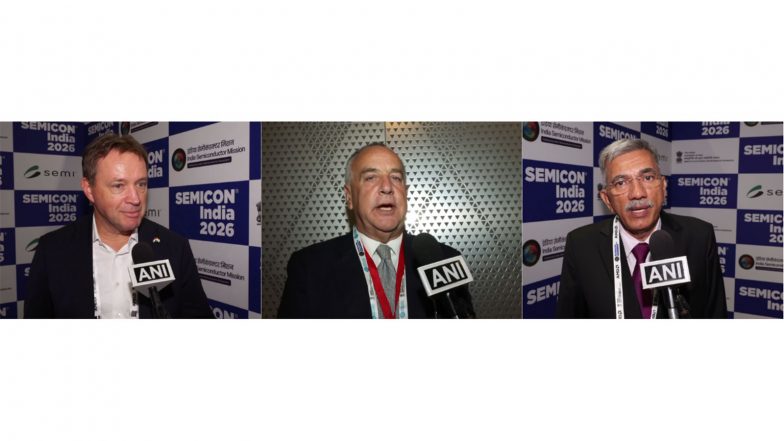
New Delhi [India], September 17 (ANI): Global industry leaders stated highlighting the rapid expansion of the domestic chip manufacturing landscape under the newly unveiled India Semiconductor Mission (ISM) 2.0.
Speaking to ANI on the sidelines of Semicon India 2026, industry executives and academic experts pointed out that India’s targeted push beyond core fabrication to supply chains, talent creation, and international partnerships is drawing global interest, with three hundred international firms participating at the summit.
Also Read | When Is Ganesh Visarjan 2026? Check Anant Chaturdashi Date, Shubh Muhurat and Timings.
Achim Kempe, Chief Operating Officer of European semiconductor firm Nexperia, stated that outside observers often fail to grasp the scale of operations currently underway across the country.
“I think people who are not here don't understand and get what's going on in India. There are so many smart people, there's so much intention and energy and motivation,” Kempe said.
Also Read | Mandakini Reacts to Infamous 'Ram Teri Ganga Maili' Breastfeeding Scene.
“I was here in July, I visited a few factories and I was already impressed by seeing what's going on here and also hearing the government this morning that shows me that India is really on a super right track and people who are not here, they should come and should really see and feel it,” he added.
Kempe noted that building domestic capability requires wide collaboration across regions, leading to Nexperia signing a memorandum of understanding (MoU) with Tata.
“You have so much competence around the world. I think you need to partner up. It was also mentioned this morning, it's not an island where you can work and you need so many partners from West, East, South, North. And I think that's why we are here today, signing an MoU with Tata,” he said.
“Now we are going to, let's say, start to use factories which are going to be built here and soon ready. We are transferring and releasing our technology here, so we will be a manufacturing partner, a development partner, and also trying to work on the ecosystem, on the material side, and the machine side,” Kempe stated.
Erez Imberman, Director of Strategic Programs at Israel-based SCD, stated that building a lasting semiconductor footprint requires direct backing for peripheral supply chains rather than standalone facilities.
“Having a fab or OSAT is just one part. When the fab is coming or an OSAT is coming or any fab, it needs a lot of supply chain, which gives the oxygen for the fab. So, like design and then material, gases, chemicals and all the other ecosystems are equally important,” Imberman said.
“Right now I think rightly the ISM 2.0 which is announced, is focusing on the ecosystem and that's the correct thing to do. To have companies that are giving support to the semiconductor fab, this is exactly what needs to be done and this is exactly what they are doing in India right now,” he added, noting that SCD is currently considering setting up a unit in India.
Detailing the policy allocations, Manoj Choudhary, Vice Chancellor of Gati Shakti Vishwavidyalaya, explained that the Prime Minister launched Semicon India 2026 with a focus on ISM 2.0, which carries an allocation of Rs 1.27 lakh crore across six pillars covering chip design, equipment, chemicals, gases, fabs, compound semiconductors, and advanced R&D.
“Under semiconductor 1.0 with Rs 76,000 crore allocation, we ended up with 12 semiconductor units being set up in the country with a total investment of Rs 1.64 lakh crore and the great thing is that out of those 12 semiconductor plants that were announced during that 5 are already under commercial production,” Choudhary said.
Choudhary noted that training one lakh new personnel forms a critical part of the program, establishing value chains for automotive, consumer, space, and defence sectors while strengthening import substitution and export capabilities. (ANI)
(The above story is verified and authored by ANI staff, ANI is South Asia's leading multimedia news agency with over 100 bureaus in India, South Asia and across the globe. ANI brings the latest news on Politics and Current Affairs in India & around the World, Sports, Health, Fitness, Entertainment, & News. The views appearing in the above post do not reflect the opinions of LatestLY)