
Business News | India's BESS Demand to Reach 236.2 GWh by FY32 on Falling Battery Costs, Rising Clean Energy Needs: Report
Get latest articles and stories on Business at LatestLY. India's Battery Energy Storage System (BESS) demand is expected to reach 236.2 GWh during FY27-FY32, driven by declining battery costs and improving revenue visibility from Firm and Dispatchable Renewable Energy (FDRE), Round-the-Clock (RTC) and ancillary services, according to an Equirus report.

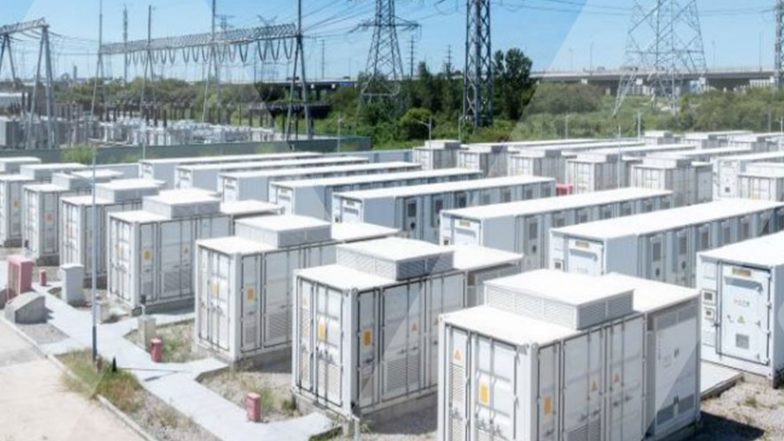
New Delhi [India], June 30 (ANI): India's Battery Energy Storage System (BESS) demand is expected to reach 236.2 GWh during FY27-FY32, driven by declining battery costs and improving revenue visibility from Firm and Dispatchable Renewable Energy (FDRE), Round-the-Clock (RTC) and ancillary services, according to an Equirus report.
The report said, "Declining battery costs and greater revenue visibility from FDRE, RTC and ancillary services have enhanced commercial viability."
Also Read | What Is Three Peaks Challenge That Princess Kate Middleton Completed After Cancer Remission?.
It said the growth of AI and cloud data centres is emerging as a key demand driver, as these facilities require uninterrupted clean power.
"Each 100 MW data centre needs ~250 MW Solar + 150MW wind + ~450 MWh BESS to run 24x7 on renewables," the report said.
Also Read | FIFA World Cup 2026 Schedule Today (July 1): Timings in IST, Venues, Groups.
The report added, "BESS enables time-shifting, not generation -- needs extra solar input."
According to the report, India's solar project pipeline remains strong, with stable execution and demand expected over the coming years. However, the standalone solar segment is facing a supply overhang, with around 58 GW of unsigned solar power purchase agreements (PPAs). Most of these are plain-vanilla projects that DISCOMs are reluctant to contract because of lower tariff attractiveness and weak offtake visibility, making financial closure difficult.
The report said DISCOMs are increasingly preferring firm and dispatchable renewable power, including battery-backed solar (BESS), FDRE and RTC projects that can supply electricity beyond solar generation hours.
It further said, "Government tenders, storage obligations and SECI/NTPC-led procurement programs have accelerated utility-scale BESS adoption."
The report also noted that the government is considering incentives for floating solar projects to ensure renewable energy capacity is more evenly distributed across the country instead of being concentrated in a few states.
Citing NITI Aayog, the report said India may require around 1,800 GW of renewable energy capacity by 2050, along with nearly 2,000 GWh of Battery Energy Storage Systems (BESS). (ANI)
(The above story is verified and authored by ANI staff, ANI is South Asia's leading multimedia news agency with over 100 bureaus in India, South Asia and across the globe. ANI brings the latest news on Politics and Current Affairs in India & around the World, Sports, Health, Fitness, Entertainment, & News. The views appearing in the above post do not reflect the opinions of LatestLY)