
Business News | India's Design Ambition Shifts to Commercialisation as Leaders Eye Global Innovation Leadership
Get latest articles and stories on Business at LatestLY. Union Minister of Commerce & Industry Piyush Goyal and Union Home Minister Amit Shah on Sunday said India's next growth phase would depend on turning design and creativity into scalable businesses that drive employment, productivity and global competitiveness. They expect the new Innovation and Incubation Center at the National Institute of Design in Gandhinagar to act as a bridge between academia and industry, helping young innovators from tier-2 and tier-3 cities commercialize ideas and position India as a world leader in design-led entrepreneurship.

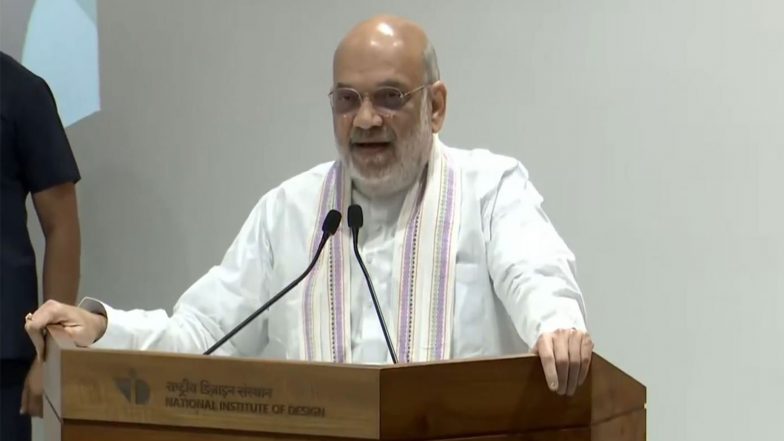
New Delhi, [India] May 17 (ANI): Union Minister Piyush Goyal and Union Home Minister Amit Shah on Sunday said India's next growth phase would depend on turning design and creativity into scalable businesses that drive employment, productivity and global competitiveness.
They expect the new Innovation and Incubation Center (IIC) at the National Institute of Design in Gandhinagar to act as a bridge between academia and industry, helping young innovators from tier-2 and tier-3 cities commercialise ideas and position India as a world leader in design-led entrepreneurship.
The remarks came during the inauguration of the Innovation and Incubation Center (IIC) at NID Gandhinagar, an event also attended by NID officials, industry representatives and students. The centre has been set up to foster out-of-the-box thinking and link design education with commercial outcomes.
The Union Commerce and Industries minister said the design was no longer just an individual pursuit but an entire way of thinking that could define India's destiny in the 21st century. He said the roadmap to a developed and prosperous India rested on three pillars: innovation, immersion in design thinking, and entrepreneurship. Goyal argued that no country had become developed on people, natural resources or consumption alone, and that India's future would be shaped by how well it connected creative ideas with economic outcomes. "The real test is whether this innovation has improved people's lives, helped people run businesses or industries, or work better," he said. "Has it created employment? Has it strengthened our economy?"
Also Read | Why is Rajat Patidar Not Playing in PBKS vs RCB IPL 2026 Match?.
Goyal emphasized that India's strength now lay in its digital connectivity and youth demographic. He noted that India was the fastest in rolling out 5G and offered digital data at some of the lowest prices globally. With the world's fastest-growing economy and the third-largest startup ecosystem, he said India had nearly 1.4 million graduates every year in science, technology, engineering and mathematics. "This very strength is making our country seen across the world as the 'most trusted partner,'" he said, adding that the next big discovery could come from Surat, Patan or Dhanbad, not just Mumbai or Delhi. He also pointed to India's success in jewellery and textiles as proof that Indian design could compete globally.
Shah, speaking as the local Member of Parliament whose constituency includes the NID campus, said NID's establishment in Ahmedabad in 1961 had been a deliberate move to give a platform to design talent that often remained buried in daily life. He said design was both a discipline and an art that made utilities more useful and attractive, but its commercial potential had not been fully realised in India.
"If those same vehicles had been designed in Japan, then the recognition and refinement received by Nitin Bose and the Japanese designers -- could there even be any comparison? No, there could not," Shah said, referring to a Mahindra design showcased at the event. He stressed that NID would need to create a separate vertical to link designers with industry requirements and commercialization, since the institution currently lacked people focused on monetizing creative work.
Shah said the incubation centre should expand design's reach beyond traditional fields into high-tech areas like semiconductors and chips, as well as large industrial parks. He urged NID to build systems that connected students' creative potential with career pathways so that more young people could confidently adopt design as a profession. "Only then will we be able to realize the 100% potential of design that exists in the country," he said.
Both leaders agreed that the centre's objective was to ensure creativity translated into prosperity. Goyal said incubation centers should help young people in small towns access mentors and refine ideas through online platforms, allowing a small startup to reach a global audience. He added that the future would be driven less by cheap labor and more by skilled talent and creative design.
The speeches positioned NID's new centre as more than a curriculum add-on. Goyal said industry would take design to the people while academia fine-tuned it, and Shah called for a structured approach to connect creativity with commercialization. Together, they framed the centre as a platform to unlock India's youth dividend and establish the country as a global design and innovation hub. (ANI)
(The above story is verified and authored by ANI staff, ANI is South Asia's leading multimedia news agency with over 100 bureaus in India, South Asia and across the globe. ANI brings the latest news on Politics and Current Affairs in India & around the World, Sports, Health, Fitness, Entertainment, & News. The views appearing in the above post do not reflect the opinions of LatestLY)