
Business News | India's Power Capacity Likely to Reach 874 GW by 2031-32; Grid Modernisation, Storage to Drive Reliability
Get latest articles and stories on Business at LatestLY. India's installed power generation capacity is likely to reach 874 GW by 2031-32 as the government plans to expand generation across thermal, hydro, nuclear and renewable sources while scaling up energy storage and transmission infrastructure, Minister of State for Power Shripad Naik said in a written reply in the Rajya Sabha.

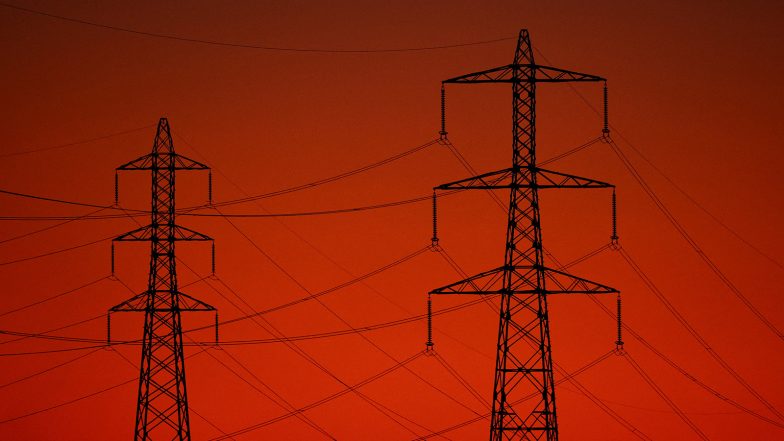
New Delhi [India], August 3 (ANI): India's installed power generation capacity is likely to reach 874 GW by 2031-32 as the government plans to expand generation across thermal, hydro, nuclear and renewable sources while scaling up energy storage and transmission infrastructure, Minister of State for Power Shripad Naik said in a written reply in the Rajya Sabha.
He added that the government is also focusing on modernising the grid and strengthening distribution networks to improve the reliability of electricity supply.
Also Read | Vivo S2 Set for India Launch on August 6; Check Expected Price, Features and Specifications.
As of June 30, 2026, India had a total installed power generation capacity of 5,48,858 MW, with non-fossil fuel sources accounting for 54.18 per cent of the total. Renewable energy sources, including hydro, accounted for 52.58 per cent, while fossil fuel-based capacity stood at 45.82 per cent. Coal remained the largest individual source, with 2,24,158 MW of installed capacity, while solar capacity stood at 1,62,152 MW.
The government said thermal power capacity is also being expanded to meet future electricity demand. Around 21,080 MW of thermal capacity has been commissioned since April 2023 through June 2026, while 47,545 MW is under construction and contracts for another 16,000 MW have been awarded. The projected thermal capacity requirement by 2035-36 is around 3,15,000 MW.
Also Read | No Marriage Certificate? Supreme Court Says Live-In Partners Can Still Get Section 498A Protection.
The government is simultaneously scaling up renewable and storage capacity. Around 1,47,720 MW of renewable capacity is under construction, including 1,19,580 MW of solar and 27,720 MW of wind capacity. Pumped storage projects totalling 15,870 MW/95,220 MWh and battery energy storage systems of 15,754 MW/42,530 MWh are also under construction.
On transmission, around 1,91,474 ckm of transmission lines and 1,274 GVA of transformation capacity is planned to be added between 2022-23 and 2031-32. The government is also deploying technologies such as STATCOMs, synchronous condensers and FACTS devices to improve voltage stability and facilitate renewable energy integration.
The government said electricity distribution performance has improved, with national AT&C losses declining from 21.91 per cent in FY21 to 15.04 per cent in FY25. Under the Revamped Distribution Sector Scheme, ₹1.53 lakh crore of loss-reduction works and ₹1.31 lakh crore of smart-metering works have been sanctioned.
The government also reported that average electricity supply in rural areas increased to 22.6 hours in FY26 from 12.5 hours in FY14, while urban supply rose to 23.4 hours from 22.1 hours over the same period. (ANI)
(The above story is verified and authored by ANI staff, ANI is South Asia's leading multimedia news agency with over 100 bureaus in India, South Asia and across the globe. ANI brings the latest news on Politics and Current Affairs in India & around the World, Sports, Health, Fitness, Entertainment, & News. The views appearing in the above post do not reflect the opinions of LatestLY)