
Business News | Pune-Based Muks Robotics Secures ISRO Project to Develop SPACEO Prime, an Indian Humanoid Space Worker
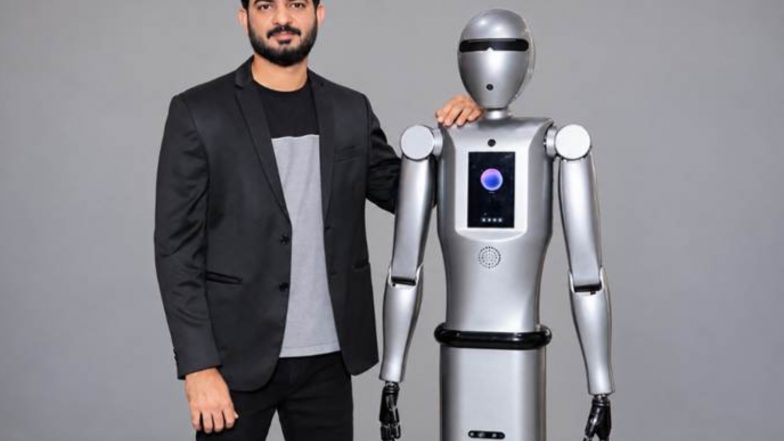
Get latest articles and stories on Business at LatestLY. Pune (Maharashtra) [India], October 16: Muks Robotics, a Pune-based humanoid robotics company, has secured a project with the Indian Space Research Organisation (ISRO) to develop SPACEO Prime, India’s first humanoid space worker. The project marks a milestone in the Indian Space Economy to develop intelligent robots capable of operating in space.

PNN
Pune (Maharashtra) [India], October 16: Muks Robotics, a Pune-based humanoid robotics company, has secured a project with the Indian Space Research Organisation (ISRO) to develop SPACEO Prime, India’s first humanoid space worker. The project marks a milestone in the Indian Space Economy to develop intelligent robots capable of operating in space.
As space missions become increasingly complex, robotic systems could play an important role in assisting astronauts, performing demanding operations and handling tasks in hazardous environments. For Muks Robotics, the project represents progress towards a vision first conceived by its founder, Dr. Mukesh Bangar, in 2021: building humanoids not just for Earth, but also for space.
Muks Robotics is a Pune-based startup, working towards the development of humanoid robots and Physical AI systems designed to perceive their surroundings, understand instructions, and perform tasks in real-world environments.
Developing a humanoid for space-related applications presents challenges beyond conventional robotics. Mobility, manipulation, autonomy, and reliability must be considered alongside the demands of the intended operating environment. The ISRO project provides an opportunity for Muks Robotics to build indigenous humanoids in alignment with “Atmanirbhar Bharat,” strengthening India’s self-reliance in advanced robotics and contributing to the nation’s vision of Viksit Bharat 2047.
At the centre of the company’s journey is Dr. Mukesh Bangar, Founder and CEO of Muks Robotics. A self-taught AI and robotics engineer, Dr. Bangar is focused on developing intelligent robotic systems capable of understanding their surroundings, learning autonomously, and performing meaningful physical tasks.
“I firmly believe that true freedom from pain and suffering (Moksh) can be achieved through self-sustaining autonomous robots. Moreover, now is the right time to deploy conscious, intelligent robots to other planets to safeguard the future of our existence,” says Dr. Mukesh Bangar.
In 2021, his vision began taking shape around a long-term ambition to build humanoids for Earth and beyond. The company subsequently presented its mission and vision through a video in 2023, outlining its direction in humanoid robotics and its ambition to extend robotic capabilities beyond Earth.
The development of the SPACEO platform created a foundation for pursuing this ambition. The ISRO project represents a significant step towards translating that vision into a dedicated humanoid development effort, bringing the company closer to its goal of developing robots capable of supporting human activities in space.
The development of SPACEO Prime aligns with India’s Make in India initiative and Prime Minister Narendra Modi’s vision of Viksit Bharat 2047, which aims to transform India into a developed nation by the centenary of its independence. The vision emphasises self-reliance, innovation and indigenous technological advancement.
With established capabilities in satellite technology, launch systems and planetary exploration, India is well-positioned to expand into advanced robotics, artificial intelligence and autonomous systems. For Muks Robotics, SPACEO Prime represents an effort to develop advanced humanoid technology in India and contribute to the country’s growing deep-tech ecosystem. However, developing a space-oriented humanoid requires rigorous testing, reliability and safety to meet the demanding conditions of space missions.
Humanoid robots could offer advantages in environments designed around human tools, workstations, and equipment. Their articulated arms and human-like body structure could potentially enable them to manipulate objects, handle tools, and interact with existing infrastructure.
Future applications could include equipment inspection, maintenance assistance, material handling, and other repetitive or hazardous tasks. Such systems could help reduce astronauts’ exposure to certain risks and support mission operations.
These possibilities depend on the robot’s capabilities, engineering validation, and mission requirements. They represent the broader potential of humanoid space robotics rather than confirmed operational capabilities of SPACEO Prime.
Muks Robotics aims to build humanoids for practical applications on Earth while developing the technological foundations for future work beyond the planet.
SPACEO Prime brings together this long-term vision and an opportunity to contribute to India’s space technology ambitions. Moving from development to actual space operations will require sustained engineering, testing, and validation.
For a robotics company based in Pune, the ambition now extends beyond conventional workplaces. With a vision of extending its mission to the Moon and Mars as well. What began as a vision in 2021 is taking shape as a dedicated development effort, with the potential to expand the role of Indian-built humanoid technology beyond Earth.
For Muks Robotics, the goal is not simply to build a machine that resembles a human, but to develop one that could help humans work in places where they have never worked before.
(ADVERTORIAL DISCLAIMER: The above press release has been provided by PNN. ANI will not be responsible in any way for the content of the same.)
(The above story is verified and authored by ANI staff, ANI is South Asia's leading multimedia news agency with over 100 bureaus in India, South Asia and across the globe. ANI brings the latest news on Politics and Current Affairs in India & around the World, Sports, Health, Fitness, Entertainment, & News. The views appearing in the above post do not reflect the opinions of LatestLY)