Here's What Data Centers Are Doing to the Planet.
As data centers multiply to meet AI demand, they're straining power grids, draining water supplies, and reshaping the land and air around them.

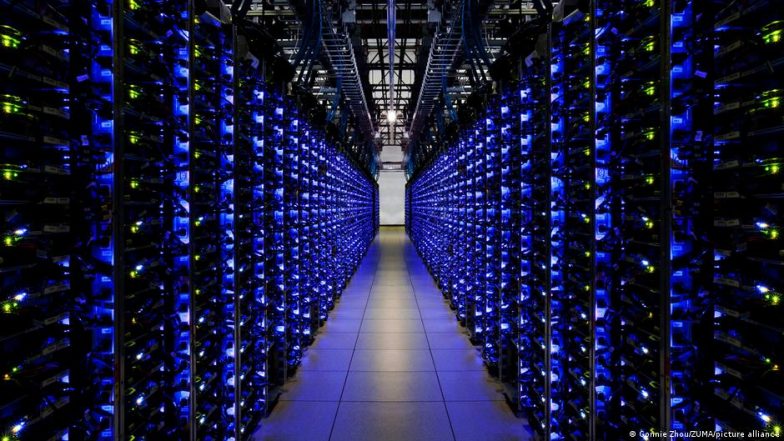
As data centers multiply to meet AI demand, they're straining power grids, draining water supplies, and reshaping the land and air around them.Every question sent to AI models provides an instant reply that seems to appear out of nowhere, but answering queries requires physical infrastructure that consumes real energy, water, and land.
Somewhere around the world — maybe in Virginia or Sao Paolo or Hong Kong — a massive warehouse filled with fiber-optic cables and seemingly endless rows of humming servers, is working to provide the processing power for the more than 2.5 billion questions ChatGPT alone fields daily.
Also Read | Business News | Business Nextgen Finance Raises Rs 215 Crore in Equity to Accelerate MSME Lending.
AI models, along with cloud storage, streaming, web hosting and social media, all have a very real physical footprint. If data centers were a country, their level of electricity use would make them the 11th largest electricity consumer in the world, according to researchers from the United Nations University.
From energy to water to land, here's the real toll data centers take on the environment.
An insatiable appetite for power
Data centers are becoming some of the world's fastest-growing sources of electricity. These warehouses of servers, routers and Internet-connected devices run 24/7, while cooling systems operate continuously to keep the tech from overheating.
In Frankfurt, Germany, the grid is currently so saturated that no new connections will be available until at least the 2030s. There, data centers consume about 41% of the city’s electricity. In Dublin, it’s double that.
And data center electricity consumption is growing rapidly — it’s expected to double by 2030 to about 945 terawatt-hours, around what Japan consumes annually, according to the International Energy Agency.
How the AI boom could slow climate progress
All that energy has to come from somewhere, increasing reliance on fossil fuels.
One 2024 study found that more than half of the United States’ data centers are powered by fossil fuels, emitting in excess of 105 million tons of CO2. Offsetting that would take more than 31,000 wind turbines running continuously for a year.
The buildout is also keeping old coal plants alive. Utilities have delayed the retirement of 15 coal-fired plants nationwide to meet surging demand, plants that together emitted nearly 65 million tons of greenhouse gases in 2023 alone.
And utilities are also constructing new gas-fired power plants, with more than 100 GW of additional facilities across the country already announced. That would lead to more carbon emissions than burning 111 million pounds (50.4 million kilos)of coal.
Of course, data centers can also be powered by renewable energy. Pairing a facility with on-site renewables can ease pressure on the local power supply, and any surplus energy can even be sold back to the grid, making it more stable.
However, using green electricity for data centers means there is less available for electrifying transport or decarbonizing other emissions-heavy industries.
The hidden water demand
Many data centers consume millions of gallons of water to stay cool. Servers generate constant heat, and water is one of the most effective ways to absorb and carry that heat away through evaporation.
A single large facility can use up to 5 million gallons a day, roughly the same as a town of 10,000 to 50,000 people. About 80% of the water withdrawn for cooling simply evaporates; the rest becomes wastewater that can overwhelm local treatment systems never designed to handle that volume.
In Northern Virginia, the almost 300 data centers clustered in one region, supply about a third of the world’s online traffic. There, in what is known as the world's data center capital, facilities collectively used nearly 2 billion gallons of water in 2023.
There are several more efficient ways to cool data centers. These include immersion cooling, where devices are bathed in a coolant, and closed-loop cooling systems which recycle water and can reduce freshwater use by up to 70%.
Data centers are making cities hotter
Cooling a data center doesn't get rid of the heat, it just moves it outside, which can exacerbate the urban heat island effect, which is when cities experience higher tempertures than rural areas.
Researchin Phoenix, Arizona, found a single large data center can emit as much waste heat as tens or even hundreds of thousands of households, raising nearby land surface temperatures by up to 9 degrees Celsius and air temperatures by up to 2 degrees Celsius. Those effects can be felt as far as half a kilometer away.
Since cities are already 0.5–4 degrees Celsius warmer than their surroundings, these higher temperatures can increase heat stress risks for nearby residents and push up air conditioning demand, requiring still yet more energy.
Not all of that heat goes to waste: a growing number of data centers are capturing it and piping it into nearby homes and businesses — this process, called thermal energy networks, can reduce data center power demand by up to 30%.
Coal, gas, and diesel all contribute to dirty air
Powering and running data centers pollutes the air on two fronts.
First, coal and gas plants release toxic particulate matter, which can lead to respiratory disease, heart disease, asthma and more health conditions for nearby communities.
On-site diesel generators, used as backup power when the grid fails, also release harmful air pollutants. These generators pump out 200 to 600 times more nitrogen oxides than natural gas plants.
One estimate found that when backup generators for all of Virginia’s data centers were emitting at just 10% of their permitted level, they could contribute to 14,000 cases of asthma symptoms, more than a dozen deaths and up to $300 million in public health costs a year.
The land data centers take over
Data center construction requires large plots of land to build on. Repurposing natural and agricultural areas into industrial zones can threaten biodiversity and disrupt local ecosystems.
In Hattersheim, Germany, for example, an 18-acre parcel reserved for agriculture and groundwater protection — a local green space known for its rapeseed blossoms — was rezoned in 2024 to make way for a five-building data center campus.
The damage often extends beyond the site itself. Gas pipelines and power plants built to supply these facilities require their own land, fragmenting habitats and eroding soil along their routes.
Edited by: Tamsin Walker
(The above story first appeared on LatestLY on Sep 03, 2026 02:40 PM IST. For more news and updates on politics, world, sports, entertainment and lifestyle, log on to our website latestly.com).