How Belarusians Still Find Hope in a Silenced Country
The documentary "Letters From the Silenced Country" depicts the ongoing repression under the authoritarian regime.

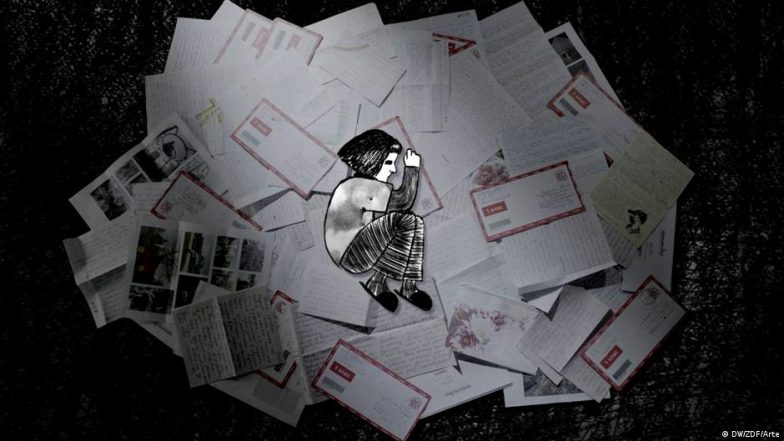
The documentary "Letters From the Silenced Country" depicts the ongoing repression under the authoritarian regime. Director Andrei Kutsila talked to DW ahead of the film's Venice premiere.When Belarusians took to the streets in 2020 to protest against the disputed results of the presidential election, hopes were high that the regime of autocratic ruler Alexander Lukashenko would end, and that Belarusian society would find freedom.
Also Read | Business News | VOKKA and Zepto Show How Quick Commerce Is Becoming a Launchpad for Occasion-Led Gifting.
But authorities responded with an unprecedented campaign of repression that continues to this day. All forms of dissent have essentially been silenced.
Also Read | World News | Alleged Chinese Documents Show Beijing Put Price on Efforts to Block Taiwan from WHA.
It's in this context that filmmaker Andrei Kutsila directed a new documentary that depicts the state's system of repression.
His film, "Letters from the Silenced Country," was co-produced by DW and premieres at the Venice Film Festival on September 9.
A silenced country
Like the 300,000 to 500,000 Belarusians who now live in exile, Kutsila realized that he had to leave his home country amid the state's crackdown on free speech.
While he was completing his previous film — the award-winning "When Flowers Are Not Silent" (2021), on the state's brutal suppression of demonstrations — different colleagues around him were arrested, he says.
Many of them have since been released, "but at the same time, new prisoners are found to keep filling the cells. The situation is not changing; it's even worse now," Kutsila tells DW.
As the film points out in a postscript card, the human rights organization Viasna has documented at least 65,000 politically motivated arrests and detentions in Belarus since the 2020 protests.
"From the outside, people live their normal lives, but the streets have become quiet and conversations are reduced to whispers," says Kutsila. Those who remained in the country can get arrested and sent to prison simply for posting Belarusian symbols of freedom and resistance online, notes the filmmaker.
That was one of the reasons that motivated him to make "Letters from the Silenced Country."
Returning to Belarus and to physically meet and film protagonists in his home country was not an option, so he searched for an alternative way to portray their situation after the protests.
Letters to prisoners served as a starting point to Kutsila's film project: "I read thousands of them," he says.
He then picked stories of individuals — political prisoners, exiles and underground activists — who embodied different aspects of the situation.
Vitold Ashurak died in prison
Belarusian opposition activist and environmental campaigner Vitold Ashurak is one of the film's protagonists.
Sentenced to five years in prison for participating in the protests, Ashurak's fate is portrayed through his correspondence with friends and family during his imprisonment.
Letters from a friend include meticulously selected photographs. Ashurak finds brief moments of mental freedom in these pictures, while the same images are also poetically embedded in the film.
But CCTV footage showing prison guards beating inmates brings viewers back to the brutal reality: Vitold Ashurak died under suspicious circumstances while in custody. His name is remembered as a symbol of the state's repression.
Between resignation and hope
The film also includes animated sequences, based on drawings created by the young student Kasia Budzko, who was sentenced to 2 1/2 years in prison for participating in protests.
Another protagonist in the film is Andrei Ostapovich, a former criminal investigator. In August 2020, he left his position, writing a letter of resignation in which he denounced the police officers' brutality against protesters.
As one of the first security officials who publicly and categorically opposed the Belarusian regime, Ostapovich fled the country — facing many perilous detours.
In one scene of "Letters from the Silenced Country," Ostapovich is asked if, after everything he's been through and witnessed, he still believes in a free Belarus. After much hesitation, his only response is a sigh of resignation.
Filmmaker Andrei Kutsila shares this ambivalence: "Of course, it's in a way my perspective too, as I tried to express my feelings through my protagonists." But, Kutsila focuses on long-term progress, as he adds, "history is the foundation on which we can build a free country."
"You know, 200 years ago Belarus didn't even exist on a map," he points out. There have been struggles to free the country ever since: "So from this long-term perspective, there is a lot of hope."
"No matter how awful the situation is, the only thing that can empower and give us hope is solidarity, connection between people and love. So these are the things giving us hope," notes Kutsila. "And the film, I think, shows this."
Edited by: Brenda Haas
(The above story first appeared on LatestLY on Sep 09, 2026 07:40 PM IST. For more news and updates on politics, world, sports, entertainment and lifestyle, log on to our website latestly.com).