
India News | 219 Sewerage Projects Taken Up Under Namami Gange; 146 Completed with 4,263 MLD Capacity: MoS Bhushan Chaudhary Tells LS
Get latest articles and stories on India at LatestLY. Giving details of the steps taken by the NMCG to improve water quality in the River Ganga, Raj Bhushan Chaudhary stated that, "a total of 219 sewerage infrastructure projects (STPs), with an estimated cost of ₹ 35,970 crores, have been taken up for remediation of polluted rivers, creating a total sewage treatment capacity of 6,610 Million Liters per Day (MLD). 146 sewerage infrastructure projects with a cumulative treatment capacity of 4,263 MLD have been completed."

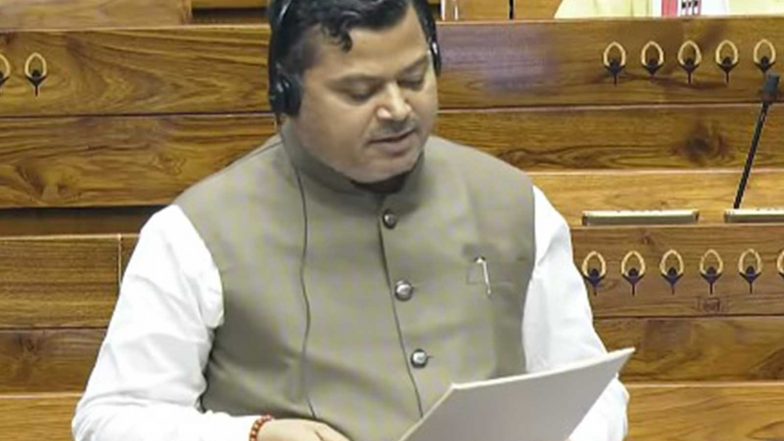
New Delhi [India], August 6 (ANI): Under the Namami Gange Mission-II (NGM-II), a total of 70 sewerage infrastructure projects (STPs) were implemented during the year 2025, including the 25 sewerage treatment plants commissioned. The Minister of State for Jal Shakti, Raj Bhushan Chaudhary, shared this information in Parliament.
Replying to a question in the Lok Sabha, MoS Jal Shakti Raj Bhushan Chaudhary stated that, "Under Namami Gange Programme, 4,263 Million Litres per Day (MLD) sewage treatment capacity has been generated till June 2026. As per the bio-monitoring conducted during 2024-25 at 50 locations along River Ganga and its tributaries and 26 locations along River Yamuna and its tributaries, the biological water quality (BWQ) predominantly ranged from 'Good' to 'Moderate'. The presence of diverse benthic macro-invertebrate species indicates the ecological potential of the rivers to sustain aquatic life."
Also Read | 8th Pay Commission Stakeholder Meetings: Complete City-Wise Schedule, Dates and Application Process.
Giving details of the steps taken by the National Mission for Clean Ganga (NMCG) to improve water quality in the River Ganga, Raj Bhushan Chaudhary stated that, "a total of 219 STPs, with an estimated cost of ₹ 35,970 crores, have been taken up for remediation of polluted rivers, creating a total sewage treatment capacity of 6,610 MLD. 146 sewerage infrastructure projects with a cumulative treatment capacity of 4,263 MLD have been completed."
"For industrial pollution abatement, 3 nos. of Common Effluent Treatment Plants (CETPs) have been sanctioned, i.e., Jajmau CETP (20 MLD), Banther CETP (4.5 MLD) and Mathura CETP (6.25 MLD). Two projects, Mathura CETP (6.25 MLD) and Jajmau CETP (20 MLD), have been completed," he added.
Also Read | Google Pixel 11 Release: Full Specs, Leaked Features and Expected US Pricing.
"Under the Namami Gange Programme, biodiversity conservation has been taken up through scientific assessment, habitat restoration, species recovery and community participation. Scientific surveys covering about 7,680 km of river stretches have documented 3,037 gharials, leading to the preparation of the National Gharial Conservation Action Plan. The National Centre for River Research has been established at the Wildlife Institute of India, Dehradun, and four Aquatic Animal Rescue and Rehabilitation Centres, along with India's first Dolphin Rescue Ambulance, have strengthened rescue, rehabilitation and monitoring of aquatic fauna, and rehabilitation of Gangetic Dolphins, turtles and other aquatic fauna," reads the written statement of the Minister.
He has further stated that, "Around 6,800 aquatic animals have been rescued and rehabilitated under the programme. Through conservation breeding programmes, more than 1,500 freshwater turtle hatchlings have been produced, 711 turtles have been released into the River Ganga, while 893 gharial yearlings and 1,899 turtles have been released into their natural habitats."
"Scientific assessments have documented 215 fish species (206 native and 9 exotic) in the River Ganga. In collaboration with the ICAR-Central Inland Fisheries Research Institute (CIFRI), NMCG has undertaken scientific river ranching for restoration of native fish populations. About 2.05 crore fish seeds, comprising Indian Major Carps, Mahseer and Hilsa, have been ranched in the Ganga and its tributaries. Biodiversity conservation is strengthened through development of seven 'Ganga Biodiversity Parks' in Uttar Pradesh, and afforestation over 33,024 hectares using native species across the five Ganga basin States in collaboration with State Forest Departments, and mobilisation of more than 5,500 'Ganga Praharis' across 113 districts," added the MoS in his reply.
He also said, "NMCG successfully implemented the minimum e-flow norms notified in October 2018, ensuring continuous environmental flow in the river Ganga. Regular compliance is being effectively monitored by the Central Water Commission (CWC)." (ANI)
(The above story is verified and authored by ANI staff, ANI is South Asia's leading multimedia news agency with over 100 bureaus in India, South Asia and across the globe. ANI brings the latest news on Politics and Current Affairs in India & around the World, Sports, Health, Fitness, Entertainment, & News. The views appearing in the above post do not reflect the opinions of LatestLY)