
India News | Delhi HC Rejects Kalindi College POSH Panel Challenge, Orders Fresh Inquiry to Be Completed in 90 Days
Get latest articles and stories on India at LatestLY. The Delhi High Court has dismissed a plea by two associate professors of Delhi University’s Kalindi College challenging the constitution of a fresh Internal Committee to inquire into their sexual harassment complaint, holding that their apprehensions of bias were not supported by cogent material establishing a real likelihood of bias.

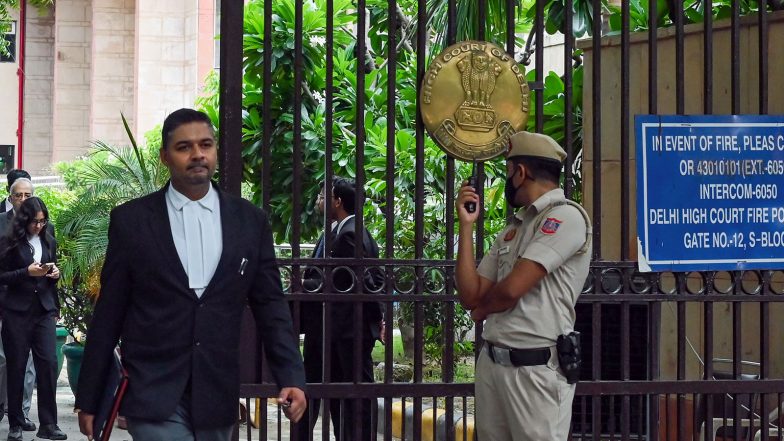
New Delhi [India], October 28 (ANI): The Delhi High Court has dismissed a plea by two associate professors of Delhi University’s Kalindi College challenging the constitution of a fresh Internal Committee to inquire into their sexual harassment complaint, holding that their apprehensions of bias were not supported by cogent material establishing a real likelihood of bias.
Justice Swarana Kanta Sharma, however, directed the newly constituted committee to endeavour to complete the inquiry within 90 days from the receipt of a copy of the judgment, noting that the complaint had remained pending for more than 15 months.
The court held that the statutory framework governing sexual harassment complaints does not envisage the Vice-Chancellor constituting a separate university-level committee to inquire into a complaint arising within a constituent college. The inquiry must be conducted by the Internal Committee constituted under the applicable law.
The judgment, pronounced on October 27, came on a petition challenging the University of Delhi Vice-Chancellor’s July 16 order setting aside the findings of the earlier Internal Complaints Committee and directing a fresh inquiry, as well as the college principal’s July 28 order constituting a new committee.
Also Read | Chennai Latest News Today on October 28th, 2026: Cyclone Arnab Impact, Auto Fares Revised & Minister Arrest.
The identities of the complainants have not been disclosed in the judgment in view of the confidentiality requirements under Section 16 of the Sexual Harassment of Women at Workplace (Prevention, Prohibition and Redressal) Act, 2013.
The complainants, who teach in the college’s departments of Zoology and Political Science, had submitted a joint complaint to the college principal on July 7, 2025, alleging harassment, intimidation and derogatory and sexually coloured remarks by four faculty members.
The alleged incidents included remarks and exchanges in the staff association’s WhatsApp group and at a staff association meeting held on July 3, 2025. The complainants also alleged that a member of the then Internal Complaints Committee had deleted a message posted by one of the persons complained against in the WhatsApp group.
The earlier committee concluded its inquiry on September 19, 2025, holding that the allegations were “not sexual in nature”. Its report was subsequently accepted by the college’s Governing Body on January 22, 2026.
The complainants challenged the outcome and sought a fresh inquiry before an impartial committee, raising objections to the participation of a committee member allegedly connected with the events forming the subject matter of their complaint.
After the matter reached the High Court, the Vice-Chancellor was directed in May 2026 to decide the complainants’ appeal independently.
In an order dated July 16, the Vice-Chancellor found that the participation of a committee member who had been named in the events underlying the complaint gave rise to a reasonable apprehension of bias. The order also identified a defect concerning compliance with the requirement of an external member under the University Grants Commission’s 2015 Regulations.
The Vice-Chancellor consequently set aside the earlier inquiry, directed a fresh investigation and required the college to constitute an impartial committee in accordance with the applicable statutory provisions.
The order stipulated that no person directly or indirectly connected with, involved in, or interested in the subject matter of the complaint should be part of the fresh inquiry.
Acting on these directions, the college principal constituted a new Internal Committee on July 28. It comprised a woman faculty member as the presiding officer, two faculty members, two non-teaching employees and a professor of law from Delhi University’s Faculty of Law as the external member. None of the members of the earlier committee was included.
The complainants nevertheless approached the High Court, questioning both the manner in which the fresh committee had been constituted and the Vice-Chancellor’s decision to send the matter back to the college.
Before the High Court, the petitioners argued that the new committee was flawed because it had been constituted by the college principal, whose administrative decisions had themselves been questioned in the proceedings.
They relied on the principal’s earlier refusal to permit a committee member to recuse himself and the subsequent acceptance of the earlier inquiry report by the Governing Body. According to the petitioners, allowing the principal to nominate members to the fresh committee undermined the principle that no person should be a judge in their own cause.
They also objected to the inclusion of a faculty member who had attended the staff association meeting of July 3, 2025, and a senior personal assistant to the principal, contending that their presence or administrative subordination raised concerns about the committee’s independence.
The petitioners further questioned whether the external-member requirement had been properly fulfilled and argued that the Vice-Chancellor should have constituted an independent committee at the university level.
They also contended that the Vice-Chancellor had passed the July 16 order without granting them a personal hearing. Their other grievances included the non-supply of CCTV footage and meeting minutes, the alleged failure to hold proceedings in camera, and claims that they continued to face a hostile work environment.
The University of Delhi and the college authorities opposed the petition, submitting that the Vice-Chancellor had granted the principal relief sought by the complainants by setting aside the earlier report and ordering a fresh inquiry. They maintained that the principal, as the college’s executive authority, was statutorily empowered to constitute the Internal Committee.
Rejecting the challenge, Justice Sharma held that a mere apprehension of bias cannot, by itself, justify the dissolution of an Internal Committee. The complainants must place cogent material on record demonstrating a real likelihood of bias.
The court observed that the earlier order passed in May 2026 had merely recorded the petitioners’ submissions that the inquiry was vitiated, particularly because their allegations concerned the Governing Body and the earlier committee. It had not returned any judicial finding that the Governing Body or the principal was biased.
The court also noted that the complainants had themselves sought the setting aside of the earlier report and a fresh inquiry before an impartial committee. The Vice-Chancellor’s order had granted precisely that relief.
On the argument that the principal should not have constituted the new committee, the court observed that she was not a respondent to the original complaint. The allegations against her concerned administrative decisions, including her refusal to permit recusal and the handling of representations.
These decisions, the court said, had effectively been undone by the Vice-Chancellor’s order, which set aside the earlier report and excluded the earlier committee members from the fresh inquiry.
“Dissatisfaction with past administrative decisions cannot amount to any personal or pecuniary interest in the outcome of the inquiry,” the court held, adding that there was no allegation that the principal had any relationship with, or interest in protecting, the persons complained against.
The court further explained that the principal’s statutory role was confined to nominating committee members, while the adjudicatory function vested in the Internal Committee, which was required to function autonomously.
If an executive authority’s past administrative decisions were sufficient to disqualify it from constituting a committee, the statutory mechanism could become unworkable, the court observed.
The court rejected the objection to the inclusion of a faculty member who had attended the staff association meeting that formed part of the complaint.
It noted that the petitioners had not attributed any specific remark or role in the alleged WhatsApp exchanges to the faculty member, nor had they claimed that she was a witness in the matter.
“Mere attendance at its meeting cannot render a faculty member a person ‘directly or indirectly connected with, involved in, or interested in the subject matter of the complaint’,” the court observed.
Accepting such an argument, it said, could lead to the disqualification of every faculty member who attended the meeting.
The court similarly rejected the objection to the inclusion of the principal’s senior personal assistant, holding that the UGC Regulations expressly contemplate the nomination of two non-teaching employees to the committee. Administrative subordination to the principal, by itself, could not disqualify such an employee.
On the external member, the court found that the newly appointed member was a professor of law who was neither employed by the college nor alleged to have any connection with the parties. The earlier defect concerning the designation of a legal expert, rather than a validly nominated external member, had therefore been cured.
The court also rejected the petitioners’ contention that the Vice-Chancellor should have constituted an independent committee at the university level.
Referring to the POSH Act and the UGC Regulations, the court said the statutory scheme places the responsibility for constituting the Internal Committee on the executive authority of the workplace concerned.
The Vice-Chancellor could not assume the fact-finding role assigned by law to the Internal Committee. Doing so would create a parallel mechanism outside the statutory framework, the court said.
It also rejected the argument that the Vice-Chancellor’s failure to grant a personal hearing invalidated the decision. The written appeal and subsequent representations had been considered, and the petitioners had not demonstrated any real prejudice arising from the absence of a personal hearing.
The court reiterated that a procedural lapse, without demonstrated prejudice, was not sufficient to invalidate the decision-making process.
While dismissing the petition, the court took note of the fact that the complaint dated July 7, 2025, had remained pending for more than 15 months and that the time stipulated in the Vice-Chancellor’s order had expired during the pendency of the litigation.
It directed the newly constituted Internal Committee to proceed with the inquiry and endeavour to conclude it within 90 days from the date it receives a copy of the judgment. The inquiry must be conducted in accordance with the POSH Act, the rules framed under it and the UGC Regulations, while adhering to the principles of natural justice. (ANI)
(The above story is verified and authored by ANI staff, ANI is South Asia's leading multimedia news agency with over 100 bureaus in India, South Asia and across the globe. ANI brings the latest news on Politics and Current Affairs in India & around the World, Sports, Health, Fitness, Entertainment, & News. The views appearing in the above post do not reflect the opinions of LatestLY)