
India News | 'From Gujarat to India: Water Lessons for the World' Traces 25 Years of India’s Water Governance Journey
Get latest articles and stories on India at LatestLY. A new case study titled 'From Gujarat to India: Water Lessons for the World' traces 25 years of India’s water governance journey, from reforms undertaken in Gujarat since 2001 to their subsequent scaling up at the national level.

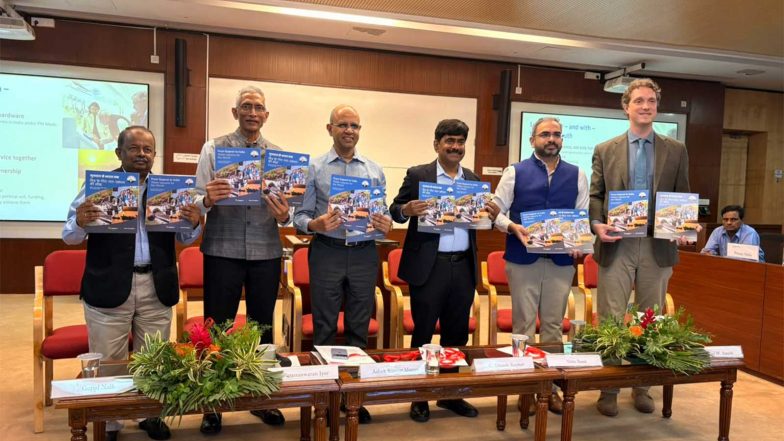
New Delhi [India], October 7 (ANI): A new case study titled 'From Gujarat to India: Water Lessons for the World' traces 25 years of India’s water governance journey, from reforms undertaken in Gujarat since 2001 to their subsequent scaling up at the national level.
George Mason University, through Assistant Professor Daniel W Smith, is a key academic partner in the study. The case study has been authored by Smith along with Nitin Bassi and Parameswaran Iyer and published by George Mason University and the Gates Foundation.
Also Read | Muzaffarpur: 2 Youths Arrested After Locals Catch Them Harassing Minor Girl on Way Home From Tuition.
The study identifies four lessons for countries in the Global South -- strong governance, integrated water-resource management, community ownership, and ambitious implementation backed by political will and financing.
The study traces a 25-year journey that began under Chief Minister Modi in Gujarat in 2001, when recurrent drought and water scarcity led to a combination of large-scale infrastructure, groundwater recharge, conservation, improved water-use efficiency, institutional reform, and community participation. It describes Gujarat's water governance reforms between 2001 and 2014 as a laboratory for approaches later scaled nationally after 2014.
The scale of the transformation is reflected in both financing and access. Among other lessons learned, one key finding is that Union water-sector allocations increased from 0.8 per cent of the total Union budget in 2001-02 to 2.2 per cent in 2025-26. Across rural India, 464 million more people use safely managed drinking water today than in 2000, while rural household tap coverage has increased from 17 per cent in 2019 to over 80 per cent in 2026.
Gujarat’s response combined the Narmada-based water grid with institutions such as WASMO and village-level Pani Samitis, alongside large-scale water conservation and groundwater recharge. By 2013, the state had constructed more than 76,000 check dams under the Sardar Patel water conservation programme. The study traces how elements of this experience subsequently informed national initiatives including Jal Jeevan Mission, Jal Shakti Abhiyan, Namami Gange, Atal Bhujal Yojana, Per Drop More Crop and AMRUT. In 2019, the creation of the Ministry of Jal Shakti provided a consolidated institutional framework for drinking water, sanitation and water-resource management.
Daniel W. Smith, co-author and Assistant Professor at George Mason University, said, “India’s water journey offers lessons well beyond its borders. The central message is that water security at scale requires strong water governance. Countries across the world can learn from these governance lessons and adapt them to their own circumstances as they work toward universal and sustainable water security.”
The study presents India’s experience as a source of practical lessons and approaches that countries can adapt and build upon in ways suited to their own circumstances. With its vast rural population, rapidly growing cities, climatic diversity and large-scale development needs, India offers a particularly relevant experience for countries across the Global South.
Earlier, Prime Minister Narendra Modi shared a news report on how India’s water-governance model is offering useful lessons for the wider Global South. Shri Modi said that water security is not only about building infrastructure but also about good planning, strong local systems and involving communities in managing water.
“India's journey from water reforms in Gujarat to large-scale national programmes offers a practical example for countries looking to improve water management and meet growing water needs”, PM Modi remarked.
India's journey from water reforms in Gujarat to large-scale national programmes offers a practical example for countries looking to improve water management and meet growing water needs. (ANI)
(The above story is verified and authored by ANI staff, ANI is South Asia's leading multimedia news agency with over 100 bureaus in India, South Asia and across the globe. ANI brings the latest news on Politics and Current Affairs in India & around the World, Sports, Health, Fitness, Entertainment, & News. The views appearing in the above post do not reflect the opinions of LatestLY)