
India News | ISRO’s NVS-3 Launch to Place Third Indigenous Atomic Clock in Space for Strengthening India's Time Sovereignty
Get latest articles and stories on India at LatestLY. The NVS-03 satellite will be carried by the GSLV-F18 launch vehicle, the 20th flight of India’s Geosynchronous Satellite Launch Vehicle (GSLV). The launch is scheduled to take place from Second launch Pad from Satish Dhawan Space Centre (SDSC SHAR), Sriharikota.

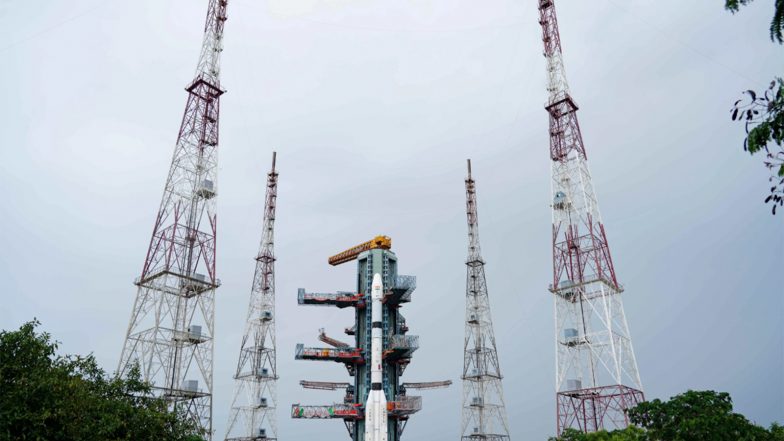
Sriharikota (Andhra Pradesh) [India], October 30 (ANI): The Indian Space Research Organisation (ISRO) has scheduled the launch of its NVS-03 satellite on Thursday at 11:51 PM, which will place a third such indigenous atomic clock in space to strengthen India’s time sovereignty and strengthen satellite navigation systems with the Indian Regional Navigation Satellite System (IRNSS), now known as NavIC.
The NVS-03 satellite will be carried by the GSLV-F18 launch vehicle, the 20th flight of India’s Geosynchronous Satellite Launch Vehicle (GSLV). The launch is scheduled to take place from Second launch Pad from Satish Dhawan Space Centre (SDSC SHAR), Sriharikota.
Also Read | Pune Latest News Today on October 30th, 2026: Water Penalty, Bank Fraud & MLC Election Analysis.
NVS-03 is the third satellite in next generation navigation satellite system envisaged for providing continuity of navigation services for IRNSS series. The earlier satellites were NVS-02, and NVS-01, which carried the other two indigenous atomic clock
“The satellite carries Indigenous Atomic clock, along with the procured Atomic clocks. It also includes L1 signal in addition to existing L5/S signals with Coverage over India land mass and a region extending 1500 km around Indian geopolitical boundary,” ISRO said in a statement. An atomic clock is the most accurate timekeeping device in the world. Instead of relying on a swinging pendulum or a vibrating quartz crystal (which can drift or change with temperature), it measures time by monitoring the natural, unchanging vibrational frequency of atoms—most commonly cesium-133.
Also Read | Visakhapatnam Latest News Today on October 30th, 2026: Cyclone Arnab Recovery, Development & Road Safety.
IRNSS is an independent regional navigation satellite system being developed by India. It is designed to provide accurate position information service to users in India as well as the region extending up to 1500 km from its boundary, which is its primary service area.
In line with the ‘One Nation, One Time’ theme, the launch of the indigenous atomic clock will push forward India’s time sovereignty goals.
The Central government notified the Legal Metrology (Indian Standard Time) Rules, 2026, on August 29, marking a significant step towards establishing Indian Standard Time (IST) as the common, legally recognised and traceable time reference for the country.
The Rules will come into force 180 days from the date of their publication in the Official Gazette. The initiative supports the Government’s vision of “One Nation, One Time”, ensuring that critical sectors and digital systems across the country operate with a common and reliable time reference.
“Accurate and synchronised time is fundamental to modern digital and critical infrastructure. Telecommunications, financial transactions and digital payments, power grids, transportation, data centres, government information systems and other critical services depend on accurate time synchronisation and reliable time stamps,” according to Ministry of Science and Technology. (ANI)
(The above story is verified and authored by ANI staff, ANI is South Asia's leading multimedia news agency with over 100 bureaus in India, South Asia and across the globe. ANI brings the latest news on Politics and Current Affairs in India & around the World, Sports, Health, Fitness, Entertainment, & News. The views appearing in the above post do not reflect the opinions of LatestLY)