
India News | “Rishikesh-Karnaprayag Rail Line is Uttarakhand’s Lifeline to Future”: Ashwini Vaishnaw
Get latest articles and stories on India at LatestLY. Union Minister for Railways Ashwini Vaishnaw on Thursday highlighted the rapid execution of the strategically vital 125-kilometre Rishikesh–Karnaprayag railway link in Uttarakhand, terming it an engineering marvel designed through the complex geology of the Himalayas and the state's "lifeline to the future."

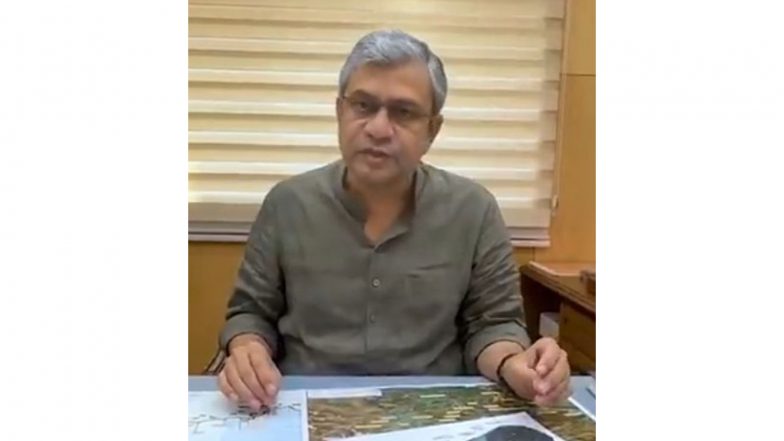
New Delhi [India], October 22 (ANI): Union Minister for Railways Ashwini Vaishnaw on Thursday highlighted the rapid execution of the strategically vital 125-kilometre Rishikesh–Karnaprayag railway link in Uttarakhand, terming it an engineering marvel designed through the complex geology of the Himalayas and the state's "lifeline to the future."
Taking to social media platform X, the Minister said, “Engineering through the Himalayas! 125 km, 12 stations, 83% tunnels. The Rishikesh-Karnaprayag rail line is not just a track, it's Uttarakhand's lifeline to the future.”
Also Read | SEBI Warns Investors Against Fraudulent WhatsApp Stock Tips Groups.
Vaishnaw further detailed the progress of the ambitious hill railway project, which features 16 tunnels and 19 bridges, making it one of the most demanding infrastructure initiatives undertaken by Indian Railways.
"Rishikesh to Karnaprayag is a very important railway project in Uttarakhand. This project has been designed amidst the complex geology of the Himalayas. In this 125-kilometre project, practically 83% consists of tunnels, which means approximately 104 kilometres of tunnels are being constructed. There are 16 tunnels and 19 bridges. If you look at it practically, this project is basically tunnel, bridge, tunnel, bridge—that is the nature of this project," he said in a video post.
Also Read | Shiva Sharma Murder Case: Police Recover Phones From Shraddha Dubey.
Explaining the geological difficulties, the Minister noted that the Young Fold Mountains often consist of soft material and humus rather than solid granitic rock, causing drilled cavities to squeeze inward.
To overcome this, engineers introduced specialised modifications to the Tunnel Boring Machines (TBMs) used for the project.
"When the decision to use a Tunnel Boring Machine (TBM) was taken for this Karnaprayag project, extensive investigations were carried out beforehand. If a tunnel is bored through solid rock strata, it does not squeeze. However, in soft strata, the tunnel has a tendency to squeeze inward. By modelling this squeezing tendency, modifications were engineered into the Tunnel Boring Machine," the Minister said.
"Numerous modifications were made to the cutter head. Following that, significant modifications were also made to the shield where the segmental lining plate assembly is housed. A special design was implemented in its drive system to deliver extra torque and extra thrust. Due to this specialised design, the Tunnel Boring Machine has proven successful in the Rishikesh–Karnaprayag project," he added.
Providing a status report on the alignment, Vaishnaw noted that except for tunnels T-1 and T-5, work on most sections is at an advanced stage.
"Tunnel 1 is the most complex section. It spans 11 kilometres. It is the most complex because the geology here is the most difficult. Several tunnels ahead have already been completed. There is also considerable human habitation in this stretch, so micropiles are being utilised to stabilise the area. Overall, the progress on this project is very good... Work on T-5 and T-1 is also progressing at a rapid pace," he said.
The stations along the route include Shivpuri, Byasi, Devprayag, Janasu, Maletha, Srinagar, Dhari Devi, Tilani, Gholtir, Gauchar, and Karnaprayag.
Underscoring its dual significance for tourism and national security, Vaishnaw remarked, "Once this project is completed, travel to Karnaprayag, Rudraprayag, and pilgrimages to Kedarnath and Badrinath will become vastly easier. Furthermore, from a strategic perspective, this project is extremely critical because its terminal station, Karnaprayag, lies just 123 kilometres away from the India–China border."
In a separate post, the Railway Minister also highlighted how India is simultaneously building complete domestic TBMs to design, manufacture, and maintain the very machines powering such mega tunnelling projects.
Vaishnaw pointed out that the entire ecosystem of Tunnel Boring Machines is now being localised under the 'Aatmanirbhar Bharat' vision, eliminating the country's historic dependence on foreign imports.
"With the vast amount of infrastructure currently being built across the country—whether for railways, highways, or power—these various infrastructure projects heavily rely on Tunnel Boring Machines (TBMs). There was a time when all tunnel boring machines had to be imported," Vaishnaw noted.
"But now, all 8-meter diameter tunnel boring machines are being manufactured in India. Moreover, even 15-meter tunnel boring machines have now started being made in India. There is a TBM plant in Tamil Nadu. And very soon, TBMs with a diameter exceeding 16 meters will also be manufactured in India. This means India is becoming self-reliant (Aatmanirbhar) in TBMs—right from design and manufacturing to maintenance," the Union Minister added. (ANI)
(The above story is verified and authored by ANI staff, ANI is South Asia's leading multimedia news agency with over 100 bureaus in India, South Asia and across the globe. ANI brings the latest news on Politics and Current Affairs in India & around the World, Sports, Health, Fitness, Entertainment, & News. The views appearing in the above post do not reflect the opinions of LatestLY)