
India News | SC Calls for Regulation of Private Detectives, Says Adultery Plea in Maintenance Cases Cannot Be Deferred Indefinitely
Get latest articles and stories on India at LatestLY. The apex court directed that a copy of its judgment be sent to the Secretary, Ministry of Law and Justice, and the Chairman of the Law Commission of India, asking them to examine the need for an appropriate legal framework to regulate private investigators, their methods of evidence collection and safeguards relating to privacy and electronic evidence.

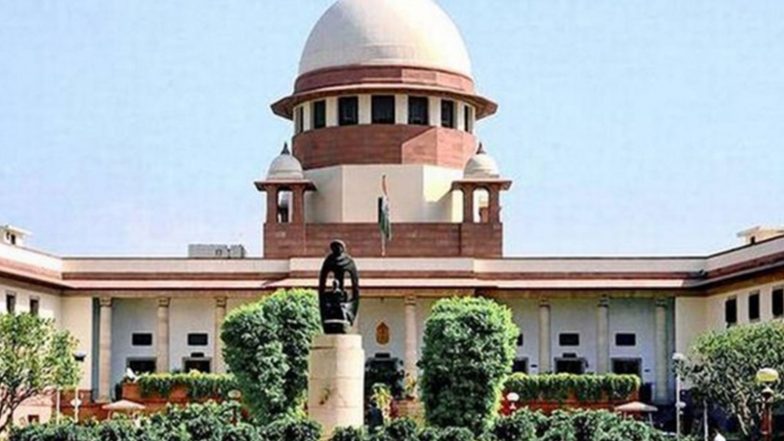
New Delhi [India], July 31 (ANI): In a significant judgment that could shape the law governing matrimonial disputes and electronic evidence, the Supreme Court on Friday called for a regulatory framework for private detective agencies in India while holding that a husband's plea alleging that his wife is living in adultery cannot invariably be deferred until the final adjudication of maintenance proceedings.
The apex court directed that a copy of its judgment be sent to the Secretary, Ministry of Law and Justice, and the Chairman of the Law Commission of India, asking them to examine the need for an appropriate legal framework to regulate private investigators, their methods of evidence collection and safeguards relating to privacy and electronic evidence.
Also Read | Vande Bharat Express Train No 20901 Transports First Live Donor Heart in India, Video Surfaces.
A Bench comprising Justice Sanjay Karol and Justice Vipul M Pancholi passed the directions while allowing an appeal against a Rajasthan High Court judgment. The Supreme Court set aside the High Court order and remanded the matter to the trial court for fresh consideration of a husband's application under Section 125(4) of the Code of Criminal Procedure (CrPC), which bars maintenance to a wife living in adultery.
Advocate Preeti Singh appeared for the wife in the matter.
The Supreme Court held that the courts below had erred in concluding that allegations under Section 125(4) could be examined only at the stage of final disposal of the maintenance petition. It observed that the statutory bar contained in Section 125(4) cannot be rendered meaningless by postponing consideration of such an application in every case.
Clarifying the legal position, the Bench said that filing an application under Section 125(4) does not automatically suspend interim maintenance. However, where the husband places clear and cogent material that ex facie establishes one of the statutory disqualifications, including adultery, the court must examine that plea. If the allegation requires appreciation of evidence, interim maintenance would continue until the application is decided on the merits.
The Court reiterated that proceedings under Section 125 CrPC are intended to provide speedy relief and prevent destitution. At the same time, it observed that the legislature has expressly carved out exceptions, including where the wife is living in adultery, and those provisions must be given meaningful effect.
In the case before it, the husband had relied upon photographs and other electronic material to support his allegations. The trial court had refused to consider the plea at the interim stage, observing that the authenticity of the electronic evidence could only be determined after a full trial. The Supreme Court held that this approach was erroneous and directed the trial court to decide the husband's application on its merits.
The judgment also raises broader concerns about the growing use of private investigators in matrimonial disputes. Referring to the large number of photographs and videos placed on record, the Court questioned who had collected the material, whether they were authorised to do so, how such information was stored, and whether the electronic evidence could have been manipulated using modern technology.
Observing that India currently lacks any statutory mechanism regulating private detective agencies, the Bench said there is a pressing need for safeguards governing the collection, storage and use of electronic evidence, protection of individuals' privacy, accountability of investigators and an effective grievance redressal mechanism. It also referred to the Private Detective Agencies (Regulation) Bill, 2007, which was never enacted, and noted that the legislature may examine regulatory models followed in jurisdictions such as Australia, Canada, the Netherlands and Singapore.
Allowing the appeal, the Supreme Court set aside the Rajasthan High Court's judgment and remanded the matter to the trial court for fresh adjudication in accordance with the principles laid down in its judgment. (ANI)
(The above story is verified and authored by ANI staff, ANI is South Asia's leading multimedia news agency with over 100 bureaus in India, South Asia and across the globe. ANI brings the latest news on Politics and Current Affairs in India & around the World, Sports, Health, Fitness, Entertainment, & News. The views appearing in the above post do not reflect the opinions of LatestLY)