
World News | Ship Ablaze in Strait of Hormuz After Attack; Crew Rescued: UK Maritime Agency
Get latest articles and stories on World at LatestLY. A missile strike has left a vessel burning and adrift in the Strait of Hormuz, forcing the crew to evacuate. The incident comes amid escalating US-Iran hostilities, with both sides exchanging severe military strikes across the region, shattering a recent truce and bringing the nations closer to full-scale war.

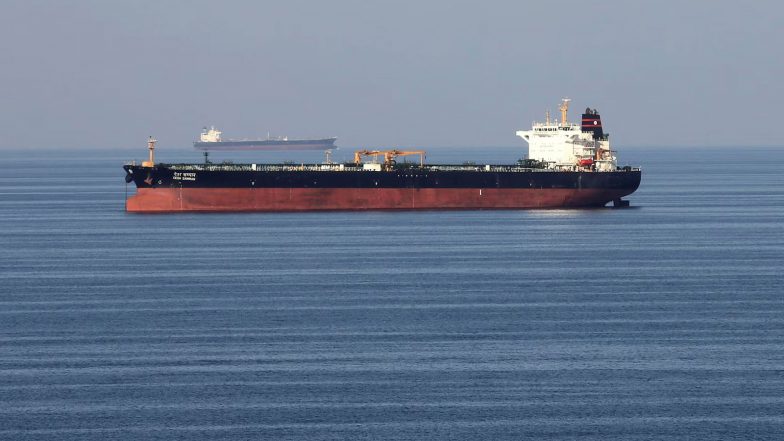
London [UK], July 20 (ANI): A vessel caught fire in the strategic Strait of Hormuz on Monday following a missile strike, prompting an immediate evacuation of the mariners on board.
The United Kingdom Maritime Trade Operations (UKMTO) confirmed the incident, stating that "the crew safely abandoned the vessel and have been recovered by a tug boat".
Also Read | Iran War: IRGC Claims Jordan Informants Helped Target US Base, Dozens of American Troops Killed.
According to the maritime security watchdog, the assault took place approximately 15 km (8 nautical miles) northwest of Kumzar, Oman.
Assessing the status of the stricken ship, the agency noted that the crisis remains active as the vessel continues to float unmanned.
Also Read | Congo Ebola Outbreak Kills 930, No Approved Vaccine as Crisis Escalates.
"The fire has not been extinguished and the vessel is currently adrift," it said in a statement. "Vessels are advised to transit with caution and report any suspicious activity to UKMTO while authorities investigate."
The maritime strike directly underscores the severe geopolitical volatility in the region, where the US military has advised vessels to navigate a route close to Oman whilst traversing the Strait of Hormuz.
In retaliation, Iran has launched assaults against these ships, maintaining that it must retain authority over the critical sea lane through which twenty per cent of all globally traded oil and natural gas previously moved during peacetime.
This escalating tanker war is tied to a broader, explosive flashpoint between Washington and Tehran.
Following the announcement of another American trooper's death, the United States launched a fresh wave of bombardments early on Monday, marking the ninth consecutive night of operations. Meanwhile, Tehran launched missiles towards Jordan, threatening to expand the hostilities into adjacent Israel.
The multi-front escalation indicates that both nations have progressively moved towards full-scale warfare following the collapse of last month's temporary agreement that was intended to bring a lasting halt to the hostilities.
Consequently, maritime transport through the Strait of Hormuz has virtually ground to a halt, with both factions striking civilian infrastructure used by millions.
The immediate trigger for the sustained American retaliation is the mounting US casualty count. According to the US military, the latest American service member lost their life in Iraq on Saturday amidst the "controlled detonation" of a downed Iranian drone.
This casualty follows an intense weekend of US military operations. Previously, the armed forces stated that their bombardments focused on Iran's paramilitary Revolutionary Guard in retribution for the killing of personnel in Jordan on Friday.
A service member went missing after that particular assault, and the latest military briefing confirmed that "unidentified remains" were recovered on Sunday and are currently undergoing identification.
The total number of US service members killed since the outbreak of hostilities has now reached 17.
The escalated crossfire, which has entered its second week, has primarily involved US operations hitting electrical installations and bridges across Iran.
Detailing the strategic objective of the continuous aerial campaign, Central Command emphasised its focus on restoring maritime security.
"The strikes will continue degrading Iranian military capabilities used to attack commercial vessels and civilian mariners transiting the Strait of Hormuz," Central Command announced in an official release.
However, Washington's offensive has provoked a wide-ranging regional response from Tehran, which has struck American-allied nations across the Middle East.
Consequently, air defence systems were once again engaged by Kuwait, Bahrain, and Jordan to counter arriving Iranian missiles and drones.
Concurrently, Israel cautioned that the projectiles aimed at neighbouring Jordan risked causing the conflict to spill over into Israeli territory for the first time in several weeks. (ANI)
(The above story is verified and authored by ANI staff, ANI is South Asia's leading multimedia news agency with over 100 bureaus in India, South Asia and across the globe. ANI brings the latest news on Politics and Current Affairs in India & around the World, Sports, Health, Fitness, Entertainment, & News. The views appearing in the above post do not reflect the opinions of LatestLY)