
World News | Ships Continue Red Sea Transit Despite Attacks and Houthi Blockade, Reports NYT
Get latest articles and stories on World at LatestLY. Despite Iran-backed Houthi threats, ships continue navigating the Bab el-Mandeb Strait, though rising war risks force some U-turns. Rerouted Saudi crude oil faces fresh exposure, and dual disruptions in the Red Sea and Strait of Hormuz have pushed Brent crude toward USD 100 per barrel.

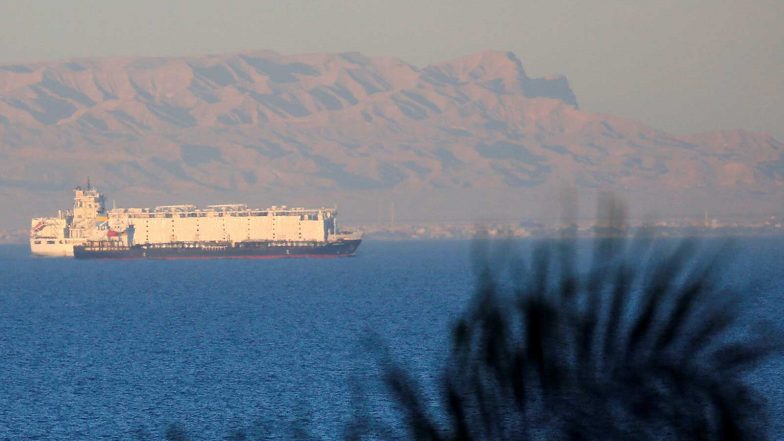
Washington, DC [US], July 25 (ANI): Dozens of vessels continue to navigate the narrow Bab el-Mandeb Strait despite persistent threats from Iran-backed Houthi rebels, according to a New York Times analysis of shipping data.
However, the report highlighted that growing uncertainty regarding the conflict and maritime safety is forcing several ships to alter course and execute U-turns before completing their journeys.
Also Read | Total Solar Eclipse 2026 on August 12: Will It Be Visible From India? Check Details.
In the past week, Houthi rebels in de facto control of Yemen targeted at least three oil tankers, with the latest strike occurring on Friday.
Any sustained disruption in the Red Sea threatens to deal a fresh blow to global commerce, which is already reeling under the strain of the expanding Middle East conflict.
Also Read | Wildfires Rage Across France and Spain, Forcing Over 250,000 to Evacuate.
The war between the United States and Iran, now in its fifth month, has severely curtailed transit through the Strait of Hormuz, a crucial maritime corridor that previously carried approximately one-fifth of global oil supplies.
In response to the hostilities, Saudi Arabia has been rerouting millions of barrels of crude oil daily via an overland pipeline connecting the Persian Gulf to the Red Sea. A significant portion of that crude oil subsequently exits through the Bab el-Mandeb Strait, a narrow choke point situated adjacent to Houthi-controlled territory.
That alternative supply line faces heightened risk after the Houthis announced plans earlier this week to target shipping linked to Saudi Arabia.
Initial indicators reflected immediate disruption, with nearly a dozen vessels either turning back or completely avoiding the strait, according to tracking data from maritime firm Kpler.
Nevertheless, Kpler data indicated that maritime activity has not slowed uniformly, recording 43 vessels crossing the Bab el-Mandeb on Thursday, an increase from 35 the previous day, even after the Houthis claimed responsibility for attacks on Saudi oil tankers.
A Saudi-linked vessel was also targeted in the Red Sea on Friday, with officials confirming minor damage and zero casualties, allowing the ship to proceed along its transit route.
The Red Sea region has served as a recurring geopolitical flashpoint. In 2024, the Houthis repeatedly launched attacks against vessels linked to Israel, framing the operations as a response to the conflict in Gaza.
As maritime risks escalate, several shipping operators are considering northern transit options via the Suez Canal. However, the route is both longer and more expensive, while the canal itself cannot accommodate fully laden supertankers, forcing logistical transfers to smaller vessels or pipelines, which tighten overall market capacity and elevate operational costs.
With concurrent disruptions across both the Red Sea and the Strait of Hormuz, analysts estimate that approximately a quarter of global oil supply is currently exposed to risk.
The escalating uncertainty has driven benchmark crude prices upward, with Brent crude nearing USD 100 per barrel this week, marking its highest level in roughly two months. (ANI)
(The above story is verified and authored by ANI staff, ANI is South Asia's leading multimedia news agency with over 100 bureaus in India, South Asia and across the globe. ANI brings the latest news on Politics and Current Affairs in India & around the World, Sports, Health, Fitness, Entertainment, & News. The views appearing in the above post do not reflect the opinions of LatestLY)