India Rejects Ex-Japan Minister Hideki Makihara’s Bullet Train Delay Claims, Says Work Progressing Rapidly
India has rejected former Japanese minister Hideki Makihara’s claims that Indian officials caused delays in the Mumbai-Ahmedabad Bullet Train project. MEA spokesperson Randhir Jaiswal said the remarks were an individual opinion and “at considerable variance with facts.” India said talks with Japan are progressing well and the first section of the high-speed rail corridor will open in 2027.

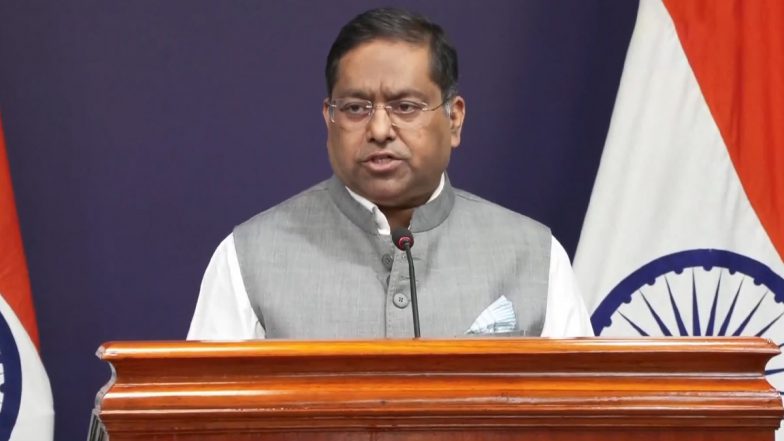
India on Friday, July 17, rejected allegations by former Japanese Justice Minister Hideki Makihara that Indian officials were responsible for delays in the Mumbai-Ahmedabad Bullet Train project, saying the claims were based on individual opinion and were not consistent with facts. The Ministry of External Affairs (MEA) said discussions with Japan on the high-speed rail project are progressing well and that construction work has advanced significantly.
Makihara had alleged that delays in India's first high-speed rail corridor were "entirely on the Indian side", accusing officials of failing to honour commitments and pursuing "self-interest" during negotiations. His comments came after a Japanese opinion article claimed that the project had moved away from the original Shinkansen model. Mumbai-Ahmedabad Bullet Train Project Delay: India Responsible for Delays, Claims Ex-Japan Minister Hideki Makihara.
ndia Hits Back at Ex-Japan Minister Over Bullet Train Delay Claims
#WATCH | Delhi: On the Mumbai–Ahmedabad High Speed Rail (MAHSR) project, MEA spokesperson Randhir Jaiswal says, "... India-Japan discussions on Mumbai-Ahmedabad high-speed train are in fact progressing well. Japan will provide the E-20 train series but only in the early 2030s.… pic.twitter.com/Pdpd2fmPM7
— ANI (@ANI) July 17, 2026
India Calls Claims ‘At Considerable Variance With Facts’
MEA spokesperson Randhir Jaiswal responded to the allegations on Friday, saying the remarks represented an individual opinion. "We have seen the post you are referring to. It is an individual opinion, and at considerable variance with facts," Jaiswal said.
He added that India-Japan discussions on the Mumbai-Ahmedabad High-Speed Rail project were continuing smoothly. "India-Japan discussions on the Mumbai-Ahmedabad High Speed Rail are, in fact, progressing well. Japan will provide the E20 train series, but only in the early 2030s. The train in question is under development," he said. India's 1st Bullet Train To Begin Phased Operations From August 15, 2027, Starting With Surat–Bilimora Section.
First Bullet Train Section Expected in 2027
Jaiswal said construction work on the project has accelerated and the first operational section is expected to open in 2027. "The construction work of the project has rapidly progressed, and the first section will be opened in 2027 itself," he said.
Indian authorities had earlier indicated that the first operational stretch would likely run between Surat and Bilimora in Gujarat. Construction activity on the 508-kilometre corridor has increased in recent months, with progress reported on viaducts, tunnels and stations after earlier delays linked mainly to land acquisition issues and political changes in Maharashtra.
MEA Clarifies Train and Signalling Arrangements
Jaiswal also addressed questions regarding future trainsets and signalling systems for the project.
He said: "... India-Japan discussions on Mumbai-Ahmedabad high-speed train are in fact progressing well. Japan will provide the E-20 train series but only in the early 2030s. The train in question is still under development. Meanwhile, construction work has rapidly progressed. The first section will be opened in 2027 itself. Therefore, both sides agreed to start operations with the Indian high-speed train. Signalling equipment has been ordered accordingly and is in line with international specifications. No Japanese offer was received in this context. The project execution is in line with the common goal of starting the high-speed train project at the earliest."
Background of the Bullet Train Project
The Mumbai-Ahmedabad High-Speed Rail (MAHSR) corridor is India's first bullet train project and a key infrastructure partnership between India and Japan. The project is based on Japanese Shinkansen technology and includes Japanese standards for railway safety, signalling and track systems. It is supported by financial assistance from the Japan International Cooperation Agency (JICA).
The corridor will connect Mumbai's Bandra Kurla Complex with Ahmedabad through 12 stations across Maharashtra, Gujarat and Dadra and Nagar Haveli. Designed to operate at speeds of up to 320 kmph, the project is expected to reduce travel time between Mumbai and Ahmedabad from around eight hours to nearly two hours.
India Expands High-Speed Rail Plans
Alongside the Mumbai-Ahmedabad corridor, India is preparing for future high-speed rail networks connecting major cities including Delhi, Varanasi, Bengaluru, Chennai and Hyderabad.
Indian Railways is also working towards domestic manufacturing of future high-speed trainsets through organisations such as Integral Coach Factory (ICF) and BEML Limited, while continuing technical cooperation with Japan.
The latest exchange has highlighted differing views over the project's execution, but Indian officials maintain that the India-Japan partnership remains strong and that construction is progressing toward the planned launch timeline.
(The above story first appeared on LatestLY on Jul 17, 2026 07:43 PM IST. For more news and updates on politics, world, sports, entertainment and lifestyle, log on to our website latestly.com).