Mumbai Autorickshaw Strike: Ola, Uber, Rapido Fares Surge Amid Auto-Taxi Strike Over Marathi Rule
Mumbai commuters are facing a sharp rise in auto and cab fares amid a three-day strike by drivers protesting Maharashtra’s Marathi language requirement. App-based autorickshaw fares for 10-km rides crossed INR 450 during peak hours, while routes such as Powai-Versova and Borivali-Chembur saw steep increases as vehicle shortages pushed up demand and surge pricing.

- Read in
- हिंदी
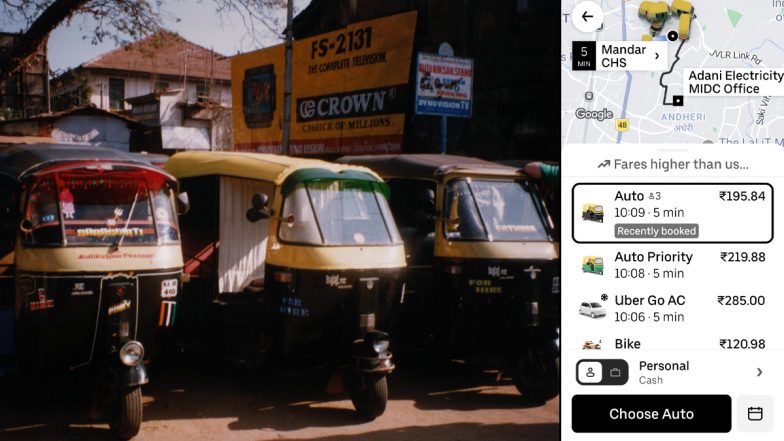
Mumbai commuters are paying sharply higher fares for autorickshaws and app-based cabs as a three-day strike by a section of auto and taxi drivers over Maharashtra’s Marathi language requirement adds to an existing shortage of public transport options. During Tuesday’s morning peak hours, commuters reported paying more than INR 450 for a roughly 10-km autorickshaw ride on Ola, Uber and Rapido, compared with the usual app fare of about INR 250-300. In some cases, the increase was as high as 100%.
The shortage has been particularly difficult during the monsoon, when finding a kaali-peeli taxi or autorickshaw can already involve a long wait. Since checks for Marathi proficiency began on August 21, commuters have reported waiting 40-50 minutes for autos in some areas. The strike that began Monday has added to the pressure, leaving commuters with fewer options and higher app-based fares. Mumbai Autorickshaw Drivers Strike Videos: Why Drivers Are Protesting Marathi Language Test.
Ola, Uber, Rapido Fares Surge in Mumbai Amid Auto-Taxi Strike Over Marathi Rule
@MumbaiPolice @mybmc @MORTHIndia
Kindly check how @Uber @UberIN_Support is in open looting by charging 400% auto fare. Also since mumbai has now lanaguage mandate @Uber taking public for granted. Fare from PMGP to MIDC as per meter Rs.56 , chk uber charges.@Dev_Fadnavis pic.twitter.com/xiLtDgFred
— DEEPAK SINGH BISHT (@DEEPAKS09950408) August 24, 2026
Surge Pricing Hits Common Mumbai Routes
The exact fare on a ride-hailing app depends on demand, vehicle availability and the time of booking. With fewer vehicles available, commuters travelling during peak hours are facing significantly higher prices.
A 10-km autorickshaw journey booked through Uber, Ola or Rapido, which generally costs around INR 250-300 during weekday peak hours, rose to more than INR 450 in some cases on Tuesday. The government-approved meter fare for a 10-km autorickshaw journey, meanwhile, is about INR 172.
On the Powai-Versova route, a journey of around 15 km that previously cost about INR 350 on an autorickshaw reached INR 589 between 8 am and 11 am on Tuesday, August 25, India Today reported.
A shorter trip from Juhu to Ranwar Village in Bandra, covering about 7.5 km, cost between INR 350 and INR 430 on most applications during the same period.
For longer cross-city journeys, the increase was also significant. An autorickshaw ride from Borivali on the Western Line to Chembur on the Harbour Line, a journey of about 28.5 km, crossed INR 600 on major ride-hailing applications during peak hours. Because app fares fluctuate according to demand and availability, commuters may see different prices for the same route at different times.
Shortage Adds To Commuters' Problems
The latest disruption follows growing difficulty in finding autos in several parts of Mumbai. A section of non-Marathi-speaking drivers began protesting after enforcement of the state’s Marathi language requirement intensified.
The strike has affected key suburban areas, with commuters reporting difficulty getting to railway stations and workplaces. A section of kaali-peeli taxi and aggregator-cab drivers also went off the roads.
Drivers have said they are not opposed to learning Marathi but object to the way the proficiency checks are being conducted. Some have claimed that RTO officials are asking questions that were not part of the prescribed training.
The issue has also led to protests, including a road blockade on Kandivali Link Road on Monday. Drivers said they felt they were being harassed or warned over their Marathi proficiency.
Official Auto And Taxi Fares Also Going Up
The current app-based surge comes just days after the Mumbai Metropolitan Region Transport Authority approved a separate increase in official auto and taxi fares.
From September 1, the minimum autorickshaw fare for the first 1.5 km will rise from INR 26 to INR 27. The minimum fare for black-and-yellow taxis will increase from INR 31 to INR 33. The revised fares will apply across Mumbai, Thane, Navi Mumbai, Kalyan, Vasai-Virar and Panvel.
The MMRTA cited higher fuel prices and operating costs as factors behind the revision. The decision was taken at a meeting chaired by Additional Chief Secretary Sanjay Sethi and attended by senior transport officials. For commuters, that means the current disruption is occurring alongside an already approved fare increase that will take effect next week.
Why Drivers Are Protesting
The Maharashtra government’s directive requires auto-rickshaw, taxi and app-based cab drivers to have a working knowledge of Marathi. The government has defended the requirement as a practical measure intended to help drivers communicate with passengers.
Chief Minister Devendra Fadnavis has said drivers do not need to become experts in the language.
“There is no reason for our Hindi-speaking brothers who work as taxi or auto drivers here to become experts in Marathi. They only need to know enough Marathi to carry out their work,” Fadnavis said. Fadnavis has also said there was no compulsion and that efforts were being made to teach Marathi to those who did not know the language. The deadline for compliance has reportedly been extended multiple times.
Drivers, however, say the concern is less about learning the language and more about the enforcement process and potential penalties. Some older drivers have also argued that they face difficulties meeting the requirement because of limited formal education.
Commuters Caught Between Shortage And Higher Fares
The immediate impact of the strike is being felt through longer waiting times and higher ride-hailing prices. With fewer autos and taxis available, demand is being concentrated on the vehicles still operating, allowing app-based fares to rise during busy periods.
The situation adds another cost to daily travel in Mumbai, where commuters are already preparing for higher regulated fares from September 1.
For now, the combination of the strike, monsoon-related travel difficulties and limited vehicle availability is leaving commuters with fewer affordable alternatives. The outcome will depend on how quickly the dispute over the Marathi requirement is resolved and how many drivers return to the roads.
(The above story first appeared on LatestLY on Aug 25, 2026 03:28 PM IST. For more news and updates on politics, world, sports, entertainment and lifestyle, log on to our website latestly.com).