Sumit Sarkar Dies: Eminent Historian Passes Away at 87 Following Age-Related Ailments
Eminent historian Sumit Sarkar, widely recognized as one of the defining scholars of modern Indian history and a founding member of the Subaltern Studies Collective, passed away at his Delhi residence on Thursday due to age-related health issues. He was 87.

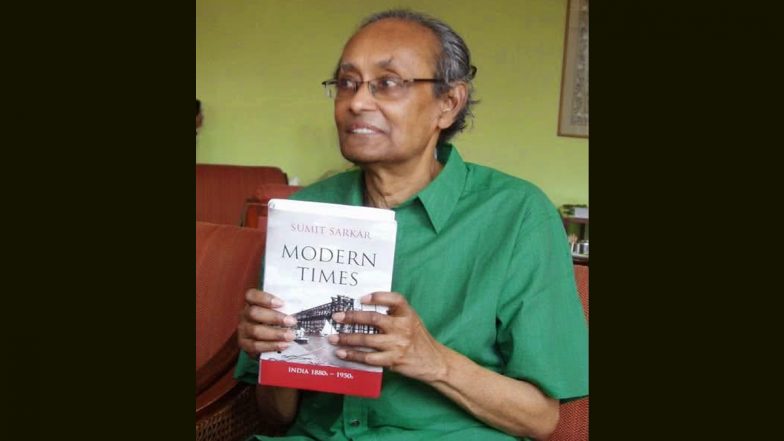
Eminent historian Sumit Sarkar, one of India’s leading scholars of modern history, died in Delhi on Thursday at the age of 87 following age-related ailments. His death marks the loss of a major academic voice whose work on nationalism, colonialism, the freedom movement and social history influenced generations of students and historians, India Today reported.
Long Academic Career
Born in 1939 to historian Sushobhan Sarkar, Sumit Sarkar studied history at Presidency College, Calcutta, and the University of Calcutta. He began his teaching career at the University of Calcutta and later served as a reader at the University of Burdwan. He spent the longest part of his academic career at the University of Delhi, where he was a professor of history. DY Patil Dies: Maharashtra Educationist and Former Governor Passes Away at 90, PM Narendra Modi Expresses Grief.
Sarkar had been unwell for a prolonged period and had largely withdrawn from public activity in recent years following a fall, according to historian and family friend G Arunima.
Influential Work on Indian Nationalism
Sarkar was particularly known for his research on the Swadeshi movement and the development of Indian nationalism. His major works include The Swadeshi Movement in Bengal, Modern India: 1885–1947 and Writing Social History. His scholarship examined India's freedom struggle through the experiences of different social groups and popular movements rather than focusing solely on prominent political leaders. This approach helped broaden the study of modern Indian history. Raj K Purohit Dies: Former Maharashtra Minister Passes Away at 71 in Mumbai Following Prolonged Illness.
Role in Subaltern Studies
Sarkar was among the founding members of the Subaltern Studies Collective, an influential intellectual project that sought to examine history from the perspective of groups that had often remained outside elite historical narratives. He later became a critic of some of the directions taken by the movement. His engagement with the collective reflected his wider interest in questioning established approaches to interpreting India's past.
Awards and Public Interventions
Sarkar received the Sarit Chatterjee Memorial Award in 2003 for his contribution to the study of India's freedom movement. The following year, he received the Rabindra Puraskar for Writing Social History. In 2007, he returned the award in protest against the treatment of farmers by the then CPI(M)-led Left Front government in West Bengal.
Tributes to a Major Historian
News of Sarkar's death prompted tributes from historians, writers, former students and public figures. Rajya Sabha MP Manoj Kumar Jha recalled Sarkar's interpretation of Mahatma Gandhi and his emphasis on creating space for people with differing views to work together. Historian and family friend G Arunima described Sarkar as a major figure in Indian historiography and praised both his scholarship and his personal qualities.
Sarkar is survived by his wife, historian Tanika Sarkar, and son Aditya Sarkar, an associate professor of South Asian History at the University of Warwick. His last rites are expected to be held on Saturday, with the family yet to announce the confirmed schedule.
(The above story first appeared on LatestLY on Aug 14, 2026 12:38 PM IST. For more news and updates on politics, world, sports, entertainment and lifestyle, log on to our website latestly.com).