Supreme Court Says Calling Someone 'Motherf**ker' Does Not Amount to Obscenity; Here's Why
The Supreme Court ruled that offensive speech, including terms like "motherf**ker" and "son of a wh*re", is not automatically 'obscenity' under criminal law. Such language must be lascivious and corrupting to be punishable. The Court set aside the appellant’s conviction for obscenity, though it upheld his conviction for grievous hurt, modifying the sentence due to his age.

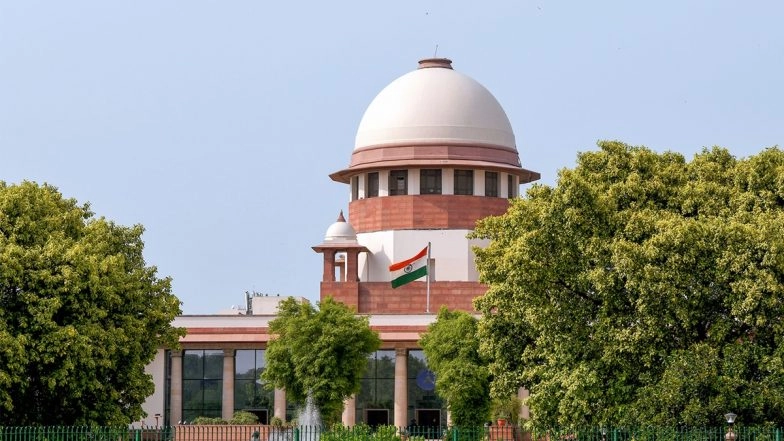
The Supreme Court of India ruled on Friday, July 17, that the use of vulgar expletives, such as "motherf**ker" and "son of a wh*re", does not automatically qualify as the criminal offence of obscenity. In the case of Mani v. State, the Court held that while such language is undoubtedly offensive and uncivil, it lacks the legal requirements for obscenity unless the words are shown to be lascivious, appeal to prurient interests, and possess a tendency to deprave or corrupt those exposed to them.
A Bench comprising Justices Sanjay Karol and Vipul M. Pancholi delivered the ruling while partially allowing an appeal by a man who had been previously convicted for obscenity following a verbal altercation over a land dispute. Comprehensive S*x Education in Schools Soon? Supreme Court Reviews New Proposal by Government.
Legal Distinction Between Vulgarity and Obscenity
The Court emphasised that criminal law distinguishes clearly between profanity and obscenity. “Let’s be clear, legally, obscenity is not synonymous with ‘vulgarity’, ‘abuse’ or ‘profanity’,” the Court noted. “Use of mere swear words, profanities and vulgar expletives, however distasteful or uncivil they may be, cannot be equated with obscenity... Words which are merely vulgar or abusive may evoke a feeling of disgust, revulsion or shock, but that by itself does not make them obscene in law," the court said. Under Section 294(b) of the Indian Penal Code, the Bench explained that for an utterance to be considered obscene, it must not only be offensive but must also cause annoyance to others in a public place. In the present case, the Court found that the prosecution failed to meet these mandatory legal ingredients.
Case Background
The legal dispute originated in August 2017 in Tamil Nadu, stemming from a disagreement over agricultural land. During an argument, the appellant, Mani, allegedly used vulgar expletives and caste-based slurs against the complainant. The situation escalated when the appellant retrieved a billhook from his residence and attacked the complainant, resulting in injuries to his forehead, thumb, and a fractured nasal bone. The trial court initially convicted Mani under various sections of the Indian Penal Code, including obscenity, grievous hurt, and criminal intimidation, as well as provisions under the SC/ST (Prevention of Atrocities) Act. While the Madras High Court later acquitted him of the SC/ST charges, the conviction for obscenity and grievous hurt remained until the appellant moved the Supreme Court. Union Cabinet Approves Proposal To Increase Strength of Supreme Court Judges From 33 to 37.
Court’s Ruling on Sentencing
The Supreme Court set aside the convictions for both obscenity and criminal intimidation, ruling that the prosecution had failed to demonstrate the necessary intent required for the latter. However, the Bench upheld the conviction for grievous hurt under Section 326 IPC, citing medical evidence that confirmed the complainant’s injury was caused by the billhook. Taking into account the appellant’s age of approximately 70 years, his health, and the fact that the incident arose from a land dispute, the Court modified his sentence to "imprisonment till the rising of the court" and directed him to pay a fine of INR 50,000 within two months.
DISCLAIMER: This article is strictly for informational and educational purposes to raise awareness about the said topic. LatestLY DO NOT host, distribute, or provide links to sexually explicit content, leaked videos, or pirated material. Any search terms or keywords mentioned are solely for the purpose of explaining the viral trend and its associated dangers. We strongly condemn the circulation of non-consensual intimate imagery (NCII) and advise all readers to refrain from searching for or sharing such content, as doing so may lead to severe legal consequences.
(The above story first appeared on LatestLY on Jul 18, 2026 03:58 PM IST. For more news and updates on politics, world, sports, entertainment and lifestyle, log on to our website latestly.com).