A Camera on the Forehead for USD 3 an Hour: Meet the Indian Workers Training AI Robots
Thousands of Indian workers are earning wages by filming their daily household chores from a first-person perspective. This 'egocentric data' is used by global tech firms to train AI humanoid robots to navigate the physical world. While the boom creates fresh digital labor, policymakers warn of long-term risks to India's informal economy.

- Read in
- हिंदी
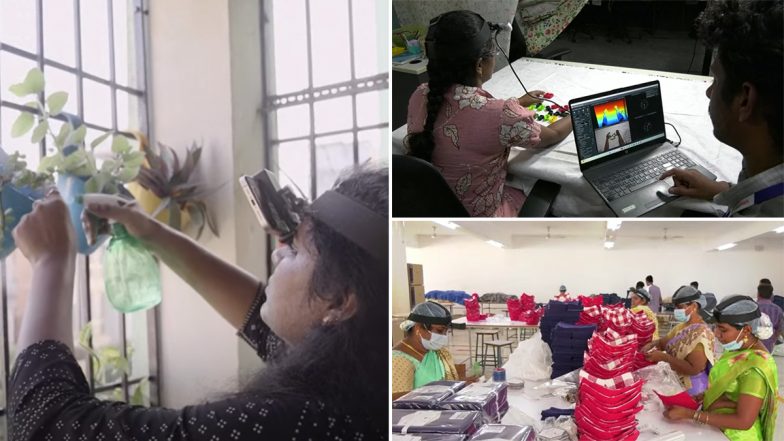
Thousands of workers across India are being hired by global technology firms to film their daily domestic routines, establishing a massive data pipeline intended to train the next generation of AI-powered humanoid robots. By recording mundane activities like slicing fruit, folding laundry, and organising household items from a first-person perspective, these data contributors are providing tech companies with crucial behavioural data needed to teach machines how to navigate the physical world.
The emerging field of spatial AI - the technology that enables AI to understand and interact with three-dimensional space - is creating a new segment of digital labour in the world’s most populous country, even as debates intensify over the long-term impact of automation on employment. Russia’s 1st Humanoid Robot: AIDOL Company Showcases Its AI-Powered Human Robot That Stumbles Down While Walking on Stage (Watch Video).
Meet the Indian Workers Training AI Robots
Collecting Egocentric Data from the Kitchen
For 25-year-old Chennai housewife Nagireddy Sriramyachandra, teaching artificial intelligence involves strapping a smartphone to her forehead while she goes about her household chores. Sriramyachandra earns approximately 250 rupees (USD 3) per hour to record her movements, which are then transmitted to AI data firms. "Who else will give you 250 rupees an hour just for doing housework?” Sriramyachandra said from her kitchen. Looking forward to the technological advancements her data supports, she added, “I may get a robot myself in the future.”
While AI chatbots and image generators rely on vast archives of text and digital imagery, training robots to accurately copy human movement requires "egocentric data" - first-person footage that captures exactly how human hands interact with objects. Sriramyachandra uploads her videos via a proprietary application developed by Objectways, an AI data annotation company with offices in both India and the United States. "It blares ‘hands not detected’ when I’m not recording properly," she noted.
Indian Workers Are Training AI Robots; Here's Why
The Indian workers training AI robots to take their jobs.
Paid to have a camera strapped to their foreheads, a growing army of thousands of AI system trainers in the world's most populous country are teaching machines how to move like humans in the real world – from folding… pic.twitter.com/Y7L6belJoc
— AFP News Agency (@AFP) June 11, 2026
The Scale of the Spatial AI Supply Chain
The corporate demand for physical data is accelerating rapidly. Investment bank Morgan Stanley projects that more than one billion humanoid robots could be in operation globally by 2050, primarily across industrial, commercial, and domestic sectors. To meet this demand, data firms are capturing specialised footage across multiple environments, including factories, textile mills, and simulated studios. Objectways, which utilises platforms like Amazon SageMaker to process machine learning models, services several Fortune 500 multinationals.
“Folding clothes, coffee making... cooking a very specific thing, sandwich making,” said Ravi Shankar, CEO of Objectways, listing the specific activities requested by global clients. "Some jobs are supposed to be taken over, so humans can go and do better things." In specialised recording studios, data trainers spend hours repeating standard household actions under varying visual conditions. At one facility, 21-year-old engineering graduate Rani N. records approximately 90 four-minute videos a day, capturing herself folding a single towel from nearly every angle on a bed. While she describes the work as "tolerable", she noted that she frequently feels as if she is "always wearing a camera".
Subcontracting and Speech Recognition
The data collection network extends deeply into India's informal labour sectors through regional subcontractors. Qanat Consulting Services, based in Andhra Pradesh, manages a network of roughly 2,000 contributors who feed data to larger tech firms. According to Qanat CEO Thaslim Pattan, some trainers are outfitted with motion-sensor bands on their wrists, hands, and legs to capture precise kinetic data alongside video feeds. Other firms are expanding the scope of data collection to include human speech and environmental audio. Manish Agarwal of Bengaluru-based Humyn Labs oversees projects where contributors are recorded debating topics ranging from regional politics to entertainment, allowing clients to map local speech patterns and conversational context.
Agarwal downplays immediate fears of widespread technological unemployment, suggesting instead that humans and automated systems will transition into collaborative networks. “A welder in India could be managing a welder-robot in Prague,” Agarwal said.
Economic Opportunities and Labor Risks
India has quickly positioned itself as a primary global hub for data labelling, processing, and annotation. “It’s likely that these data collection services will increase,” said Aditi Surie, a digital labour expert at the Indian Institute for Human Settlements in Bengaluru, highlighting the country's growing role in the global tech supply chain. However, the rapid growth of the automation industry has drawn scrutiny from government policymakers concerned about long-term displacement. In a report published ahead of a global AI summit, the Indian government think-tank NITI Aayog warned that existing labour discussions focus heavily on white-collar job losses while neglecting the vulnerabilities of the informal economy. Buddharoid: Kyoto University Unveils AI Robot Monk to Perform Sacred Rituals, Provide Spiritual Guidance and More (Watch Video).
“Little attention, if any, is paid to how AI can serve India’s 490 million informal workers, the very people who form the backbone of our economy,” the think-tank stated, urging for a more balanced examination of how automation will impact traditional trades ranging from farming to street vending. The paradox of the industry is evident to long-time informal workers like 55-year-old Ponni, who has spent ten years selling flower garlands on a roadside in Bengaluru. She, too, was recently paid to wear a head-mounted camera while weaving flowers, but remains sceptical about the future. “The next generation... who might have to do work similar to mine - they will face a problem,” Ponni said.
(The above story first appeared on LatestLY on Jun 13, 2026 09:43 AM IST. For more news and updates on politics, world, sports, entertainment and lifestyle, log on to our website latestly.com).