Partial Lunar Eclipse 2026 Live Streaming: Watch Chandra Grahan Online
A deep partial lunar eclipse (Chandra Grahan) occurred on August 28, 2026, with nearly 96% of the Moon submerged in Earth's umbral shadow. While visible live across the Americas, Europe, and Africa, skywatchers in India, where the daytime eclipse remains invisible, are watching the event online via livestreams like the Virtual Telescope Project.

- Read in
- हिंदी
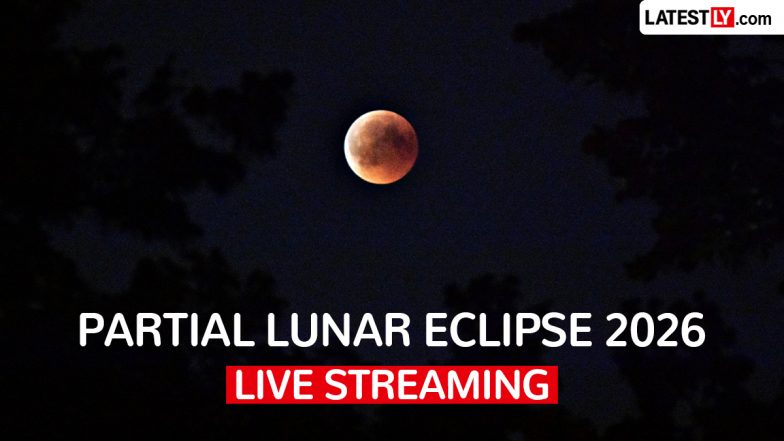
Skywatchers around the globe are tuning in to witness the final lunar eclipse of 2026, a deep partial lunar eclipse (Chandra Grahan) taking place today, August 28. At peak eclipse, approximately 96 percent of the Moon’s disk will be submerged in Earth’s dark central shadow (umbra), giving the lunar surface a dramatic coppery-red tint.
While millions across North America, South America and parts of Europe and Africa can view the event directly in the night sky, international audiences, including observers in countries like India where the eclipse falls during daytime hours, are relying on official livestreams to watch the celestial show unfold live. What Happens During a Total Lunar Eclipse?
Where and How to Watch the Live Stream
For those outside the visibility zone or dealing with unfavorable local weather, several astronomical observatories and space institutions are offering free, high-definition online broadcasts.
- Virtual Telescope Project: Led by astrophysicist Dr. Gianluca Masi, this popular broadcast offers real-time views fed from telescopes in Italy and Chile alongside expert commentary.
- Griffith Observatory: The Los Angeles-based observatory is streaming live feed directly from its telescopes throughout the duration of the umbral phase.
- Space Agencies and Science Outlets: Global science platforms and official space channels are broadcasting live feeds on YouTube and dedicated web portals, tracking the shadow's progression from start to finish.
Partial Lunar Eclipse 2026 Live Streaming
Global Timings and Visibility Breakdown
The eclipse sequence occurs simultaneously worldwide, though local clock times vary significantly by geographic location.
According to NASA data, the key phase milestones in Universal Time (UTC) and Indian Standard Time (IST) are as follows:
- Penumbral Phase Begins: 01:24 UTC / 6:54 AM IST (August 28)
- Partial Eclipse Begins (Umbral Entry): 02:34 UTC / 8:04 AM IST (August 28)
- Maximum Eclipse Peak: 04:13 UTC / 9:43 AM IST (August 28)
- Partial Eclipse Ends: 05:51 UTC / 11:21 AM IST (August 28)
- Penumbral Phase Ends: 07:01 UTC / 12:31 PM IST (August 28)
The entire sequence will be fully visible across North and South America during late-night and pre-dawn hours. Observers in Western Europe and Western Africa will witness the early to mid-stages of the eclipse before moonset at dawn. Chandra Grahan 2026: Will Partial Lunar Eclipse Be Visible in India on August 28?
Visibility and Cultural Context in India
In India, the Chandra Grahan will not be visible directly because the celestial alignment takes place during daytime hours when the Moon is positioned below the horizon. As a result, skywatchers in major metropolitan areas such as Delhi, Mumbai, Bengaluru, and Kolkata must rely entirely on digital streams.
The eclipse coincides with the festival of Raksha Bandhan on August 28. Under traditional Hindu calendar practices, because the eclipse is not physically visible in the Indian sky, the ceremonial Sutak Kaal (inauspicious period) does not apply locally, allowing festival celebrations to proceed normally without ritual restrictions.
The Science Behind a Deep Partial Eclipse
A partial lunar eclipse occurs when the Sun, Earth, and Moon line up imperfectly in space, causing Earth to cast its shadow across part of the lunar surface.
Because roughly 96 percent of the Moon enters the umbra during this event, only a tiny sliver of the lunar disk remains exposed to direct sunlight. Sunlight passing through Earth's atmosphere gets filtered and scattered, refracting red wavelengths onto the shaded portion of the Moon, creating a subtle "blood moon" aesthetic despite technically being a partial eclipse.
Unlike solar eclipses, observing a lunar eclipse, whether in person or online, requires no protective eye equipment and is entirely safe to view with the naked eye, binoculars, or telescopes.
(The above story first appeared on LatestLY on Aug 28, 2026 11:25 AM IST. For more news and updates on politics, world, sports, entertainment and lifestyle, log on to our website latestly.com).