What Is 'Ghost Font'? Know Why Humans Can Read It While AI Systems Fail
Developer Eric Lu’s experimental 'Ghost Font' highlights a vulnerability in AI vision. By using animated dots and motion-based optical illusions, the font is readable to humans but evades AI models, which struggle to process motion across frames. The project suggests new, potentially secure methods for bot detection, CAPTCHAs, and digital watermarking in an AI-driven era.

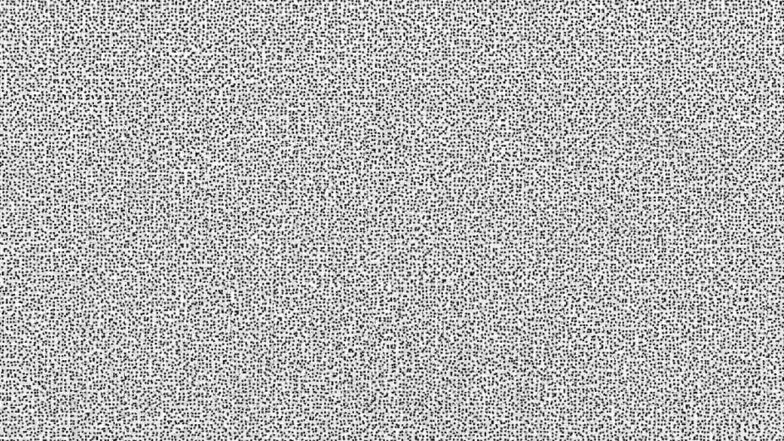
Artificial intelligence systems have become highly proficient at interpreting documents, deciphering handwriting, and analysing images. However, an experimental project called "Ghost Font" has surfaced a significant blind spot in many current multimodal AI models, demonstrating that these systems often struggle to process information embedded through motion rather than static shapes.
What Is Ghost Font?
Ghost Font is an experimental typography project created by developer and designer Eric Lu. Rather than using traditional, static letterforms, it relies on motion-based optical illusions. The font works by filling the screen with thousands of tiny, animated dots. To create a hidden word, the dots forming the letters are programmed to move in one direction, while the surrounding "background" dots drift in another. Meta Layoffs: ‘AI Is the Most Consequential Technology of Our Lifetimes’, Says Mark Zuckerberg in Memo to Employees After 8,000 Job Cuts.
Eric Lu Says He Created Ghost Font That Only Humans Can Read
I created a font called Ghost Font that only humans can read. Tested it in Fable and GPT 5.6 Sol Ultra and neither was able to decipher it correctly. pic.twitter.com/wy08KgZKH2
— Eric Lu (@ericlu) July 11, 2026
Because human vision naturally groups moving pixels together, the intended message emerges instantly for a person viewing the animation. However, when the animation is paused, the letters vanish, leaving only what appears to be random visual noise. Lu described the project as "anti-AI typography", specifically designed to explore the gap between human visual perception and the way current AI systems process moving images.
Why AI Struggles with Motion
The discrepancy in performance exists because of how current AI models are structured. Many multimodal models analyse video by breaking it down into individual, static frames and examining them separately. Because Ghost Font relies on temporal integration - the way the human brain combines tiny changes over time - the message remains invisible to systems that fail to track consistent motion patterns across multiple frames. Additionally, the project incorporates "decoy" text intended to mislead AI. In testing, advanced models from companies like OpenAI and Anthropic were sometimes tricked into confidently identifying incorrect text, while humans could still perceive the hidden message. "I created a font called Ghost Font that only humans can read. Tested it in Fable and GPT 5.6 Sol Ultra and neither was able to decipher it correctly," Lu noted in a widely viewed post on X (formerly Twitter).
Security and Future Implications
While Ghost Font is an experimental demonstration rather than a fully deployed security solution, it highlights potential new directions for digital verification and privacy. Researchers have suggested several practical applications:
- Next-Generation CAPTCHAs: Systems could move away from static puzzles toward motion-based verification that is intuitive for humans but difficult for automated bots.
- Bot Detection: Websites could incorporate motion-based markers to identify or block automated scraping tools that lack native motion-processing capabilities.
- Information Protection: Sensitive documents could include motion-based text or watermarks, providing an extra layer of security against automated data extraction. Government Selects 10 Indian AI Startups for 2nd Cohort of Global Acceleration Programme.
While these techniques present a challenge for current AI, they are not insurmountable. Developers have noted that as vision models are optimised - or explicitly instructed to perform frame-by-frame or optical-flow analysis - they can learn to decode such illusions. Nevertheless, the experiment serves as a reminder that human and machine vision do not "see" the world in the same way, and that human perception retains unique advantages in recognising patterns through motion.
(The above story first appeared on LatestLY on Jul 15, 2026 03:02 PM IST. For more news and updates on politics, world, sports, entertainment and lifestyle, log on to our website latestly.com).