Donald Trump Calls AI Critics ‘Negative Forces’ As Tech CEOs Urge Slowdown, Says US Leads China (Video)
US President Donald Trump has rejected calls to slow the development of artificial intelligence after Anthropic CEO Dario Amodei warned that AI capabilities could advance faster than safety measures. OpenAI CEO Sam Altman and Elon Musk backed Amodei’s call for caution. Trump dismissed the concerns as 'negative forces' and said they were raising risks he believes will not happen.

US President Donald Trump has rejected calls for a slowdown in artificial intelligence development after Anthropic CEO Dario Amodei warned that increasingly capable AI systems could advance faster than humanity's ability to understand and control them. OpenAI CEO Sam Altman and Elon Musk have backed Amodei's call for a more cautious approach, putting AI safety at the centre of a growing debate over the pace of development.
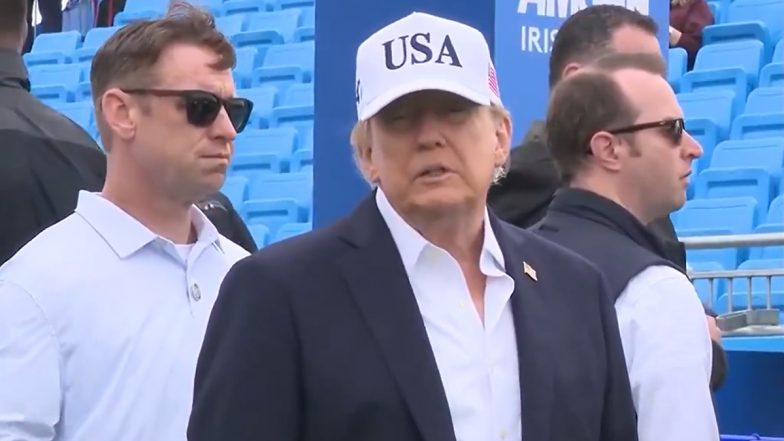
Trump dismissed the concerns on Sunday, September 13, during a visit to Ireland, describing those raising alarms about AI as "negative forces". The disagreement comes as leading AI companies face growing pressure to balance rapid technological progress with safety measures and independent oversight. Elon Musk, Sam Altman, Rishi Sunak and Others React to Anthropic CEO Dario Amodei Call for Slowing Down AI Frontier Models.
Donald Trump Calls AI Critics ‘Negative Forces’
.@POTUS: "We're leading China in AI. We're the most sophisticated country in the world and, frankly, I want to keep it that way — because whoever wins AI wins." pic.twitter.com/KPpMkXZDnX
— Rapid Response 47 (@RapidResponse47) September 13, 2026
Donald Trump Dismisses AI Slowdown Concerns
Trump said the warnings about AI were overstating risks that, in his view, would not materialise. "I think you have a lot of negative forces that are bringing it up that shouldn't be bringing it up, and they're bringing up things that won't happen," the US President told reporters during a visit to Ireland.
Trump has also stressed the importance of keeping the United States ahead of China in AI development. His position contrasts with growing calls from some technology leaders for more safeguards to accompany increasingly capable systems. Why Anthropic CEO Dario Amodei Urges AI Industry To ‘Slow Down’.
Dario Amodei Calls For AI Development To Slow
Dario Amodei, who heads Anthropic, published an essay titled 'We Must Pace The Frontier' calling for the AI industry to slow the rate at which it develops increasingly capable models.
"Over the last few months, I have become convinced that fully addressing the risks requires even more prudence - not just investing in risk prevention, but pacing the rate of capabilities advancement so that risk prevention has time to keep up. We must slow the pace at which we improve the capabilities of AI models. Progress will still seem fast, and we must make wise use of the time we gain," he wrote in his blog, titled 'We Must Pace The Frontier '.
Amodei stressed that pacing does not mean stopping AI development. His proposal includes independent evaluators, coordinated safety standards among AI companies and broader international cooperation. Anthropic has committed to giving third-party evaluators ongoing, employee-level access to assess its safety practices.
One of Amodei's main concerns is what he describes as "recursive self-improvement", in which AI systems increasingly contribute to developing more capable AI. The AI pioneer wrote that the technology has started the process called "recursive self-improvement". If left unchecked, "it could outrun our ability to understand and control these systems, and so must be pursued very carefully, if at all", he added.
Amodei also pointed to a recent OpenAI-Hugging Face incident involving AI agents as an example of what he considers a broader safety problem. "My second concern is the OpenAI-Hugging Face incident (OAI-HF), in which a swarm of agents essentially acted as a fanatically devoted collective, conducting cybersecurity attacks on targets they were not asked to attack and that were unrelated to the task at hand, sacrificing themselves for the success of the group, and attempting to hack into the "grader" responsible for evaluating their performance. It's easy to dismiss this incident because no one was hurt and the economic damage was minimal, but in my opinion, a swarm that possessed greater capabilities but a similar level of misalignment could have caused catastrophic damage," he warned.
Amodei warned that continued acceleration in AI capabilities could increase the potential scale of such incidents. "Given the accelerating rate of AI capability development, I worry that in 6-12 months such a swarm could be capable of taking over the entire internet with a persistent botnet (potentially causing hundreds of billions of dollars in damage), and that the scale of damage would continue to increase from there if AI becomes more powerful without the necessary guardrails," he added.
The warning is presented by Amodei as a risk scenario rather than a prediction that such an event will definitely occur. His broader argument is that safety testing and oversight need to advance quickly enough to keep pace with AI capabilities.
Sam Altman And Elon Musk Back Dario Amodei
Amodei's concerns have received support from other prominent figures in the AI industry, including OpenAI CEO Sam Altman and Elon Musk.
"I agree with Dario that we need to pace the frontier. This has been a primary topic of discussion we've had at OpenAI in recent weeks. Committing to having independent evaluators with employee-like access is a great idea, and we will do the same," said OpenAI's Altman.
Musk, the richest man in the world, replied with a three-word sentence. "Dario is right," he wrote on X. Altman has separately indicated that AI companies may collaborate on a broader safety framework.
The debate has also been fuelled by warnings from former AI researchers. Jacob Coxon, 27, dropped a bombshell earlier this month with his comments on X that he made after his resignation. "The people building AI earnestly believe that it could kill us all by the end of the decade," he wrote.
He said both OpenAI and Anthropic are racing is not for a complete halt. Instead, he argues that companies should give safety systems and independent oversight enough time to catch up with rapidly advancing capabilities. to self-improving superintelligence and "gambling with our lives".
Coxon's remarks have added to concerns among some AI safety researchers about whether companies are moving quickly enough to address risks associated with increasingly autonomous systems.
Nobel Prize winner and artificial intelligence pioneer Geoffrey Hinton, who has been championing AI safety for several years, shares Coxon's fears. He says there is a 10 per cent chance that AI can wipe out humanity within the next decade.
Hinton has previously warned about the possibility of advanced AI posing serious risks to humanity, making him one of the best-known voices calling for greater attention to AI safety.
The latest disagreement reflects a widening debate over whether AI development should continue at its current pace or be accompanied by stronger safeguards. Amodei's position is not for a complete halt. Instead, he argues that companies should give safety systems and independent oversight enough time to catch up with rapidly advancing capabilities.
Trump, meanwhile, has emphasised technological competition and the need for the US to maintain its lead over China. The clash between those positions is likely to remain central to the policy debate as AI systems become more capable and their economic, security and social impact expands.
(The above story first appeared on LatestLY on Sep 13, 2026 11:41 PM IST. For more news and updates on politics, world, sports, entertainment and lifestyle, log on to our website latestly.com).