Middle East Conflict: Iran Confirms Killing of Iranian Intelligence Minister Esmail Khatib As Israel Keeps Targeting Leaders
Iranian President Masoud Pezeshkian confirmed on Wednesday that Intelligence Minister Esmail Khatib was killed in an overnight airstrike in the capital. The announcement follows a claim by Israeli Defense Minister Israel Katz that the Israeli military successfully targeted Khatib.

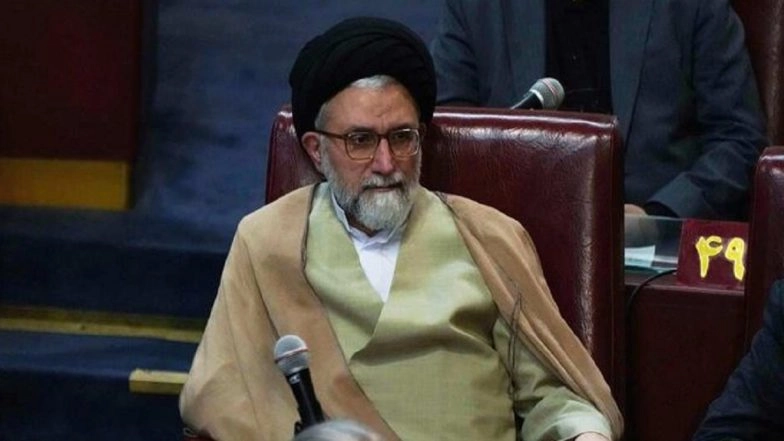
Tehran, March 18: Israel’s defense minister said Wednesday that the military killed Iranian Intelligence Minister Esmail Khatib. Khatib’s killing follows Israel killing top Iranian security official Ali Larijani and the head of the paramilitary Revolutionary Guard’s all-volunteer Basij force. Also on Wednesday, Iran launched strikes toward Israel and neighboring Gulf countries, with explosions heard in the United Arab Emirates and Qatar and interceptions reported in Saudi Arabia.
The attacks came hours after Iranian state media confirmed Israel’s military killed top Iranian security official Ali Larijani in an overnight strike, as well as Gen. Gholam Reza Soleimani, the head of the Revolutionary Guard’s Basij force, known for its role in suppressing protests. Middle East Conflict: Iran Threatens Energy Assets in Saudi Arabia, Qatar and UAE After Attack on Its Gas Facilities.
Israeli strikes targeting central Beirut have become increasingly frequent in recent days, with or without prior warning. The attacks have hit far from the city’s southern suburbs, for which the army issued evacuation notices early in the war with Hezbollah. Israeli strikes and evacuation orders for swathes of Lebanon have displaced more than 1 million people in the small Mediterranean country — roughly 20% of the population — according to the Lebanese government.
The U.S.-Israeli war with Iran has killed at least 1,300 people in Iran, more than 900 in Lebanon and 14 in Israel, according to officials in those countries. The U.S. military says 13 U.S. service members have been killed and about 200 wounded. Middle East Conflict: Israel Destroys Over 80 Hezbollah Linked Structures During Defence Operation in Southern Lebanon (See Pics).
Here is The Latest:
US National Intelligence Director Avoids Saying Whether She Warned Trump About Fallout From Attacking Iran
U.S. Director of National Intelligence Tulsi Gabbard dodged when asked by senators during a hearing about whether she had warned Trump about the likelihood of Iran attacking other Gulf nations and threatening ships in the Strait of Hormuz.
“I have not and won’t divulge internal conversations,” Gabbard said in response to questions from Democratic Sen. Mark Warner. “I will say that those of us within the intelligence community continue to provide the president with all of the best objective intelligence available to inform his decisions.”
Warner was clearly frustrated with Gabbard’s lack of a clear response and pointed repeatedly to Trump’s remarks that suggest he did not expect Iran to launch attack on other Gulf nations or close the Strait of Hormuz, which is vital for oil exports from the region.
Israel Says 3 Private Aircraft Were Damaged in Recent Days by Fragments of Intercepted Iranian Missiles
The aircraft at Israel’s Ben Gurion International Airport were damaged by shrapnel from the missile interceptions, according to Israel’s airports authority. Airport traffic has been severely curtailed since the war started.
Iran Confirms Killing of Intelligence Minister
Iranian state television confirmed the killing of Khatib, who the U.S. sanctioned in 2022 for alleged cyber-related activities against the U.S. and its allies. Iranian President Masoud Pezeshkian calling Khatib’s killing “an unfair assassination.”
White House says Trump will waive Jones Act requirements for 60 days
It applies to goods shipped between U.S. ports to be moved on U.S.-flagged vessels. The 1920s law, designed to protect the American shipbuilding sector, is often blamed for making gas more expensive.
The moves highlight the increased pressure the Republican administration is under to ease soaring oil prices as the United States, along with Israel, wages a war with Iran without a foreseeable end date. Global oil prices have since spiked as Iran halted traffic through the narrow Strait of Hormuz, where one-fifth of the world’s oil typically passes through from the Persian Gulf to customers worldwide.
US Eases Venezuela Oil Sanctions As Trump Seeks To Boost World Oil Supply During Iran War
U.S. companies will be allowed to do business with Venezuela’s state-owned oil and gas company after the Treasury Department eased sanctions, with some limitations, Wednesday as the Trump administration looks for ways to boost world oil supplies during the Iran war.
The Treasury issued a broad authorization allowing Petróleos de Venezuela S.A, or PDVSA, to directly sell Venezuelan oil to U.S. companies and on global markets, a massive shift after Washington for years had largely blocked dealings with Venezuela’s government and its oil sector.
The move highlights the increased pressure the Republican administration is under to ease soaring oil prices as the United States, along with Israel, wages a war with Iran without a foreseeable end date. Global oil prices have since spiked as Iran halted traffic through the narrow Strait of Hormuz, where one-fifth of the world’s oil typically passes through from the Persian Gulf to customers worldwide.
German Leader Says He Doesn’t Want War To Burden Trans-Atlantic Relations
Chancellor Friedrich Merz told German lawmakers Wednesday “we’re speaking at all levels with Washington” and “seeking trans-Atlantic agreement.” He stressed that Germany shares many U.S. aims “but we can’t and won’t shy away from telling our partners honestly where we see things differently and where we have different interests.”
Merz said he still has questions about the war in Iran and there is still “no convincing concept for how this operation could succeed.” He noted that Washington “didn’t consult us and said European help wasn’t necessary … we would have advised against pursuing this road the way it has been pursued at present.” Germany is among the countries that say they won’t contribute to a military mission in the Strait of Hormuz as long as the war continues.
Iran’s Military Vows To Respond With Force Following Attack on South Pars Offshore Natural Gas Field
“Targeting fuel, energy and gas infrastructure in the aggressor country is our legitimate right and we will respond with force as soon as possible,” Iran’s Khatam al-Anbiya Central Headquarters said in a statement.
US Stocks Fall Under Pressure From Rising Crude Oil Prices
U.S. stocks are slipping as another rise in oil prices raises worries about inflation, which may have already been primed to worsen even before the war with Iran began.
The S&P 500 fell 0.4% in early trading Wednesday and was on track for its first loss this week. The Dow Jones Industrial Average fell 237 points, and the Nasdaq composite fell 0.4%. Stocks fell under the pressure of a 2% climb for the price of a barrel of U.S. crude. The Federal Reserve is widely expected to hold interest rates steady when its latest policy meeting wraps up later Wednesday.
(The above story first appeared on LatestLY on Mar 18, 2026 09:15 PM IST. For more news and updates on politics, world, sports, entertainment and lifestyle, log on to our website latestly.com).