PoJK Protests: Violent Clashes Erupt as Security Forces Block JAAC's 'Awami Huqooq Long March'
Tensions in Pakistan-occupied Jammu and Kashmir (PoJK) reached a boiling point this week as violent clashes erupted between security forces and demonstrators participating in the Joint Awami Action Committee's (JAAC) "Awami Huqooq Long March."

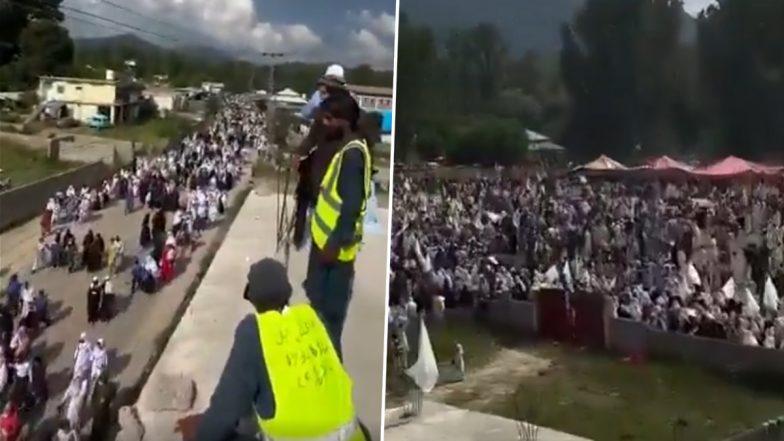
Tensions in Pakistan-occupied Jammu and Kashmir (PoJK) reached a boiling point this week as violent clashes erupted between security forces and demonstrators participating in the Joint Awami Action Committee's (JAAC) "Awami Huqooq Long March." The civil rights collective alleged that dozens of unarmed protesters were killed by law enforcement in Rawalakot and Mirpur, while local officials disputed the casualty claims.
The march, aimed at reaching the regional capital of Muzaffarabad, escalated when police and paramilitary forces set up blockades to intercept thousands of demonstrators. Eyewitnesses and JAAC representatives accused security forces of firing live ammunition and tear gas directly into the crowd. Activists claimed that at least 14 people died in Rawalakot alone, with violence subsequently spreading to Mirpur. PoJK Protests: Amnesty International Demands Independent Probe Into Pakistan Forces' Use of Lethal Force.
Pakistan-administered regional authorities denied reports of indiscriminate firing. Police officials stated that law enforcement acted to restore order after several government and security vehicles were set on fire by protesters. Local administration leaders asserted that no bodies had been brought to government or private hospitals to substantiate the death toll claimed by the organizers.
The region remains under a severe telecommunications and internet blackout, severely restricting communication and making independent verification of the total casualties challenging. Rights groups, including Amnesty International, have called on authorities to restore internet access and initiate an independent investigation into the force used against demonstrators.
The current wave of civil unrest stems from long-standing economic and political grievances across PoJK. The JAAC, an alliance of civil society members, traders, and local activists, initially launched demonstrations demanding subsidies on essential items—such as wheat flour and electricity—citing high energy costs despite the region generating significant hydroelectric power. International Concern Mounts over PoJK Violence as UK MP Naz Shah, Amnesty International Demand Accountability.
Political tensions intensified around the regional legislative assembly election process. The JAAC has called for the abolition of 12 assembly seats reserved for refugees living outside PoJK, claiming these seats are manipulated by political parties in Islamabad to sway local assembly outcomes and undermine local representation.
The crackdown follows the local government's proscription of the JAAC under anti-terrorism laws earlier this summer, leading to widespread sit-ins, market shutdowns, and mass detentions of organizers across the territory. Despite the heavy security presence and road blockades, JAAC leaders maintained that their march towards Muzaffarabad would continue, calling on overseas Diaspora groups to raise awareness globally amid the ongoing communication blackout.
DISCLAIMER: This article is strictly for informational and educational purposes to raise awareness about the said topic. LatestLY DO NOT host, distribute, or provide links to sexually explicit content, leaked videos, or pirated material. Any search terms or keywords mentioned are solely for the purpose of explaining the viral trend and its associated dangers. We strongly condemn the circulation of non-consensual intimate imagery (NCII) and advise all readers to refrain from searching for or sharing such content, as doing so may lead to severe legal consequences.
(The above story first appeared on LatestLY on Jul 29, 2026 06:44 PM IST. For more news and updates on politics, world, sports, entertainment and lifestyle, log on to our website latestly.com).