What Demands Has Iran Set for Reopening Strait of Hormuz?
Iran has set several conditions for reopening the Strait of Hormuz to maritime traffic, including lifting the US naval blockade and sanctions, withdrawing American forces from around Iran, paying war reparations and releasing frozen Iranian assets. Tehran also wants an end to attacks on its regional allies and threats against Iran, complicating ongoing Iran-Oman talks.

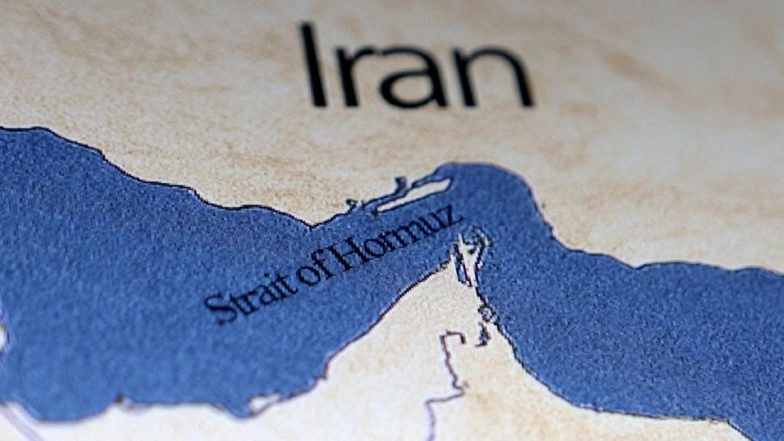
Iran has set a series of conditions that it says the United States must meet before the Strait of Hormuz can reopen to maritime traffic, putting renewed uncertainty around efforts to restore shipping through the vital waterway. The demands include lifting the US naval blockade and sanctions on Iran, withdrawing US forces from around the country, paying war reparations and releasing frozen Iranian assets.
The statement by Mohammad Bagher Zolghadr, secretary of Iran’s Supreme National Security Council, came as Tehran and Oman continued negotiations over the future management of the strait. Iranian officials have said an agreement with Oman is close, but stressed that such a deal alone would not be enough to reopen the waterway. ‘US, Israel Trying To Turn Persian Gulf Nations Against Us’: Iran President Masoud Pezeshkian Calls for Muslim Unity.
What Demands Has Iran Set?
Zolghadr said the United States must meet several conditions before Iran will reopen the Strait of Hormuz.
The demands include:
- Lifting the US naval blockade of Iran.
- Ending US sanctions on Iran.
- Withdrawing US military forces from around Iran.
- Paying war reparations to Iran.
- Releasing frozen Iranian assets.
- Ending attacks on Iran’s regional allies.
- Ending threats against Iran.
The White House had not immediately responded to the demands in the account provided.
Iran-Oman Talks Continue
Iran and Oman have been negotiating an arrangement concerning the management of the Strait of Hormuz, which lies between the two countries. Iranian Foreign Minister Abbas Araghchi said the two sides were “very close” to an agreement, according to Tasnim. Iran Strikes UAE’s Tanker With Missiles in Strait of Hormuz.
However, Araghchi said reopening the waterway would depend on additional conditions, including US compensation over what Tehran considers violations of the June cease-fire agreement.
“However, the reopening of the Strait of Hormuz is contingent on other conditions, including the United States compensating for its violations of the Islamabad Memorandum,” Mr. Araghchi was quoted as saying, referring to the cease-fire agreement that Iran and the United States signed in June.
Oman’s Foreign Ministry said negotiations with Iran were proceeding in a “positive and constructive atmosphere” and urged all sides to avoid actions that could disrupt the talks.
Why The June Cease-Fire Matters
The June agreement, described as a memorandum of understanding brokered by Pakistani mediators in Islamabad, called for the Strait of Hormuz to be opened and for oil sanctions on Iran to be temporarily lifted.
However, the language of the agreement was not specific enough to prevent differing interpretations by Washington and Tehran.
The United States backed a southern route for ships that would avoid Iranian waters along Oman’s coastline. Iran subsequently warned and struck ships using that route, according to the account provided.
The cease-fire later collapsed, and the United States reimposed its naval blockade of Iranian ports.
“The Americans were seeking to establish new routes through the Strait of Hormuz, and despite the warnings issued by our country, they sought to undermine Iran’s management of the strait,” Mr. Araghchi said. “Therefore, any violation of the memorandum of understanding or of Iran’s management of the Strait of Hormuz is absolutely unacceptable to the Islamic Republic of Iran.”
US Says Shipping Safety Is Key
US Vice President JD Vance said Washington and Tehran were still working through arrangements for commercial shipping. In an interview with Fox News, Vance described the discussions as being in “the middle of the game”.
“What we’re really working through now is how you can actually set up a traffic scheme so that the ships that pass can pass through safely,” Mr. Vance said. “That includes of course demining, but it also includes a commitment from the Iranians that they’re not going to fire at commercial vessels.”
Vance did not specify what concessions Washington could offer Tehran. “They’re hurting in a big way,” he said. “They want this thing to be over. The question is whether they’re able, their system is able, to give the things that are necessary for us to be happy.”
Iran Says Reopening Is Not Imminent
Even before Zolghadr announced the conditions, Iranian officials had indicated that reopening the strait was not necessarily tied to the Iran-Oman negotiations. Hossein Mohebbi, a spokesman for Iran’s Islamic Revolutionary Guards Corps, said reopening the waterway was “not contingent on the Iran-Oman negotiations”.
He said it would depend “on the United States fully accepting Iran’s conditions” and added that Washington should not interfere in Iran’s negotiations with Oman or other countries.
The comments suggest that Tehran views the Oman talks as only one part of a broader arrangement required for the waterway to reopen.
Shipping Traffic Remains Severely Reduced
The Strait of Hormuz is a critical route for global energy shipments, making its disruption a major concern for oil markets and international trade.
According to Kpler data cited in the report, just over a dozen ships per day navigated the strait during the past week, compared with an average of about 130 ships per day before the war.
The actual number of crossings is difficult to establish because some vessels have switched off their tracking transponders to avoid detection by Iranian or US forces imposing blockades around the waterway.
Vessel Attacks Add To Pressure
The diplomatic negotiations are taking place amid continued reports of attacks on commercial shipping.
The United Arab Emirates said an Iranian attack had targeted a tanker belonging to Abu Dhabi National Oil Company while it was crossing the Strait of Hormuz.
ADNOC said at least 15 of its vessels had been attacked in the waterway since the conflict began, resulting in one death and 20 crew injuries.
Oman condemned what it described as “repeated attacks on ships transiting the Strait of Hormuz,” saying such attacks violated international law and territorial sovereignty.
What Happens Next?
The immediate challenge is whether Iran, Oman and the United States can agree on a framework that addresses both shipping safety and Tehran’s broader political demands.
Iran’s latest conditions go beyond the technical arrangements needed to restore maritime traffic, touching on sanctions, US military deployments, frozen assets and compensation.
That makes the path to reopening the Strait of Hormuz dependent not only on an Iran-Oman arrangement but also on wider negotiations between Tehran and Washington.
(The above story first appeared on LatestLY on Aug 08, 2026 10:59 PM IST. For more news and updates on politics, world, sports, entertainment and lifestyle, log on to our website latestly.com).